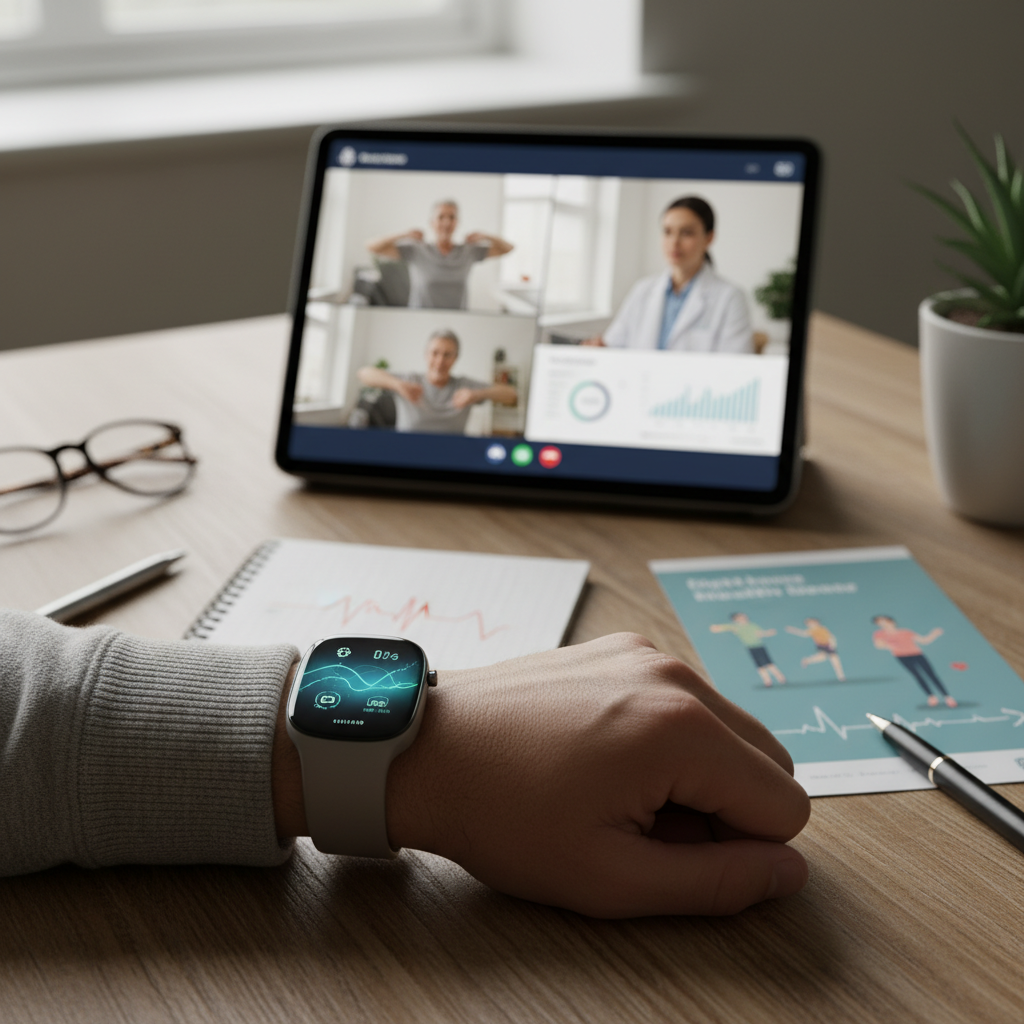
Wearable data may help personalise remote COPD rehabilitation — but it does not yet predict engagement with confidence
Wearable data may help personalise remote COPD rehabilitation — but it does not yet predict engagement with confidence
Chronic obstructive pulmonary disease, or COPD, does more than limit breathing. It often reshapes daily life in ways that are easy to underestimate: walking becomes harder, exertion starts to feel threatening, breathlessness changes routines, and inactivity can gradually feed further decline.
That is why pulmonary rehabilitation plays such an important role in COPD care. It can improve exercise tolerance, reduce symptoms, increase confidence and help patients regain some control over daily function. The challenge is that participating in — and staying engaged with — rehabilitation is not easy, especially when care shifts from in-person programmes to remote delivery.
In that setting, the idea of using wearable-derived data to anticipate which patients are likely to engage in telerehabilitation is highly appealing. If a watch or activity sensor could help identify who is participating consistently, who is starting to disengage and who may need more intensive support, remote care could become much more personalised.
The idea makes sense. But the most accurate reading of the available evidence is still cautious: the literature supports the role of wearables in monitoring activity and supporting digital COPD interventions, yet it does not directly validate a model that can reliably predict patient engagement in remote rehabilitation.
COPD is also a disease of daily behaviour
Although COPD is usually defined in terms of airflow limitation, exacerbations and lung function decline, it is also a condition that changes everyday behaviour. Many patients walk less, avoid exertion, limit outings and reorganise daily life to reduce the chance of breathlessness.
That matters because physical inactivity is itself tied to worse outcomes, poorer function and rising frailty. Pulmonary rehabilitation is therefore not just about improving muscle strength or cardiorespiratory capacity. It is also about changing how a person lives day to day.
That makes engagement central. In face-to-face rehabilitation, clinicians can often see who is showing up, who is progressing and who is drifting away. In remote care, that becomes much harder to judge. That is one reason wearables have become so attractive.
What wearables add to remote care
The key advantage of wearables is that they turn behaviour into objective data. Instead of relying only on patient recall, they can track steps, active time, walking patterns and sometimes other physiological signals.
In COPD, that is particularly useful because subjective impressions do not always reflect real activity levels or actual participation in a rehabilitation programme. A sensor may show whether a person is moving more, stalling or beginning to disengage even before that becomes obvious in a clinical check-in.
This kind of continuous measurement makes it plausible that wearable data could help remote teams intervene earlier: increasing contact, simplifying goals, revising plans or offering support before a patient fully drops out.
What the supplied literature actually supports
The references provided support the broader relevance of digital and wearable tools in COPD management and rehabilitation.
A recent systematic review and meta-analysis found that digital health interventions — including wearables and web-based platforms — can improve quality of life, self-efficacy and dyspnoea-related outcomes in COPD. That is important because it shows digital care is not just a technological add-on. It can produce clinically meaningful gains.
The COPD physical-activity intervention literature also highlights the growing use of wearable devices to objectively measure activity participation. That is especially relevant here because the core problem is behavioural: how much patients move, how consistently they take part, and whether they remain active over time.
Taken together, these findings support the plausibility of using wearable data within remote COPD rehabilitation programmes. They suggest wearables may help monitor behaviour and perhaps guide more tailored support.
But monitoring is not the same as prediction
This is the crucial distinction.
The supplied PubMed articles do not directly validate a model that predicts patient engagement in remote COPD rehabilitation. The strongest evidence provided relates to the effectiveness of digital interventions overall and to the feasibility of tracking activity, not to a proven capacity to predict adherence before or early in a programme.
That difference matters a great deal. Monitoring tells clinicians what is happening. Prediction would mean identifying, in advance or very early on, who is likely to stay involved, who may struggle, and who needs a different kind of support.
That leap is substantial. To say wearables truly predict engagement, the evidence would need to show specific modelling studies, clear definitions of adherence, external validation and a practical improvement in care. That is not what the supplied references provide.
Even so, the idea remains clinically plausible
Despite that gap, the idea still has practical logic. Engagement in remote COPD rehabilitation depends on many factors: symptom burden, confidence, fatigue, digital access, comorbidities, motivation, social support and day-to-day stability.
Many of those influences leave behavioural traces. If a wearable captures activity patterns with reasonable accuracy, it is plausible that those patterns could reflect whether a patient is coping well, struggling to participate or beginning to disengage.
For example, persistently low activity, lack of response to goals or a gradual downward shift in movement could indicate a need for earlier intervention. That does not mean the device fully understands the patient’s experience. It means it may detect a practical signal of what is happening in everyday life.
The strongest value may be in tailoring support, not labelling patients
The most promising application may not be rigidly classifying patients as “likely to adhere” or “unlikely to adhere”. It may be something more useful: helping clinicians tailor support in real time.
That is an important difference. Instead of using wearable data as a hard predictive label, programmes could use it to detect early warning signs of disengagement. From there, teams could intensify support, revise exercise targets, troubleshoot digital barriers or increase encouragement before a patient falls away entirely.
Seen this way, the wearable is less an oracle of adherence and more a tool for clinical navigation. That role fits the current evidence much better.
Digital health still comes with implementation limits
It is also important not to romanticise the technology.
The wider COPD literature notes that although digital interventions can improve some outcomes, sustained gains in physical activity remain uncertain, and the most effective intervention components are still not fully established. A wearable alone does not solve poor digital literacy, limited internet access, fatigue, depression, anxiety, fear of exertion or broader social barriers.
Collecting more data does not automatically mean delivering better care. The data only become useful when they sit inside a well-designed programme with a clinical team able to interpret patterns and respond meaningfully.
Why strong predictive claims would go too far
Another reason for caution is that not all of the supporting references are equally direct. One of the wearable-validation papers concerns gait metrics across multiple conditions and is only indirectly relevant to engagement in COPD rehabilitation.
That means part of the evidence supports the broader digital-health ecosystem rather than the specific prediction claim in the headline. So while the concept is plausible, it would be too strong to say science has already shown, with robust performance, which COPD patients will or will not engage in telerehabilitation based on wearable data alone.
What this changes right now
The most immediate value of this research is practical rather than predictive. It suggests remote pulmonary rehabilitation could become more responsive if objective activity data are integrated into care.
That matters in a setting where engagement is hard to judge and disengagement is often noticed too late. If wearables help teams spot behavioural changes earlier, they may already be clinically useful.
In systems where access to pulmonary rehabilitation remains uneven, remote care supported by digital tools may be especially valuable. But that also means implementation must stay realistic: usability, connectivity, cost, human support and fit with patients’ lives matter just as much as the sensor itself.
The most balanced takeaway
The available evidence supports the growing role of wearables and digital tools in COPD management. They appear useful for remote rehabilitation, objective activity monitoring and improving some important outcomes such as quality of life, self-efficacy and dyspnoea.
It is also plausible that wearable-derived activity data could help identify behavioural patterns relevant to tailoring support in telerehabilitation. But based on the supplied material, it would overstate the science to claim there is already a validated model that predicts patient engagement with confidence.
The strongest takeaway is therefore an implementation one: wearables look promising less as definitive predictors of adherence and more as tools to observe real-world behaviour and help clinicians personalise support earlier. In COPD rehabilitation, that alone could be a meaningful step forward.