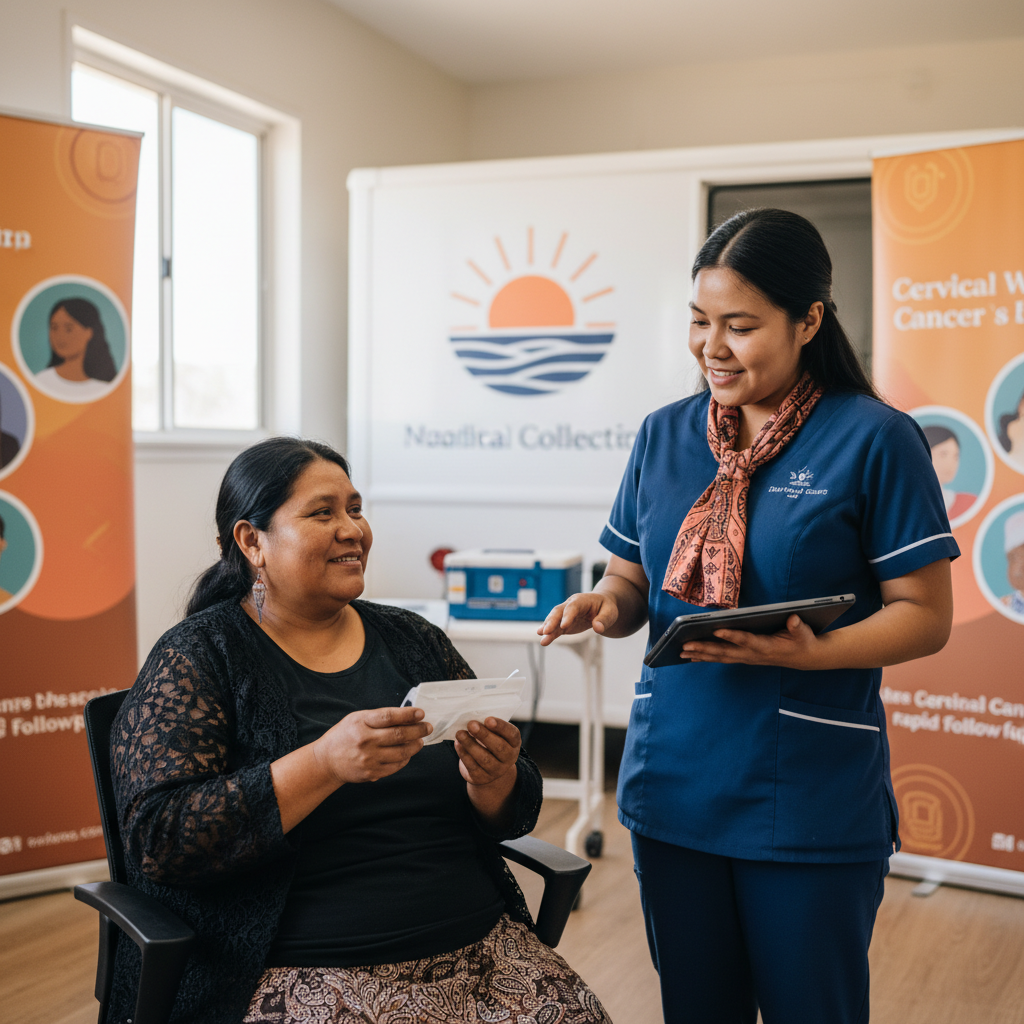
Eliminating cervical cancer for Indigenous women may depend less on new technology than on getting screening access right
Eliminating cervical cancer for Indigenous women may depend less on new technology than on getting screening access right
Cervical cancer is one of the few cancers for which medicine can now see a plausible path to elimination. HPV vaccination, regular screening, early detection and treatment of precancerous lesions have created a prevention strategy that is unusually powerful by cancer standards.
On paper, this should be one of public health’s clearest success stories. In practice, the benefits are not being shared evenly. In many settings, Indigenous women remain less well served by the very systems that are pushing overall populations closer to elimination.
That is the context behind a striking idea now gaining traction: eliminating cervical cancer for Indigenous women may depend less on inventing new tools and more on rapidly expanding culturally safe, targeted screening access for women who are still being missed by mainstream programmes. The evidence provided supports that broad direction. What it does not directly prove is the more specific forecast that elimination could be reached by 2036 with any certainty.
The problem is not simply medical. It is structural.
From a technical standpoint, the main pieces already exist. Health systems know how to reduce HPV-related risk through vaccination. They know how to screen for early changes. They know how to treat lesions before invasive cancer develops.
So when major gaps persist, the issue is no longer just whether effective tools are available. It becomes a question of implementation, access and equity.
One of the supplied reviews, focused on high-income colonised countries, found that Indigenous women have lower screening coverage and are not on track for equitable cervical cancer elimination. That finding matters because it changes the frame of the discussion. The problem is not that there is no workable prevention strategy. The problem is that the strategy is not reaching everyone in ways that are acceptable, accessible and sustainable.
That makes this less a story about scientific discovery than about whether health systems are willing to design around the people they have historically underserved.
Why screening still misses many women
Low screening uptake is often described in simplistic terms, as though the main barrier were individual reluctance. But that framing can flatten what is actually happening.
The qualitative research included in the references, involving under-screened Aboriginal and Torres Strait Islander women, points to a more realistic picture. Privacy, control, trauma-informed care and culturally safe communication emerged as central to improving participation.
That is important because it shows that screening does not fail only because of distance or scheduling. It can fail because the experience of care itself feels invasive, disempowering, culturally unsafe or disconnected from a woman’s lived history.
For communities that have experienced discrimination, institutional mistrust or trauma, this is not a minor detail. It is often the difference between a programme that exists on paper and one that people can genuinely use.
Why self-collection matters
This is where self-collection becomes so important.
Allowing women to collect their own HPV sample can reduce barriers related to embarrassment, loss of control, bodily exposure and discomfort. It does not solve every problem. But it can shift the balance of power in a meaningful way.
In a mainstream programme, self-collection may look like a convenience feature. In underserved Indigenous communities, it may function as something more significant: a way of making screening possible for women who would otherwise avoid or delay it.
That is a crucial distinction. If the major obstacle is not the absence of a test but the way the system requires women to access it, then changing the mode of delivery can be as important as changing the test itself.
Same-day follow-up may be just as important as the test
Another strong piece of the evidence is the implementation study from remote Western Australia. It found that a targeted model combining self-collection, point-of-care HPV testing and same-day specialist assessment was feasible, highly acceptable and capable of engaging under-screened women.
That matters for two reasons.
First, it shows that targeted outreach can work when it is designed around real barriers rather than abstract assumptions. Second, it highlights that screening is only part of the challenge. What happens after the test may be just as important.
In many systems, women are lost not at the point of first contact but in the long chain that follows: waiting for results, travelling again, returning for further assessment, navigating referrals or simply trying to stay connected to a fragmented service. Every extra step creates another chance for care to break down.
That is why same-day follow-up is so compelling. It does not just improve efficiency. It may reduce attrition in a pathway where delay and dropout are common.
Elimination is not only a screening issue
At the same time, the evidence also argues for restraint.
The supplied studies support targeted screening strategies, but they do not directly prove the specific claim that Indigenous cervical cancer elimination could be achieved by 2036. One implementation study was relatively small, short-term and region-specific, which means its findings are encouraging without being automatically generalisable.
More importantly, elimination depends on more than screening alone. Vaccination rates matter. Follow-up matters. Access to treatment matters. Long-term system performance matters. A strong screening effort can accelerate progress, but it cannot by itself guarantee elimination if the rest of the care pathway remains inconsistent.
This is especially relevant in communities where structural barriers are persistent. Geographic access, trauma, mistrust, poor continuity and culturally unsafe care can all limit scale-up if they are not confronted directly.
What the 2036 forecast really means
A date-specific claim such as 2036 is powerful because it turns a general aspiration into a concrete target. But it should be read as a model-based possibility, not as a certainty.
The supplied literature supports the idea that a focused screening push could plausibly bring elimination closer for Indigenous populations. It does not establish that outcome as guaranteed, nor does it show that every setting could reproduce the same timeline.
That distinction matters. Policymakers often need ambitious targets to mobilise funding and attention. But in health journalism, the responsible interpretation is to treat the date as contingent: achievable perhaps under the right conditions, but not promised by the evidence alone.
The deeper lesson is about how health systems behave
What makes this story important is that it exposes a familiar weakness in modern healthcare. Systems often celebrate innovation while tolerating predictable exclusion.
If Indigenous women continue to face lower screening coverage, delayed follow-up and culturally unsafe care, then the issue is not merely that more technology is needed. It is that implementation has not been built with equity at its core.
That means real progress will likely depend on community-informed design, Indigenous leadership, respectful communication, trauma-aware practice and service delivery models that reduce friction rather than add to it. Without those elements, even excellent screening tools can end up reinforcing the very inequities they were supposed to reduce.
Why this matters beyond one country
Although the evidence centres on specific Indigenous populations in high-income settings, the lesson travels widely. In countries such as the UK, where average national progress can coexist with stark access gaps in marginalised communities, overall success can still hide deep inequality.
A screening programme that works reasonably well overall may still fail the communities carrying the highest burden of missed prevention. That is why Indigenous cervical cancer screening cannot be treated as a niche issue within a broader elimination strategy. It is a test of whether the strategy is equitable in the first place.
The most balanced reading
The supplied evidence strongly supports the idea that cervical cancer elimination for Indigenous women will require direct action on screening gaps. It also supports the plausibility of targeted, culturally safe models that combine self-collection, point-of-care HPV testing and rapid follow-up to reach women who are being missed by conventional programmes.
But it would go too far to say the studies have proven elimination by 2036. The evidence is better read as support for a credible implementation pathway, not a guaranteed deadline.
The bigger takeaway is practical rather than futuristic. If health systems are serious about eliminating cervical cancer for Indigenous women, the priority may not be inventing the next breakthrough technology. It may be delivering the screening tools already available in ways that are trusted, culturally safe, logistically realistic and fast enough to keep women from falling through the cracks.