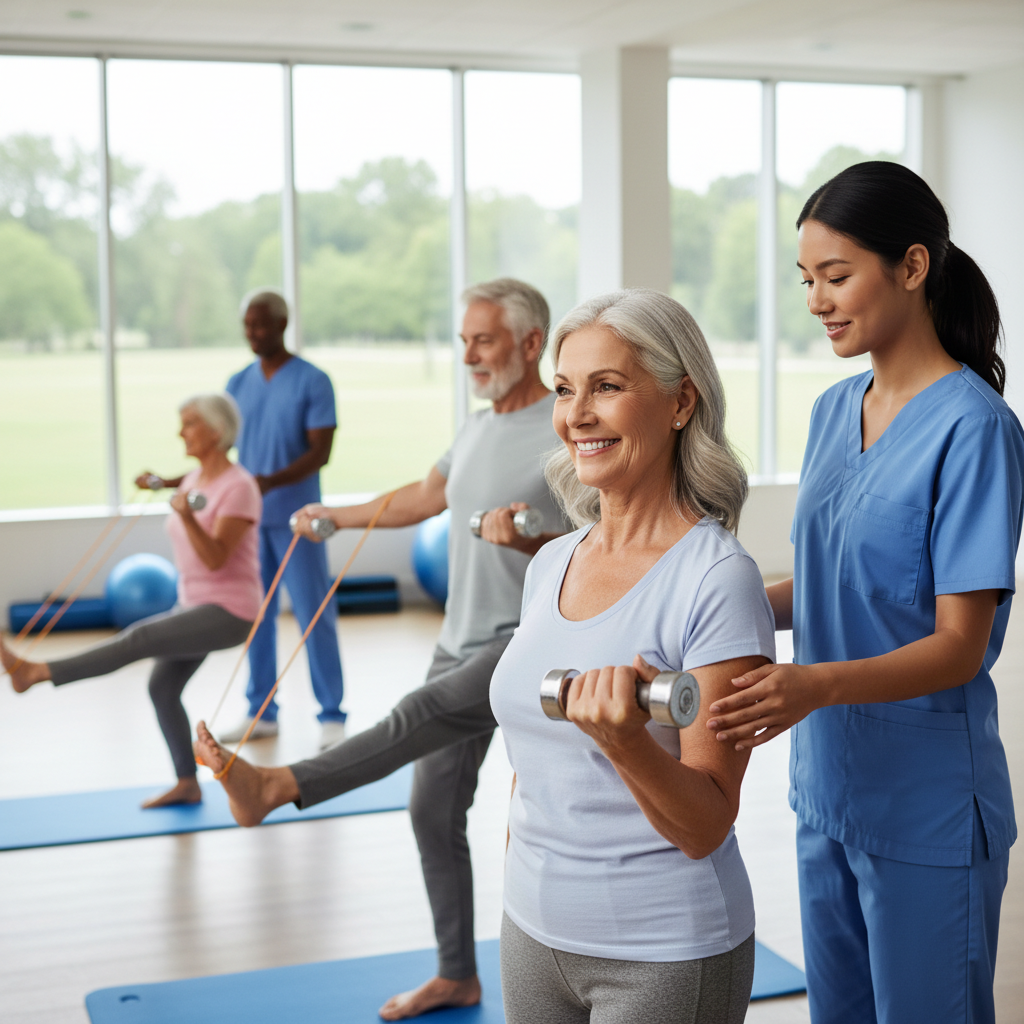
The best exercises for ageing joints are not the most intense — they’re the ones you can keep doing
The best exercises for ageing joints are not the most intense — they’re the ones you can keep doing
Ageing changes the whole body, and joints often feel it early. Stiff knees when getting up, hips that take longer to loosen, shoulders that no longer move as freely, hands that ache at the end of the day — these experiences are common. The instinctive response is often to move less in order to protect the body from further wear. But in most cases, that strategy backfires.
What the evidence suggests is almost the opposite: regular, well-chosen movement helps protect joint function. That does not mean exercise completely prevents joint ageing, or that it can erase osteoarthritis or pain. But it does mean that the right kind of activity can preserve mobility, improve strength, reduce disability and help people stay independent longer.
Among the most strongly supported forms of exercise, one stands out as especially important: progressive resistance training, ideally combined with mobility-focused work and low-impact aerobic activity.
Healthy joints depend on more than cartilage
When people talk about ageing joints, the discussion usually centres on cartilage, degeneration and inflammation. All of that matters. But a joint does not function in isolation. It depends on what surrounds it: muscles, tendons, balance, coordination and the way force is distributed through the body.
That is where exercise becomes so important. A knee, for instance, tends to cope better when the thigh and hip muscles can absorb load and stabilise movement. The same principle applies to shoulders, ankles and the spine. In many cases, pain is not only about ageing tissue. It is also about the muscular system around the joint losing its ability to support and organise movement.
That is the central logic behind exercise for older adults: strengthening the body does not “rejuvenate” a joint, but it can help that joint work better for longer.
The best-supported exercise type: progressive strength training
A large Cochrane review included in the supplied evidence found that progressive resistance training improved physical function, walking speed, chair-rise performance and muscle strength in older adults. Among participants with osteoarthritis, there was also some reduction in pain.
That matters because these are not minor improvements. Walking more confidently, standing up more easily, maintaining balance and preserving strength are all core to independence.
In practical terms, progressive resistance training means working muscles against resistance and gradually increasing the challenge over time. That resistance might come from free weights, machines, resistance bands, bodyweight movements or a combination of these.
The key is not whether the exercise looks “hard”. The key is whether it follows a few principles:
- consistency;
- gradual progression;
- good technique;
- and adaptation to pain levels, balance and current fitness.
Stronger muscles protect joints indirectly — and powerfully
A more recent review on musculoskeletal exercise reinforces a point that is often missed: strength training may reduce long-term joint stress by improving muscle strength, balance, force distribution around joints and overall musculoskeletal health.
That changes how ageing joints should be thought about. Many people still see resistance training as something that helps muscles but not joints. In reality, stronger muscles often act as joint protection. They help control movement, reduce compensation patterns and make everyday tasks less stressful for knees, hips and the spine.
It is a useful shift in perspective. Instead of assuming exercise “wears out” joints, it may be more accurate to say that inactivity weakens the very structures that help protect them.
But strength alone is not enough: mobility and low-impact movement matter too
If strength training is an anchor, it should not stand alone. The broader evidence suggests the best approach for ageing joints often includes:
- mobility work;
- gentle, controlled stretching;
- low-impact aerobic activity, such as walking, stationary cycling, swimming or water exercise;
- balance and coordination training.
These elements matter because joints need more than strength. They need regular movement, safe range of motion and the ability to respond to changes in position, speed and surface.
For many people — especially those already dealing with pain — lower-impact forms of exercise may be the difference between staying active and giving up. Good exercise, in the end, is exercise that improves function without creating unnecessary flare-ups.
There is no single best exercise for every person or every joint
The question “What is the best exercise for ageing joints?” is appealing. But the most honest answer is less tidy: there is no single best exercise for every joint or every older adult.
The evidence supports exercise broadly, especially resistance training, but programmes need to be individualised. That depends on factors such as:
- current pain;
- severity of osteoarthritis;
- previous injury;
- balance limitations;
- fear of falling;
- baseline fitness;
- and other health conditions.
Someone with painful knees and degenerative meniscus changes may benefit from supervised physiotherapy and targeted strengthening. Someone with shoulder stiffness and weakness may need to begin with mobility work and lighter exercises before progressing. Someone without major pain may tolerate a broader strength and conditioning routine.
That does not weaken the recommendation. It simply reflects reality: joints age differently, and exercise needs to match the person, not just the condition.
For degenerative knee problems, conservative care often comes first
One of the supplied papers focuses specifically on degenerative meniscus tears, a common age-related knee problem. In that context, conservative management typically includes physiotherapy and supervised exercise as first-line treatment.
That is a useful reminder that even when structural degeneration is already present, the first answer is not always to stop moving or rush to more invasive options. Often, the priority is to rebuild function, strength and movement control.
Although that study is more specific to knee degeneration than to joint ageing overall, it illustrates a broader principle: before concluding that an ageing joint is simply “worn out”, it is worth asking how much function might improve with a well-designed rehabilitation plan.
What the science does not support
It is also important not to oversell exercise.
The supplied literature does not support the claim that exercise can completely prevent joint ageing. Nor does it identify one perfect routine that eliminates pain, stiffness or degeneration for everyone. And while serious harms appeared rare, some studies reported adverse events poorly, so caution still matters.
The strongest claim the evidence supports is more measured: exercise helps preserve function, may reduce pain in some cases, improves strength and balance, and supports healthier ageing overall.
That is already a meaningful outcome.
What a joint-friendly exercise plan often looks like
For most older adults, the most defensible pattern includes:
- Strength training two to three times per week
- focusing on legs, hips, core and upper body;
- using progressive but tolerable resistance.
- Low-impact movement on most days
- walking, cycling, elliptical training, swimming or water-based exercise;
- enough to support endurance, circulation and regular movement.
- Mobility and flexibility work
- especially for ankles, hips, shoulders and the thoracic spine;
- without forcing sharp pain.
- Balance training
- such as supported single-leg stance, directional changes and functional exercises;
- important for fall prevention and confidence.
- Professional supervision when pain or limitations are significant
- a physiotherapist, physio-led exercise specialist, trainer or sports medicine clinician can help tailor the programme.
The biggest mistake is often stopping too much
Perhaps the most useful message for people who want to protect ageing joints is this: the biggest threat is not always movement — often it is losing it.
When pain leads to complete avoidance, muscles weaken, balance worsens, stiffness increases and simple tasks begin to place even more strain on joints. That creates a cycle: less movement leads to more limitation, and more limitation leads to even less movement.
Breaking that cycle does not always require intense workouts. More often, it requires consistency. Small gains repeated over time usually matter more than occasional bursts of effort.
The most balanced reading
The supplied evidence strongly supports the idea that exercise is a key part of keeping ageing joints functional. Progressive resistance training has especially good support for improving strength, walking performance, chair-rise ability and overall physical function, with some pain benefit in people with osteoarthritis. More recent review evidence also supports the view that stronger muscles help distribute load more effectively and reduce joint stress over time.
At the same time, the literature does not point to one single “best exercise” for every older adult or every joint. The right programme depends on pain, osteoarthritis severity, balance, injury history and fitness level. That is why the most evidence-based combination is progressive strength training plus mobility work plus low-impact activity, tailored to the individual.
The most responsible conclusion, then, is this: exercise cannot fully stop joints from ageing, but it is one of the best-supported ways to preserve function, maintain independence and age with less limitation.