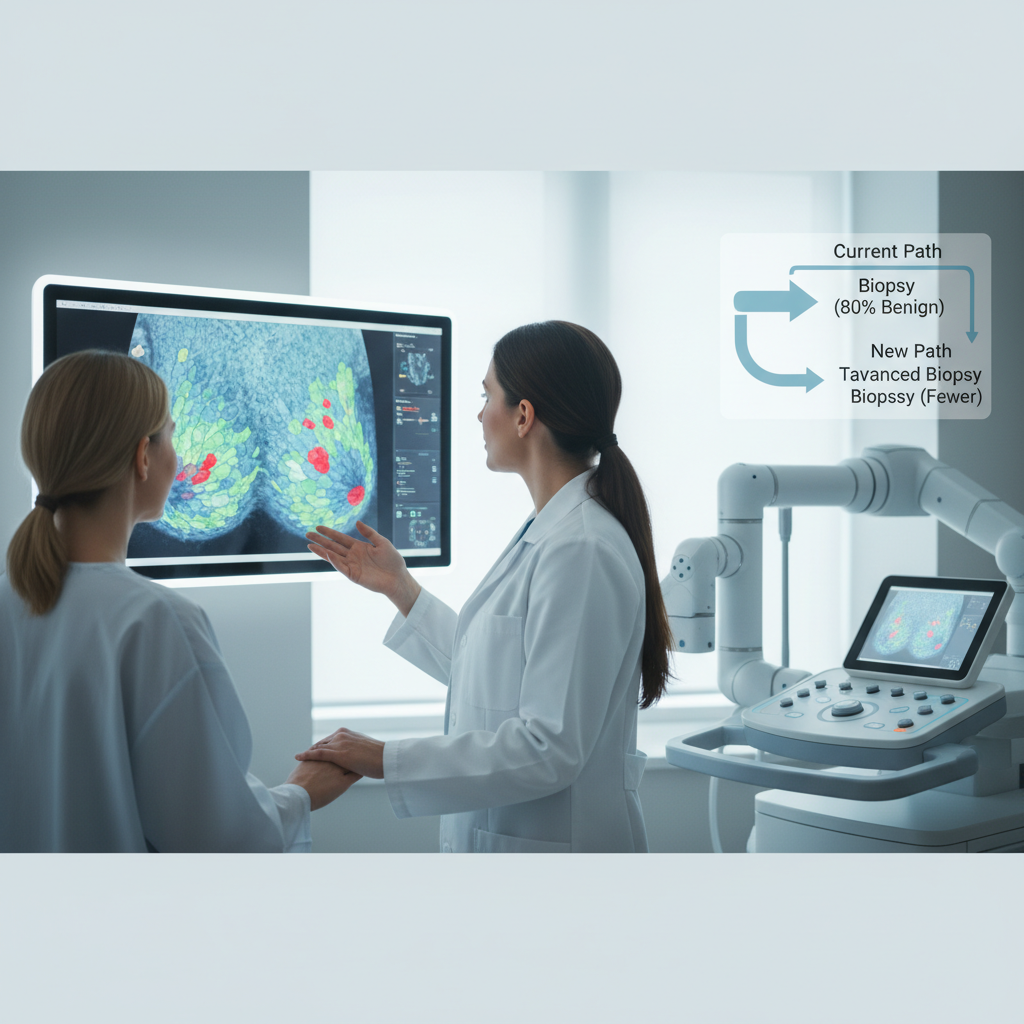
New breast imaging may help avoid unnecessary biopsies — but the real challenge is getting better at telling benign from suspicious
New breast imaging may help avoid unnecessary biopsies — but the real challenge is getting better at telling benign from suspicious
In breast cancer screening and diagnosis, one of the hardest problems in modern medicine is not only missing cancers, but also over-investigating findings that ultimately turn out to be benign. That tension is built into the system. When an imaging test shows something suspicious, no one wants to overlook a real tumour. But the more sensitive screening becomes, the more likely it is that some patients will be sent down a path of repeat imaging, needle procedures, and days or weeks of worry for findings that are not malignant.
That is why a headline about a new imaging tool promising clearer diagnoses and fewer biopsies sounds so compelling. The clinical need is real. The concept makes sense. But the safest reading of the supplied evidence is broader and more measured: better breast imaging could help distinguish suspicious lesions from benign ones more accurately, but the studies provided support that goal mainly at a general imaging-strategy level rather than validating one specific new tool.
Why this matters: many abnormal breast findings are not cancer
One of the most important pieces of context in the supplied literature is a screening review showing that most women with abnormal screening mammograms do not have breast cancer. That fact is central to understanding the problem.
An abnormal mammogram does not mean a woman has cancer. It means there is something that may need a closer look: calcifications, asymmetry, distortion, a mass, or another finding that cannot be confidently dismissed on the first scan. Many of these abnormalities turn out to be benign. But getting to that reassuring answer can involve further imaging, ultrasound, MRI, core needle biopsy, and considerable emotional stress.
This is why reducing unnecessary biopsies is not a minor technical issue. It sits at the intersection of diagnostic accuracy, patient experience, cost, and the broader problem of overtesting.
What better imaging is supposed to achieve
A more precise imaging approach would ideally do one thing better than current workflows: help clinicians decide whether a lesion truly looks suspicious enough to warrant biopsy, or whether it is more likely to be benign and safe to monitor.
That is a meaningful goal because so much uncertainty in breast diagnosis lives in that grey zone. The challenge is not only detecting abnormalities, but characterising them well enough to make a confident next-step decision.
The supplied evidence supports that broader goal. It suggests that newer imaging approaches, along with improved biopsy techniques, can reduce uncertainty and improve lesion characterisation. But that is different from proving that a specific new device already performs well enough to change routine practice on its own.
The studies support the direction, not the device
This is the main point of caution.
The supplied PubMed studies do not directly validate the specific new imaging tool described in the headline. Instead, they provide broader background on breast screening, supplemental imaging, and biopsy methods.
That still matters, because it shows the clinical rationale is sound. There is a real need to improve how breast findings are sorted into “biopsy now” versus “watch more carefully” pathways. But it also means the strongest defensible conclusion is a modest one: more accurate breast imaging is a worthwhile clinical aim, and better tools may help reduce unnecessary biopsies, but the supplied evidence does not directly prove that this one new tool can do so at scale.
Better diagnosis is not just about the scan
Another important point is that reducing unnecessary biopsies is not only about imaging hardware. It also depends on how findings are interpreted, what a patient’s baseline risk looks like, whether breast tissue is dense, and how well biopsy is performed when tissue sampling is needed.
That is where one of the supplied references on vacuum-assisted breast biopsy becomes useful. It showed improved sampling accuracy and less histologic underestimation compared with older biopsy approaches. That is not the same as avoiding biopsy altogether, but it does reinforce the broader move towards more precise diagnosis.
In other words, progress in this area is happening on more than one front. It is not only about deciding whether to biopsy, but also about doing a better job when biopsy is necessary.
Supplemental imaging can help — but not without trade-offs
The supplied literature also supports the role of supplemental imaging such as tomosynthesis, ultrasound, and MRI in selected groups, particularly women with dense breasts. These tools can improve cancer detection and may help clarify findings that are uncertain on standard mammography.
But there is an important catch: better imaging does not automatically mean fewer false positives. In some settings, increasing sensitivity can reveal more suspicious-looking abnormalities without improving specificity enough to avoid additional work-up.
That is one of the central tensions in breast imaging. More information can be helpful, but not all added information reduces uncertainty. Sometimes it creates more of it.
So whilst advanced imaging may help reduce benign biopsies in some settings, it can also increase follow-up testing if it identifies more lesions that cannot be confidently classified.
The key balance: fewer biopsies, but not missed cancers
This is the most important clinical issue in the whole story.
Reducing benign biopsies is a worthy goal, but only if it does not come at the cost of missing important cancers. If imaging thresholds become too restrictive in an effort to spare patients invasive procedures, the result could be delayed diagnosis in women who actually do need prompt tissue confirmation.
That is why any new imaging tool has to be judged on both sides of the equation:
- Does it reduce unnecessary biopsies?
- Does it do so without increasing the risk of missed or delayed cancer diagnoses?
That balance is what separates a useful innovation from an appealing but premature promise.
Benign biopsy does not mean harmless experience
It is also worth remembering that a biopsy that comes back benign was not necessarily a low-cost experience for the person who went through it.
Even when the final result is reassuring, the pathway can involve pain, disrupted schedules, lost work time, extra appointments, and intense psychological stress. For many women, the period between “we found something suspicious” and “it is not cancer” can be one of the most frightening stretches of medical care they ever experience.
That is why reducing unnecessary biopsies matters beyond efficiency. It is also a patient-centred goal. A system that gets better at distinguishing what needs tissue diagnosis from what can be followed safely is not just more efficient — it is more humane.
But only if that confidence is well earned.
What this headline really says about the future of breast imaging
The most responsible way to read this story is not “a new tool is about to eliminate most benign breast biopsies”. That would go beyond what the supplied evidence supports.
A more balanced reading is that breast imaging is moving towards greater diagnostic precision, partly because the burden of false positives and benign biopsies is so real. In that sense, the headline captures a legitimate direction in the field: clinicians want tools that characterise lesions better, reduce uncertainty, and spare patients avoidable procedures.
That ambition is well supported. What remains unproven here is whether the specific new tool in the headline is ready to deliver that promise in everyday practice.
To justify a real practice shift, a tool like this would need directly matched evidence showing that it:
- improves lesion characterisation;
- reduces benign biopsy rates;
- maintains or improves detection of clinically important cancers;
- and performs reliably across different patient populations and clinical settings.
Until then, it is best described as promising rather than practice-changing.
The most balanced reading
Taken together, the supplied evidence supports the idea that better breast imaging could help reduce unnecessary biopsies. It also supports the broader point that many abnormal breast findings are not cancer, and that improving diagnostic accuracy is an important clinical goal. More precise biopsy methods and supplemental imaging strategies are part of that larger effort to reduce uncertainty.
At the same time, the supplied PubMed articles do not directly validate the specific new imaging tool described in the headline. Most of the evidence is broader background on screening, biopsy methods, and supplemental imaging rather than a definitive study of one technology lowering benign biopsy rates.
The safest conclusion, then, is this: more accurate breast imaging has real potential to help separate benign from suspicious lesions and reduce some unnecessary biopsies, but it is too soon to suggest that one new tool is ready to eliminate most benign biopsies without stronger directly matched evidence.