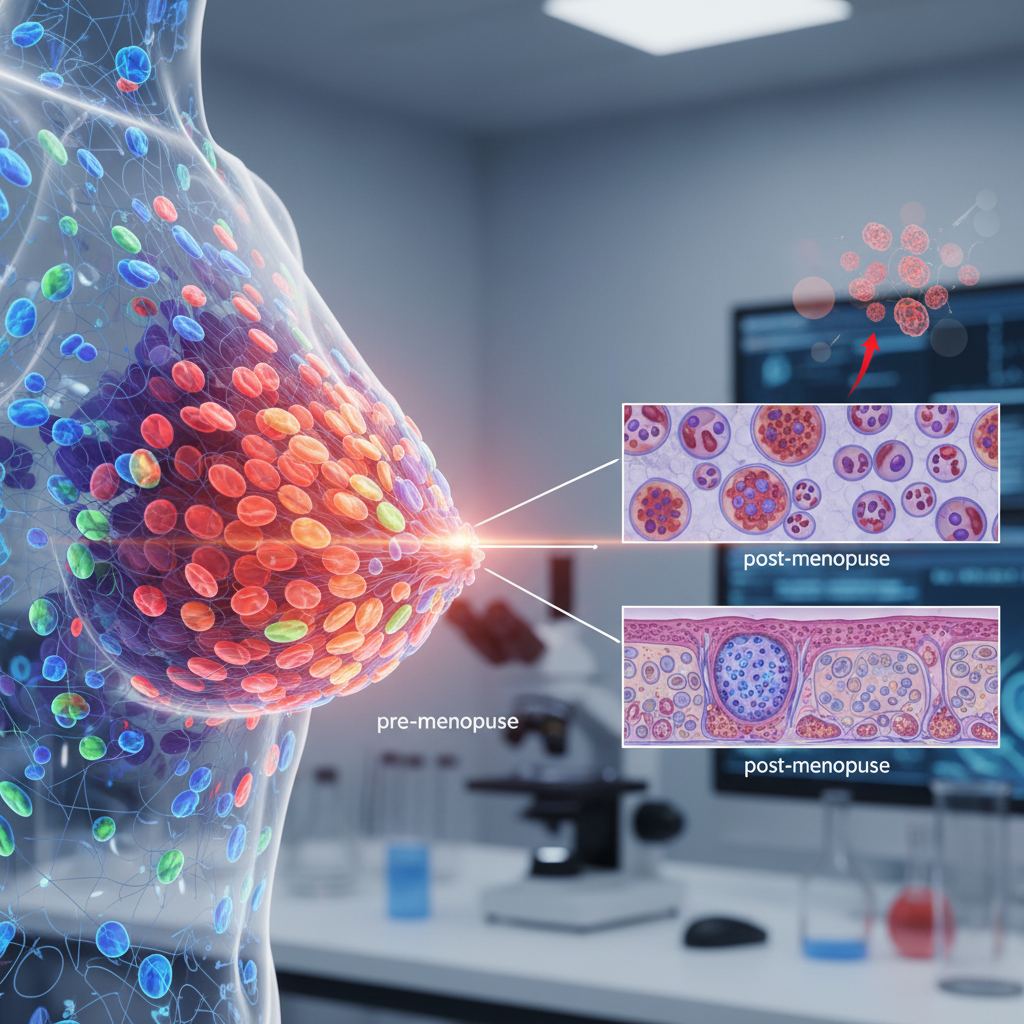
Menopause appears to reshape breast tissue in major ways — and that may help explain shifts linked to cancer risk
Menopause appears to reshape breast tissue in major ways — and that may help explain shifts linked to cancer risk
Menopause is often framed as a hormonal milestone, a turning point associated with hot flushes, sleep disruption, bone loss and cardiovascular change. But there is another transition happening during this period that is far less visible: the remodelling of breast tissue itself.
According to the evidence provided here, the breast does not simply age in a passive, gradual way. Instead, the mammary epithelium appears to undergo substantial reorganisation across the lifespan, with menopause emerging as one of the most important remodelling periods. Using a high-resolution single-cell atlas built from millions of cells, researchers have begun to map these changes in far greater detail than was previously possible.
That matters because breast cancer does not arise in a biological vacuum. Tumours emerge from tissues that are changing over time, under the influence of age, hormones and cellular state. If menopause reshapes the breast in important ways, that may help explain why the tissue environment changes in ways that are relevant to cancer biology.
Still, the distinction between mechanism and proof is essential. The new work offers biological plausibility, not direct evidence that menopausal tissue remodelling increases breast cancer incidence in people. It points to a possible contribution to risk, not a confirmed causal link.
What a single-cell atlas can reveal that older approaches could not
For decades, scientists studied breast tissue largely through broader tissue analysis, histology and bulk molecular methods. Those approaches revealed important structural patterns, but they had a limit: they could not easily show what individual cell populations were doing across different stages of life.
Single-cell atlas work changes that. Instead of looking at the breast as one blended tissue block, researchers can examine large numbers of individual cells, identify distinct populations, track lineage-specific gene programmes and observe how the tissue architecture shifts during puberty, pregnancy, ageing and menopause.
This is more than a technical upgrade. It changes the kinds of questions researchers can ask. Rather than only asking what the breast looks like overall, they can ask which cell types expand or contract, which genetic programmes turn on or off, and how those changes may influence tissue vulnerability over time.
That is especially important in cancer research, because the behaviour of a tissue can shape whether a mutation remains biologically quiet or becomes part of a malignant process.
Menopause may be a major remodelling phase, not just a drop in hormones
The central finding supported by the supplied study is that the mammary epithelium undergoes major remodelling during menopause. That shifts the conversation away from menopause as merely an endocrine event and towards menopause as a tissue-biology event as well.
In practical terms, this means menopause is not simply about lower circulating oestrogen. It may also involve changes in breast cell composition, lineage balance, structural organisation and gene expression programmes. These are the kinds of shifts that can alter how the tissue behaves — and potentially how it responds to damage, repair and abnormal growth.
Because most breast cancers arise from epithelial cells, changes in this compartment matter. If menopause reorganises the epithelial landscape, then it may alter the background conditions in which cancer-related processes unfold.
That does not mean every postmenopausal change is dangerous, or that menopause itself should be treated as a disease state. It means the tissue is actively changing, and those changes may be biologically meaningful.
Why this matters for understanding breast cancer subtypes
One of the more interesting implications of the atlas work is that it identifies lineage-specific gene programmes and suggests that tissue reorganisation may help explain how different breast cancer subtypes relate to different cells of origin.
That is an important idea because breast cancer is not one disease. It is a family of diseases with different molecular profiles, clinical behaviours and treatment responses. For years, researchers have tried to understand why these subtypes differ so much. Part of the answer may lie not only in which mutations occur, but in which cells those mutations arise in and what state those cells are in at the time.
If menopause shifts the relative balance of mammary epithelial cell populations, or changes the programmes those cells are running, then it could help shape the biological landscape from which different tumour types emerge.
Put simply, cancer risk is not only about acquiring genetic damage. It may also be about what kind of tissue that damage lands in.
Age may change risk not only by accumulation, but by reorganisation
There is a long-standing assumption in medicine that cancer risk rises with age largely because cells accumulate damage over time. That remains true. But work like this suggests that age-related risk may involve more than wear and tear.
The breast appears to be an actively changing organ. Cell populations reorganise. Developmental programmes shift. Hormonal transitions leave structural marks. That means ageing may not just add damage; it may also change the tissue context in which damage becomes consequential.
This is one reason menopause is scientifically interesting. It is a natural life-stage transition, but it may also be a period in which the breast’s internal environment is being reset in ways that are relevant to later disease biology.
That framing is more sophisticated than the simple claim that menopause raises cancer risk. What it suggests instead is that menopause may help reshape the tissue environment in ways that could influence how risk is expressed.
The scientific value goes beyond the headline
Even if the direct link to human cancer incidence is not proven by the supplied evidence, the atlas itself has substantial value.
High-resolution cell maps can help researchers ask sharper questions. Which epithelial populations become more prominent after menopause? Which pathways linked to proliferation, differentiation or cancer-related signalling become more active? How do shifts across life stages connect to known tumour biology?
Those are not abstract academic questions. Over time, answers to them could improve how researchers think about breast development, age-related tissue vulnerability and tumour classification. They may also help explain why some cancer subtypes are associated with certain age groups or tissue states.
In other words, the real advance here may be less about announcing a new risk factor and more about improving the biological map researchers use to understand how breast cancer begins.
Why caution still matters
For all its interest, the evidence supplied here has clear limits.
First, it is largely based on a single atlas-focused study and is primarily mechanistic. That means it is useful for generating biologically plausible explanations, but it does not establish a direct rise in breast cancer incidence tied specifically to menopausal remodelling.
Second, part of the work includes mouse data. Animal models are extremely valuable for tracing cell states and tissue dynamics, but translation to humans always requires caution. Mouse mammary biology can illuminate important principles without perfectly mirroring human disease.
Third, the supplied evidence focuses mainly on epithelial remodelling. That is a major part of the story, but not the whole story. Breast cancer risk is also shaped by stromal tissue, immune cells, extracellular matrix, metabolic signals and broader systemic hormonal context. A cell atlas can deepen one layer of understanding without fully capturing all of them.
That is why the most responsible interpretation is restrained. The study supports a mechanism that could be relevant to risk. It does not prove that menopause itself causes breast cancer.
What this changes right now
In the near term, this research changes how menopause can be understood biologically. Rather than seeing it only as a hormonal endpoint, it may be more accurate to see it as a period of substantial breast tissue reorganisation.
That should not be turned into a patient alarm. The message is not that menopause is dangerous in itself, nor that it should be viewed as a direct trigger for cancer. The message is that natural hormonal and ageing transitions may reshape breast tissue in ways that matter for cancer biology.
For researchers, that is a meaningful shift. It brings together developmental biology, ageing biology and breast cancer research in a more integrated way. Instead of focusing only on tumour cells after they appear, scientists are getting a better look at the tissue terrain in which those tumours may begin.
The most balanced reading
The supplied evidence supports the view that menopause is an important period of mammary epithelial remodelling. It also supports the idea that high-resolution cell atlases can reveal lineage-specific programmes and tissue changes that are relevant to breast carcinogenesis.
But the link to real-world cancer risk remains mechanistic rather than proven. The study does not show that menopausal remodelling directly increases breast cancer incidence in humans, and it should not be used to argue that menopause itself causes breast cancer.
What it does offer is something more foundational: a plausible biological explanation for how age-related and menopause-related cellular changes might alter the breast tissue environment in ways that influence cancer-related pathways. That makes it an important step in understanding breast biology — and a promising, if still incomplete, clue to how cancer risk may be shaped over time.