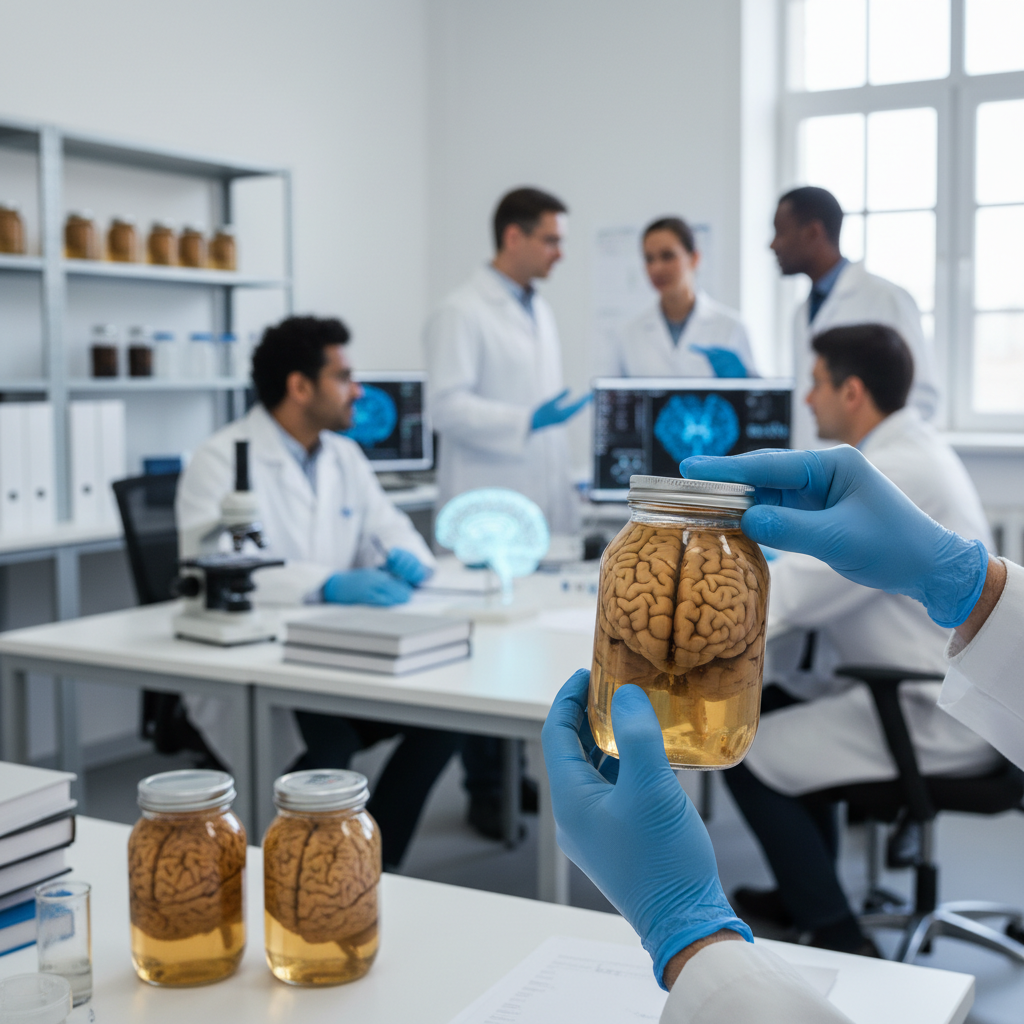
Brain donation may help autism research move forward — but the evidence provided cannot confirm how well the public understands that
Brain donation may help autism research move forward — but the evidence provided cannot confirm how well the public understands that
When most people think about autism research, they tend to picture genetics, brain scans, developmental assessments, behavioural studies or long-term clinical follow-up. That picture is not wrong. In fact, those approaches have driven many of the field’s biggest advances. But there is another, much less visible part of neuroscience that also matters: the study of human brain tissue after death.
That is the backdrop to a headline claiming that most Americans do not realise brain donation is needed to study autism. The underlying idea is both plausible and important. In neuroscience, access to postmortem human tissue can provide forms of evidence that living-brain methods cannot fully capture, including fine cellular organisation, microscopic circuit changes, region-specific gene activity and highly detailed structural features.
Still, there is a clear limit to what can responsibly be said based on the material supplied here. No PubMed articles were provided to independently verify two important parts of the headline: the public-awareness claim and the strength of the word “needed” when applied to brain donation for autism research.
Why postmortem tissue can matter in autism science
Autism research faces a central challenge: autism is highly heterogeneous. People can differ widely in communication style, sensory profile, support needs, co-occurring conditions and developmental trajectory. That makes it difficult to reduce autism to one biological signature.
Research in living people helps a great deal. Neuroimaging can examine large-scale brain structure and function. EEG can track electrical activity. Genetics has identified many variants associated with autism risk. Longitudinal clinical studies can show how traits and support needs evolve over time. Organoids, cell models and animal models can all help scientists test mechanisms.
But none of those methods fully replaces direct study of human brain tissue. Postmortem samples may allow researchers to ask questions that are otherwise hard to answer: how are certain cell types distributed? Are there differences in synaptic markers or inflammatory signals? Which genes are turned on in specific brain regions? How are cortical layers and microcircuits organised at a scale beyond what scans can show?
That helps explain why brain banks are viewed as important research infrastructure across neuroscience, including autism research. Not because they are the only route to knowledge, but because they can add a kind of evidence that other tools cannot easily reproduce.
The hidden infrastructure problem behind discovery
Part of this story is not only scientific, but logistical. Research depends on infrastructure. And in neuroscience, infrastructure does not mean just laboratories, sequencing machines or databases. It also means access to high-quality biological material that has been collected ethically, documented carefully and linked, where possible, with meaningful clinical information.
That is where postmortem donation can become a bottleneck. Even when researchers have strong questions and advanced methods, progress can be slowed if there are not enough suitable samples.
This may matter especially in autism, where variability is such a defining feature. For brain tissue studies to be informative, researchers often need not just tissue, but also developmental history, medical background, sometimes genetic data and a clearer sense of the individual context. Building collections like that takes time, trust and sustained organisation.
So it makes sense to frame brain donation as part of autism research infrastructure and public awareness. If few families know that donation is even possible, the research system may struggle to build the kinds of collections needed for deeper study.
The public-awareness claim is plausible — but unverified here
Where the headline becomes more fragile is in its claim about what “most Americans” do or do not realise.
That may be true. Public awareness of brain donation is likely lower than awareness of blood donation or organ donation for transplantation. It is also plausible that many families have never been told that postmortem donation can support neuroscience.
But plausibility is not proof. Without supporting studies, it is not possible to know whether this claim comes from survey data, advocacy outreach, experience from brain banks, empirical analysis of donation shortages or a journalistic summary of a real but not precisely measured problem.
That distinction matters. Saying public awareness is likely limited is one thing. Making a broad population-level claim about what most people know is another.
With no PubMed evidence supplied, that specific point cannot be treated as independently established.
“Needed” is a strong word in a field with many research tools
Another reason for caution is the word “needed”. In headline writing, it is attention-grabbing. In science writing, it may be too absolute.
Brain donation can certainly be important for autism research. In some questions, it may be unusually valuable or difficult to replace. But that is not the same as saying autism research depends on it in any exclusive sense.
The field already relies on many powerful approaches: genetics, imaging, epidemiology, developmental psychology, organoids, animal models, family studies and clinical observation. Each of these methods reveals a different part of the picture.
The safer framing, then, is not that brain donation is the single meaningful route to understanding autism, but that it can be an important and sometimes uniquely informative part of a much broader research ecosystem.
Why human tissue still holds special scientific value
Even with those cautions, it would be a mistake to downplay the importance of postmortem brain tissue.
Across neuroscience, direct study of human tissue helps connect genetic findings and clinical observations to more concrete biology. That can matter in autism, where researchers are interested in cortical development, synaptic organisation, cell diversity, immune signalling and other features that may not be fully visible through imaging or blood-based approaches.
Human tissue also provides a kind of biological anchor that experimental models cannot fully replicate. Organoids are useful. Animal studies are useful. But neither is a complete substitute for the complexity of an actual human brain.
This is why many scientists view brain banks as strategic resources. They do not replace other methods, but they can help integrate them.
A sensitive subject that depends on trust and ethics
Brain donation is not just a technical issue. It is also a deeply personal one. It touches grief, family values, culture, religion, trust in medicine and understanding of what happens to donated tissue.
That means public-awareness efforts in this area cannot be handled as simple recruitment campaigns. They need transparency, informed consent, respect for families and clarity about how donated tissue will be stored, studied and used.
In autism research, this sensitivity may be even greater. Autism is not only a biomedical topic; it is also tied to identity, neurodiversity, representation and longstanding debates about how society understands autistic people. Any public messaging around donation has to avoid reducing autistic people to biological specimens or turning a deeply personal decision into a moral obligation.
What this says about autism research today
At a deeper level, this story reflects how ambitious autism research has become. The field is no longer focused only on observable traits or genetic associations. It increasingly tries to connect multiple layers of explanation: genetic, cellular, circuit-level, developmental, clinical and social.
Within that larger effort, brain donation appears as one potentially important piece of the puzzle. It may help answer questions that cannot be fully resolved through scans, genetics or behavioural study alone. At the same time, the way this issue is communicated shows how easily a real infrastructure need can be overstated.
That balance matters. Overstatement can undermine trust. But ignoring the role of postmortem donation would also leave the public with an incomplete view of how neuroscience actually works.
The most balanced reading
The headline points to a plausible and important issue: access to postmortem brain tissue may help researchers study aspects of autism biology that are not fully accessible with living-brain methods. It is also plausible that public awareness of this kind of donation is limited, and that awareness affects the availability of tissue for research.
The problem is that these claims could not be independently verified from the scientific evidence supplied. Without PubMed articles, there is no way to know how the public-awareness statement was measured or how strongly brain donation should be framed as necessary for autism research.
The most responsible conclusion, then, is this: brain donation can be an important part of autism research infrastructure and deserves more public visibility. But with the material currently available, it would be premature to make strong claims about how many Americans understand that, or to imply that brain donation is the only meaningful path to understanding autism.