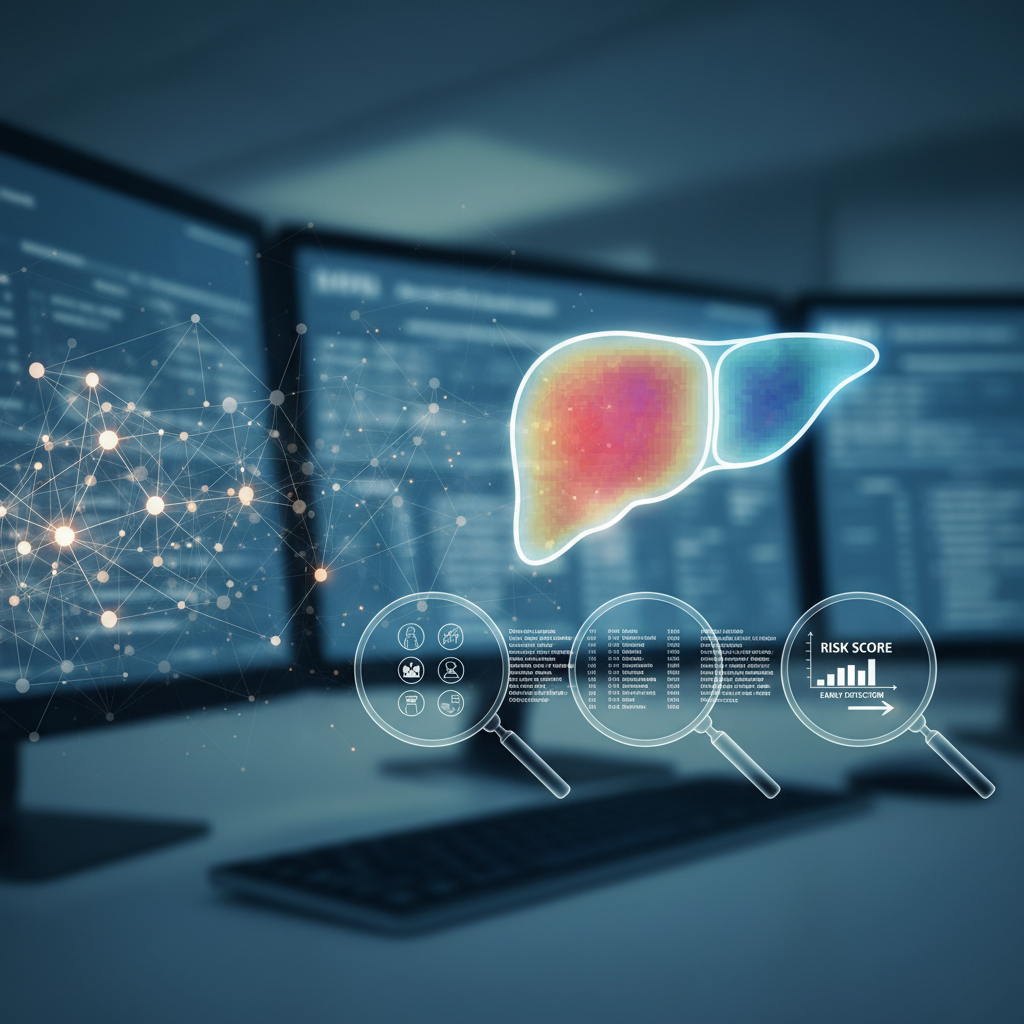
AI may help predict liver cancer risk using data already sitting in the medical record
AI may help predict liver cancer risk using data already sitting in the medical record
One of the hardest parts of liver cancer care is timing. Hepatocellular carcinoma, the most common form of primary liver cancer, is far more treatable when it is found early. The trouble is that many patients are diagnosed later, when curative options have narrowed. That is why any tool that might help identify higher-risk patients sooner immediately attracts attention — especially if it can do so using information that health systems already collect as part of ordinary care.
That is the appeal of machine learning in this setting. The underlying idea is straightforward: rather than relying only on fixed rules or isolated clinical judgement, a model can combine many pieces of routine information — age, medical history, lab results, chronic liver disease status, metabolic conditions and other structured data from the medical record — to estimate who may be at increased risk and who may need closer surveillance.
In theory, that could make liver cancer screening and monitoring more targeted, less generic and potentially more useful. But as with many AI stories in medicine, the real question is not whether a model can generate a prediction. It is whether that prediction is accurate across real-world populations, understandable to clinicians and helpful enough to change care.
Why liver cancer is a logical target for risk modelling
Liver cancer does not usually appear out of nowhere. In many cases, hepatocellular carcinoma develops on top of pre-existing risk such as cirrhosis, chronic viral hepatitis, advanced fatty liver disease, diabetes, obesity or other forms of long-term liver damage.
That means there is often a long interval in which a person does not yet have diagnosed cancer but already has measurable signs of risk. During that window, hospitals and clinics may accumulate years of information: liver enzyme levels, platelet counts, fibrosis markers, imaging reports, age, sex, metabolic history and evidence of chronic liver disease.
On their own, those details may not seem decisive. Taken together, they may begin to describe a risk profile. That is exactly the kind of environment in which machine learning tends to be attractive. These models are built to combine many variables at once and identify patterns that more traditional approaches may miss or weigh less efficiently.
What the supplied evidence actually supports
The references provided support the broader premise that artificial intelligence and machine learning are increasingly being applied to hepatocellular carcinoma risk prediction, detection and prognosis.
The most directly relevant source is a review arguing that machine learning and deep learning can use electronic health records, imaging, histopathology and biomarkers to improve risk prediction and clinical management in hepatocellular carcinoma. That is important because it gives direct plausibility to the idea that routine clinical information — especially structured chart data and laboratory results — could be used for liver cancer risk stratification.
The broader oncology literature also supports the modelling logic. In different cancer settings, machine learning systems have shown that they can combine multiple biological and clinical variables in ways that may produce meaningful predictive accuracy.
Taken together, that evidence does not prove that one specific model is ready for immediate clinical use. But it does support the direction of the headline: machine learning could plausibly help make liver cancer risk prediction more practical.
The practical appeal: using what the system already has
Part of the strength of this approach is that it does not necessarily depend on inventing a brand-new test. Instead, it attempts to extract more value from information that is already sitting in the medical record.
That matters because large health systems are already full of underused clinical data. If a model can meaningfully identify which patients with chronic liver disease are more likely to develop hepatocellular carcinoma, it could in principle help focus surveillance efforts where they are most needed.
That would be particularly relevant in settings where clinicians are trying to monitor large numbers of at-risk patients with limited time and uneven access to specialist care. A system that helps separate higher-risk from lower-risk individuals using information already collected in routine practice could, at least in theory, make surveillance more efficient.
But strong performance in a study is not the same as usefulness in the clinic
This is where enthusiasm needs to slow down.
The supplied PubMed articles do not directly validate the specific new model referenced in the headline. The strongest directly relevant evidence is a review, not a prospective external validation study of one particular machine learning tool in real-world liver cancer screening.
There are also mismatches in the literature provided. One cited study focuses on cholangiocarcinoma rather than hepatocellular carcinoma, and another concerns pancreatic cancer metastasis rather than liver cancer risk prediction from routine clinical information. Those papers may support the broader use of AI in oncology, but they do not directly answer the headline’s central question.
So while the general premise is credible, the evidence provided does not establish that this specific new model is already ready to guide routine practice.
The real tests still lie ahead
For a machine learning model like this to matter clinically, it has to pass several difficult tests.
The first is generalisability. A model may perform well in the hospital or database where it was developed and then lose accuracy when applied to a different region, population or health system. Differences in patient mix, disease prevalence, coding practices and data quality can all change performance.
The second is interpretability. In medicine, a prediction is easier to trust and use when clinicians can understand what is driving it. If a model simply outputs a high-risk score without any meaningful explanation, adoption becomes harder.
The third is clinical utility. Even a statistically strong model may fail to improve care. The crucial question is whether it changes screening or surveillance decisions in a way that leads to earlier detection, better resource use or more effective follow-up.
Without those pieces, a model may remain impressive on paper but less meaningful in day-to-day practice.
Predicting risk is not the same as improving outcomes
This distinction is especially important in AI medicine. There is a tendency to assume that if a model can predict something accurately, it will automatically improve patient outcomes. But that is not guaranteed.
In liver cancer, a risk score only becomes valuable if it fits into a workflow that leads to better surveillance, earlier imaging, more timely referrals or more rational follow-up. If the health system cannot act on the information, then the prediction may not change very much.
That is why claims about immediate clinical usefulness need restraint. A strong algorithmic result is only the beginning. The bigger question is whether the tool actually helps clinicians make better decisions and helps patients benefit from them.
Why this line of research still matters
Even with those cautions, this is still a meaningful direction for research. Liver cancer is exactly the kind of disease where risk stratification could be valuable: it often develops in identifiable high-risk groups, there is a large volume of routine clinical data available, and early detection matters greatly.
That makes machine learning an appealing fit. It offers the possibility of turning fragmented clinical information into a more personalised estimate of risk. Done well, that could help health systems move away from one-size-fits-all surveillance towards something more targeted.
It will not replace clinical judgement. But it could become a useful layer of support — provided the model proves reliable, understandable and workable beyond the research setting.
What patients and clinicians should take from this now
For patients, the most helpful message is that this is still better understood as a promising risk-organising tool than as a finished diagnostic solution. It is not a crystal ball, and it is not yet proof that AI can reliably tell who will develop liver cancer.
For clinicians and health systems, the message is more practical: this kind of model could become useful because it works with routine information already being collected. But the real value will depend on validation, transparency and whether it improves actual care pathways.
The most balanced takeaway
The idea of using machine learning to predict liver cancer risk from routine clinical information is plausible, practical and consistent with where hepatology and oncology are heading. The supplied evidence supports the broader view that AI is increasingly being used in hepatocellular carcinoma risk prediction, detection and management.
What the evidence does not yet show directly is that the specific new model in the headline has already been broadly validated or is ready to transform screening in practice. The most important tests still involve generalisability, interpretability and real-world usefulness.
So the fairest reading is one of disciplined optimism. Machine learning may well help identify patients at higher risk of liver cancer using data the health system already has. But the real milestone is not just building a model that predicts well in one study. It is proving that the model works across settings and improves decisions in the clinic.