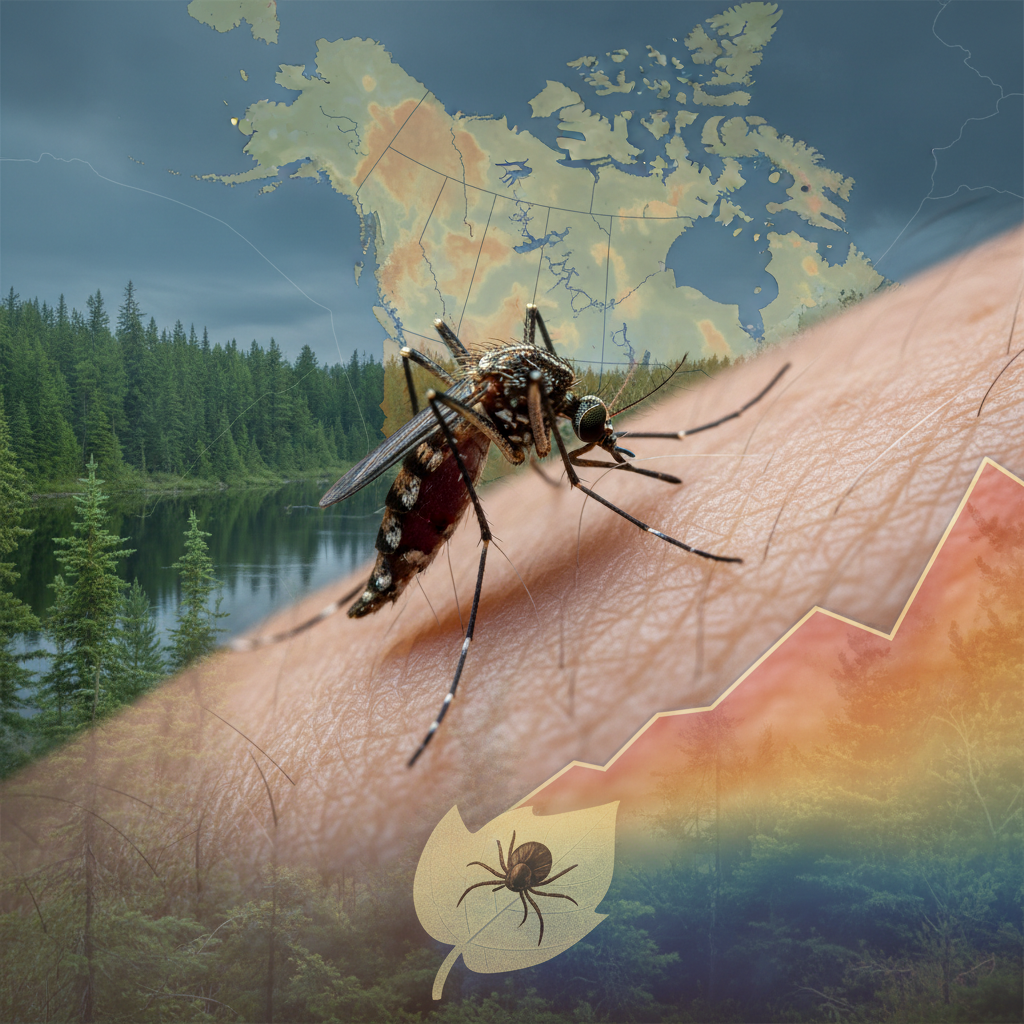
Warming temperatures may create more room for vector-borne diseases in Canada
Warming temperatures may create more room for vector-borne diseases in Canada
Climate change is usually discussed through its most visible consequences: heatwaves, wildfires, floods and smoke-filled skies. But some of its health effects are quieter, slower and easier to underestimate. One of them is the way a warming climate can reshape the ecological conditions that allow infectious diseases to spread.
In Canada, that question is becoming harder to ignore. As temperatures rise, the environments that support disease-carrying ticks, mosquitoes and other vectors may expand, shifting infectious risk in places that once seemed relatively protected.
The strongest safe reading of the supplied evidence is that warming temperatures are likely to expand conditions favourable to at least some vector-borne diseases in Canada, making surveillance and preparedness increasingly important. At the same time, the literature supports this more as a growing and biologically plausible risk — especially for Lyme disease — than as a definitive forecast that multiple vector-borne infections will inevitably spread widely across the country.
Climate change is already affecting health risks in Canada
One reason this issue matters is that climate change is no longer only a future-health story in Canada. The supplied literature supports the broader claim that it is already affecting health risks in the country.
That shifts the conversation. The question is no longer whether climate change could someday alter infectious disease patterns in a northern country. It is whether the environmental shifts already under way are beginning to change those patterns now.
In higher-latitude settings, warming can have outsized effects because it loosens ecological constraints that previously limited where vectors could survive and how long they could remain active. Milder winters, longer warm seasons and changing moisture patterns can all make a region more hospitable to vector life cycles.
Lyme disease is the clearest case in the evidence
Among the supplied references, the strongest disease-specific support is for Lyme disease in Canada.
A detection-and-attribution paper cited in the evidence identifies Lyme disease as a case where changes in health outcomes and geographic distribution can be linked, at least in part, to climate-related weather changes. That is an important finding because it goes beyond a general warning. It suggests that, in at least one vector-borne disease, climate change is already part of the explanation for how risk is shifting.
That does not mean climate is the only force involved. But it does mean the relationship is no longer purely theoretical.
In a field where ecology matters enormously, that is a meaningful step.
Why vectors are so sensitive to temperature and environment
Vector-borne diseases depend on more than just the presence of a pathogen. The vector must survive, reproduce, encounter appropriate hosts and remain active under conditions that allow transmission to occur.
Temperature, humidity, seasonal duration and host distribution all shape that process. When climate conditions change, the entire transmission system can change with them.
In practical terms, a warmer country may become more accommodating to certain ticks or mosquitoes for longer parts of the year, or in regions where their persistence was previously more limited. That does not automatically produce outbreaks. But it can increase the plausibility of geographic spread and longer windows of risk.
What the broader Canadian literature is warning about
Beyond Lyme disease specifically, Canadian commentary and review literature on climate and health also identifies infectious diseases — including vector-borne diseases — as a growing area of concern as the country warms.
This kind of literature does not carry the same weight as a new multi-disease epidemiologic study directly documenting expansion across Canada. But it does show that climate-health researchers and public-health experts already see this as a serious emerging issue.
The message is not that every vector-borne disease is now poised to surge across the country. It is that the conditions that shape those risks are changing enough to merit sustained attention.
The risk is plausible, but it is not automatic
This is where nuance matters.
The supplied evidence supports the idea that warming temperatures could increase vector-borne disease risk in Canada. But it does not prove that rising heat alone will produce widespread emergence of multiple diseases across the country.
That is because climate is only one driver of vector-borne disease spread. Other important forces include:
- land use changes;
- host ecology;
- surveillance intensity;
- public behaviour;
- diagnostic awareness;
- and prevention and control practices.
So while a warmer climate may create more favourable conditions, those conditions do not translate mechanically into disease expansion everywhere or for every pathogen.
Why surveillance becomes more important as the climate shifts
If the strongest conclusion is one of growing plausibility, then the practical response is clear: better surveillance.
In public health terms, that means paying closer attention to:
- the geographic distribution of vectors;
- changes in the timing and duration of their activity;
- the appearance of cases in areas previously seen as lower risk;
- the health system’s ability to recognise and diagnose infections early;
- and communication of risk to the public and health professionals.
This is especially important in slow-moving climate-related health threats. When risk changes gradually rather than explosively, there is a tendency to underestimate it until it is much harder to manage.
Preparedness may matter more than precise forecasting
One of the difficulties in climate-sensitive infectious disease planning is that health systems often want hard forecasts before they act. But vector-borne disease risk does not always emerge in dramatic leaps. It may shift gradually, redrawing public-health maps over time.
That is why preparedness matters even before certainty arrives.
Even without a precise prediction of which diseases will expand where, a changing climate can justify stronger clinical awareness, ecological monitoring, public education and coordination between environmental, veterinary and health systems.
The point is not to wait for every risk to become obvious. It is to notice early that the background conditions are becoming more favourable.
What the headline gets right — and what it should not imply
The headline is broadly fair in warning that rising temperatures could bring more vector-borne diseases to Canada. That cautious phrasing fits the evidence provided.
It is also appropriate to frame this as a preparedness issue. Waiting until expansion is fully obvious would be a poor public-health strategy.
But there are limits to what the literature can support. The strongest disease-specific evidence in the supplied material is for Lyme disease, not necessarily for all vector-borne infections. And because much of the evidence is commentary- and review-based, it supports risk plausibility more than a definitive multi-disease forecast.
So the more accurate message is not that warming guarantees widespread emergence of multiple vector-borne diseases. It is that warming increases the likelihood that conditions favourable to some of them will expand.
What this says about climate and health more broadly
Perhaps the most important lesson is that climate change does not only create visible environmental disasters. It also quietly reshapes biological risk.
A warming country does not just change in scenery. It may also change in epidemiology.
For Canada, that means diseases once viewed as geographically limited, seasonal or peripheral may require more sustained attention. And that attention depends not only on treating cases once they appear, but on recognising early that the environmental baseline is shifting.
The most balanced interpretation
The most responsible reading of the supplied evidence is that climate change is already affecting health risks in Canada and is likely expanding conditions favourable to at least some vector-borne diseases, strengthening the case for surveillance, preparedness and early response.
The clearest support in the supplied literature is for Lyme disease, whose changing health burden and geographic distribution in Canada have already been linked in part to climate-related weather changes. Broader Canadian climate-health reviews and commentaries also identify infectious diseases and vector-borne disease risk as areas of growing concern in a warming country.
But it is just as important to stay precise. The supplied evidence supports a plausible warning more than a definitive forecast of widespread expansion across multiple diseases, and climate is only one part of the larger transmission picture.
Even so, the direction is clear. As Canada warms, its infectious disease risk map may shift with it — and when the environment becomes more favourable to vectors, the best time to prepare is usually before the case counts make the change impossible to miss.