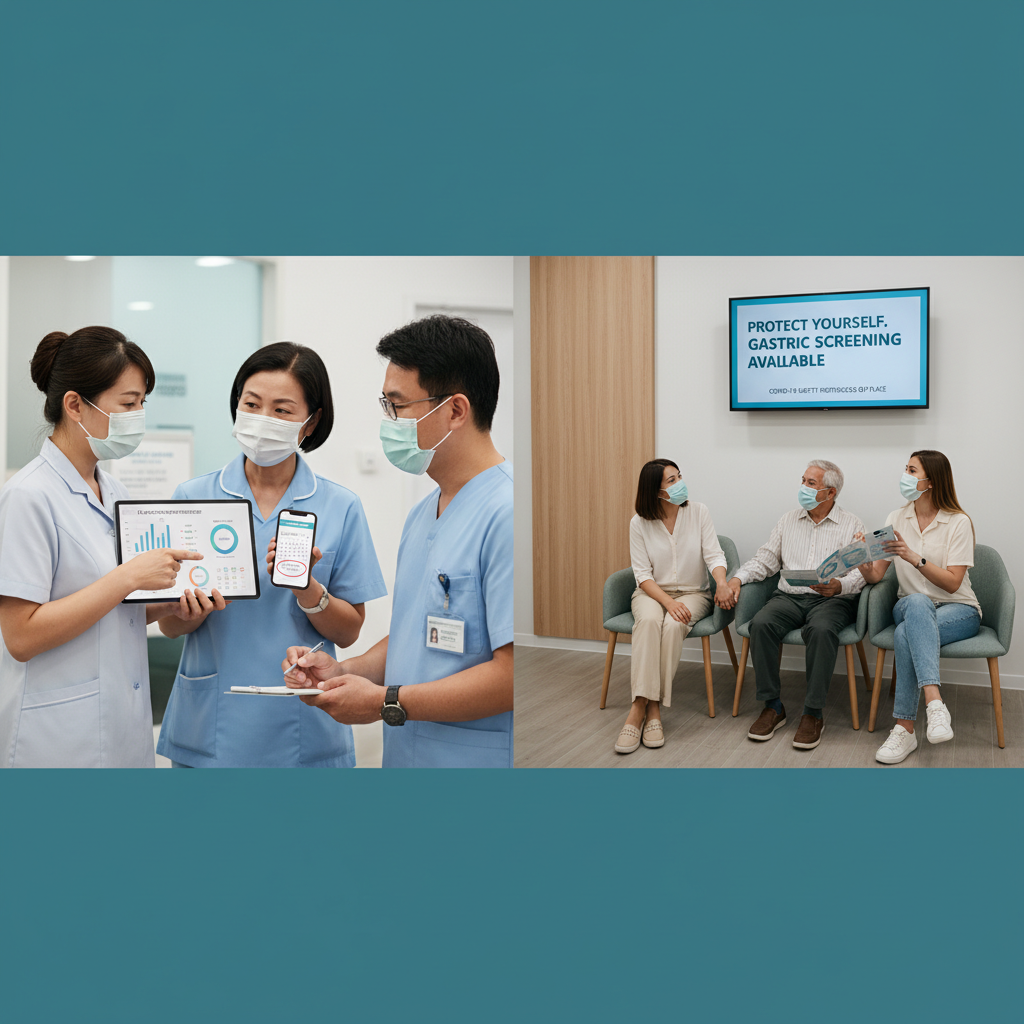
Understanding cancer risk and making a concrete plan helped sustain gastric screening during the pandemic
Understanding cancer risk and making a concrete plan helped sustain gastric screening during the pandemic
The COVID-19 pandemic disrupted almost everything that depended on routine, predictability, and trust — including cancer screening. In many places, appointments were postponed, tests were rescheduled, and patients were forced to weigh one risk against another: leave home to prevent a serious disease in the future, or avoid the immediate possibility of infection.
In the case of gastric cancer screening during COVID-19, that tension became especially visible. The supplied evidence suggests that people’s behaviour did not depend only on access or fear. It also depended on risk perception, health literacy, and perhaps most importantly, the ability to turn intention into a plan.
The strongest safe reading of the evidence is this: during the pandemic, people were more likely to follow through with gastric cancer screening when they understood their cancer risk and translated that concern into specific action steps, even in a context where fear of COVID-19 could both encourage and discourage screening.
When intention is not enough
Many people understand in theory that preventive screening matters. The problem is that knowing something is important is not the same as doing it. Between recognising the value of a test and actually booking it, organising the time, arranging transport, and dealing with anxiety, there are many small barriers.
During the pandemic, that gap widened. New fears emerged, new restrictions appeared, questions about safety multiplied, and it became much easier to postpone anything that felt “non-urgent”. In that setting, simply wanting to get screened was often not enough.
That is why the findings around implementation intentions are so striking. In health behaviour research, this idea refers to the shift from a vague intention — “I should get screened” — to a specific plan — “I will book it on this date, go to this location, and handle it this way”.
That difference may sound small, but in practice it can be decisive.
What the Japanese study found
One of the central references provided, a longitudinal Japanese study, directly supported this idea. Researchers found that perceived susceptibility to cancer, health literacy, and cues to action increased screening intention, while implementation intentions helped turn that intention into actual gastric cancer screening behaviour.
That matters because it sharpens the story. The message is not simply that “information helps”. It is that information appears to work better when it is paired with a practical mental structure for follow-through.
In other words, people who better understood their risk and could form a concrete plan were more likely to move from concern to action, even during a period of enormous social and healthcare disruption.
Fear of COVID-19 worked in two directions
Perhaps the most interesting part of the story is that fear of COVID-19 did not act as a simple good or bad force. Its effects were mixed.
According to the same study, fear of infection could increase screening intention in the short term, perhaps because the pandemic made many people more aware of their vulnerability in general. At the same time, that fear could reduce actual participation over time, likely because concern about exposure to the virus eventually outweighed preventive motivation.
This is an important point because it resists simplistic interpretation. It is not enough to say that pandemic fear drove everyone away from screening, or that it made everyone more health-conscious. It appears to have done both, depending on timing and on how people processed competing risks.
Risk awareness remained a major behavioural driver
Another supplied study reinforces that picture. In a separate survey, perceived gastric cancer risk was associated with anxiety and decision-making around esophagogastroduodenoscopy screening during the pandemic.
That finding supports the idea that perceived cancer risk remained a powerful behavioural driver even in the middle of a public-health crisis. When people saw gastric cancer as a plausible personal threat, that shaped how they thought about screening, when they considered doing it, and how they weighed it against pandemic-related risks.
But the link with anxiety also suggests something important: awareness is not neutral. It can motivate, but it can also overwhelm. If it is not paired with practical guidance, reassurance, and accessible care, risk awareness may create hesitation rather than action.
What this teaches about screening during disruption
One of the most useful lessons here is that screening campaigns do not work only through abstract reminders. In moments of disruption, such as a pandemic, health systems may need to help people bridge the gap between intention and execution.
That could mean measures such as:
- clear communication about cancer risk and the benefit of screening;
- concrete explanations about infection-control safety;
- step-by-step guidance for booking;
- reminders that include timing, location, and preparation;
- and reducing practical barriers to attendance.
What the evidence suggests is that awareness alone does not work as well as awareness plus concrete planning.
Why the lesson matters beyond COVID-19
Although the pandemic was an extreme setting, the logic behind these findings goes beyond it. Many people miss screening not because they fundamentally oppose it, but because they get stuck between vague intention, fear, delay, and practical obstacles.
COVID-19 simply exposed something that already existed: prevention depends on behaviour, and behaviour depends on context. When the context becomes harder, the distance between “I mean to do this” and “I actually did it” grows wider.
That is why the most durable lesson from this story may be that effective screening programmes need to do more than persuade. They need to make action easier.
What the headline gets right
The headline gets two central things right: cancer risk awareness and concrete planning. The supplied studies support the view that both mattered for sustaining gastric screening uptake during the pandemic.
It is also right to suggest that participation was not shaped only by the availability of the test itself. How people perceived risk, interpreted the pandemic, and organised practical follow-through all made a measurable difference.
What needs caution
At the same time, some restraint is important. The evidence is centred on Japanese populations, so its relevance to other countries, healthcare systems, and screening cultures may be limited.
Some findings also come from self-reported survey data, which can be affected by recall bias and selection bias. And while the results point to strong associations, they are stronger for identifying behavioural predictors than for proving a simple one-direction causal effect.
It would also go too far to suggest that awareness by itself solves the problem. The stronger message is more specific: awareness appears to work better when it is paired with concrete planning and practical support.
The most balanced reading
The most responsible interpretation is that, during the pandemic, gastric cancer screening was more likely when people understood their susceptibility to cancer and could convert that understanding into a specific action plan. Fear of COVID-19 shaped this process in complicated ways: it sometimes increased intention, but it could also make follow-through harder.
That makes this story less a lesson about “fear” and more a lesson about the architecture of health behaviour. People do not only need to be told they are at risk. They also need to know exactly what to do, when to do it, and how to do it safely.
In short, the evidence most strongly supports the idea that cancer awareness and concrete planning helped maintain gastric screening uptake during pandemic disruption, while COVID-related fear had both motivating and paralysing effects. For public health, that reinforces a simple but powerful point: prevention works better when information is paired with a clear path to action.