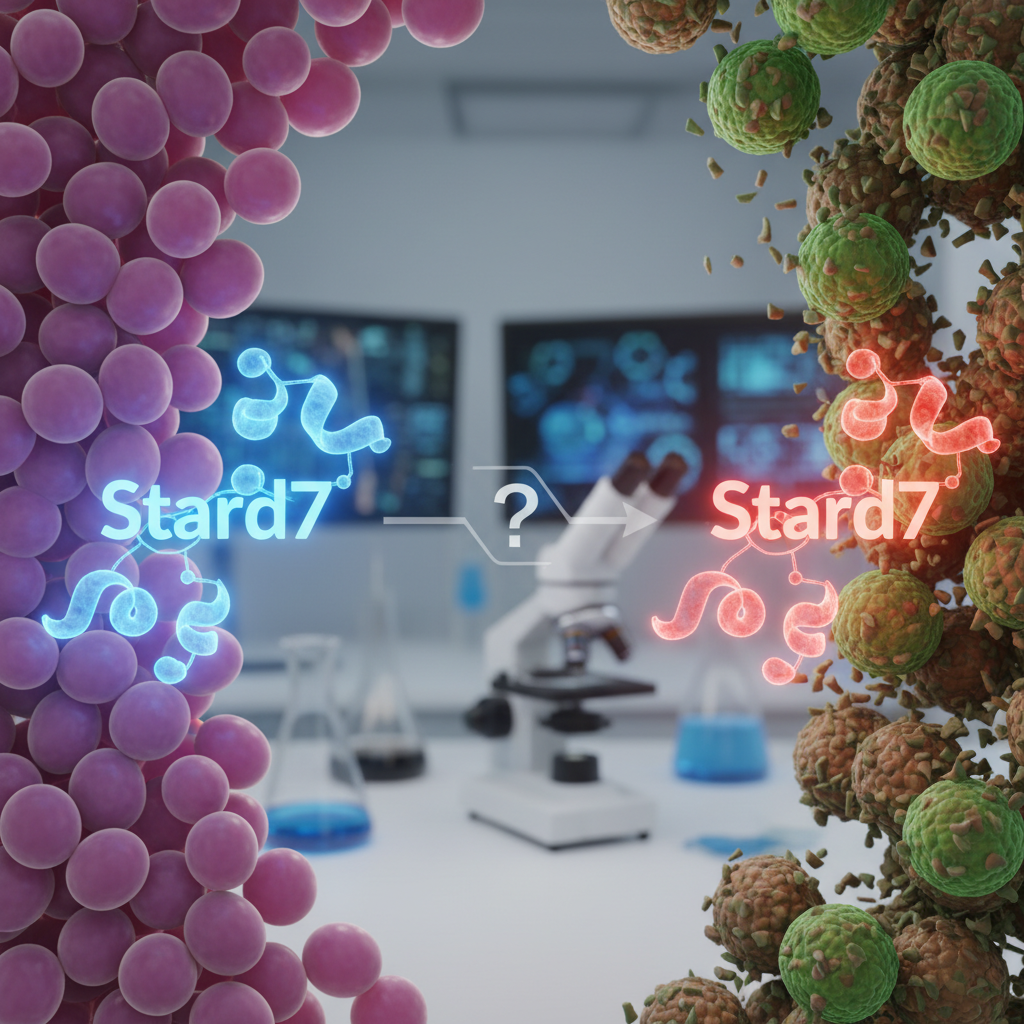
The same protein may look like both friend and foe in colon cancer — and Stard7 shows why tumour biology is rarely simple
The same protein may look like both friend and foe in colon cancer — and Stard7 shows why tumour biology is rarely simple
There is an intuitive expectation in science reporting that a protein should be one thing or the other: either it helps cancer grow, or it helps restrain it. Real tumour biology is often much less tidy. In oncology, the same gene or protein can promote tumour growth in one setting, look protective in another, and behave differently again when moving from a dish in the lab to a living organism.
That is what makes the Stard7 story interesting. The headline suggests that this protein may play different — perhaps even opposing — roles in colon cancer depending on the experimental model used. If that turns out to be true, it would not be an odd exception in cancer biology. It would fit a much broader pattern: context matters, and often matters more than early simplified narratives suggest.
The difficulty is that, based on the material supplied here, this story has to be handled with real caution. No PubMed articles were provided to independently verify Stard7’s specific role in colon cancer, to show how robust the findings are, or even to clarify what systems were studied. That sharply limits how far any interpretation should go.
Still, the topic opens the door to an important discussion: why the same protein can appear to “play both sides” in cancer depending on where and how it is studied.
What it means when a protein behaves differently across models
In simple terms, saying that Stard7 shifts its apparent role across different models means its biological effects are not fixed or universal. Proteins do not act in isolation. They interact with other molecular pathways, with the type of cell they are in, with the metabolic state of that cell, with the surrounding microenvironment and with the experimental design itself.
That means a result seen in cell culture may not be reproduced in animals. A pattern observed in one tumour cell line may not appear in another. Even two models of colon cancer may respond differently depending on co-existing mutations, inflammatory signals, tissue architecture or nutrient availability.
So when a protein appears to have opposite effects, that does not necessarily mean the science is inconsistent. It may mean the biology is highly context dependent.
Why that is plausible in colon cancer
Colon cancer is not one uniform disease. Under the same diagnostic label sit tumours with very different genetic, metabolic and immune characteristics. Some are more inflammatory. Some are more driven by proliferative signalling. Some rely heavily on one pathway; others adapt around it.
In that kind of biological landscape, it is not surprising that a protein such as Stard7 might behave differently depending on the setting. In one context, it might support cell survival, metabolic adaptation or stress resistance. In another, it might interfere with tumour progression, depending on which pathways are already active and what pressures the cells are under.
Cancer biology is full of examples like this. Molecules involved in inflammation, oxidative stress, lipid handling or intracellular transport can look pro-tumour in one system and anti-tumour in another. The behaviour is often shaped less by the molecule alone than by the network around it.
The real issue is not just Stard7 — it is translation
Even if the study did find a dual or shifting role for Stard7, the most important question for readers is not only “what does this protein do?”, but “under what conditions does it do it, and what does that actually mean outside the lab?”
That is one of the central problems in cancer research. Many mechanistic findings are real within the system in which they were observed, but become much harder to interpret when researchers try to move from simplified experimental models to human disease.
Cell culture is valuable because it strips the problem down. Animal models add more complexity, but still do not capture the full genetic, metabolic and immune diversity of human cancers. Patient samples get closer to real disease, but often make mechanism harder to prove cleanly.
Without supporting studies, it is impossible to know where this Stard7 finding sits on that spectrum. That matters enormously for how seriously it should be taken outside a mechanistic research context.
When a protein looks contradictory, that can actually mean the science is getting better
There is a temptation to see context-dependent findings as muddled science. Often they are the opposite.
For years, cancer biology was too often presented in a linear way: activate a molecule, the tumour grows; block it, the tumour shrinks. That framework works for some targets, but fails badly for others. Tumours are adaptive systems composed of heterogeneous cells, shaped by evolution, competition and microenvironmental pressures.
When a protein like Stard7 seems to change role from one model to another, that may reflect a more realistic understanding of disease. And that matters. Not because it gives clean headlines, but because it prevents premature conclusions.
If a biological target only has a certain effect in certain contexts, then any future claims about prognosis, biomarkers or treatment would also need to be context-specific from the outset.
What cannot be claimed from the material provided
Without supporting scientific papers, several claims would go too far.
First, it is not possible to say with confidence whether Stard7 is a tumour promoter, a tumour suppressor or both under different conditions. The headline implies a dual role, but that remains unverified from the supplied evidence.
Second, there is no way to judge whether the finding comes from cell culture, animal models, patient tissue or some combination of those. That makes a major difference to its scientific weight.
Third, no clinical relevance can safely be inferred. The material provided does not support framing Stard7 as a useful biomarker, a therapeutic target or a clinically meaningful predictor in colon cancer.
Fourth, it cannot be assumed that a model-specific finding will translate into human disease. Some findings remain important in biology while never becoming useful in the clinic.
What this says about modern cancer research more broadly
Even with those limits, this story fits a broader direction in oncology. Cancer research is increasingly moving away from binary explanations and towards systems thinking.
That shift is visible across the field. Genes once labelled too rigidly as “good” or “bad” are now understood through tissue context, disease stage, interacting pathways and surrounding immune or stromal conditions. Metabolic programmes depend on available fuel. Inflammatory signals depend on which immune cells are present. Transport-related proteins may carry very different significance depending on the broader state of the tumour.
In that sense, Stard7 is less important as a standalone celebrity molecule than as an example of a larger truth: understanding cancer means mapping relationships, not just naming components.
Why mechanistic headlines need restraint
Findings like this often generate dramatic headlines because they seem to reveal a hidden rule of biology. Sometimes they do. But there is a sharp line between mechanistic intrigue and clinical importance.
Without independent verification and without methodological detail, it would be premature to turn Stard7 into a therapeutic promise or a clinically actionable insight in colon cancer. The most that can be safely said is that the reported work appears to raise the possibility of context-dependent behaviour — something entirely plausible in tumour biology.
Everything beyond that, including treatment implications, biomarker value or relevance to patient care, would require stronger evidence than what has been supplied here.
The most balanced reading
The headline points to a biologically compelling idea: in cancer, the same protein may not have one fixed role. It may behave differently depending on the experimental system, the cellular environment and the wider biological context.
That idea is plausible and scientifically interesting, especially in colon cancer, where tumour heterogeneity is substantial. But with no supporting PubMed evidence provided, it should still be treated as a mechanistic clue rather than an established conclusion with clear clinical implications.
The most honest takeaway is this: Stard7 may help illustrate why tumour biology is so dependent on context and why clean, one-directional stories are often misleading. But without further evidence, it is still too early to say exactly which side this protein is on in colon cancer — or whether that is even the right question to ask.