The Brain’s Internal Compass May Be One Reason Some Memories Last
The Brain’s Internal Compass May Be One Reason Some Memories Last
When most people think about memory, they picture storage.
The brain takes in information, files it away somewhere, and then retrieves it later when needed. But modern neuroscience has been pushing towards a more interesting possibility: remembering may depend less on simply storing information and more on organising it. And one of the brain’s most important tools for that organisation may be something much more basic than memory itself — the ability to know where we are, which way we are facing, and what spatial context surrounds an experience.
That is where the idea of the brain’s “internal compass” comes in.
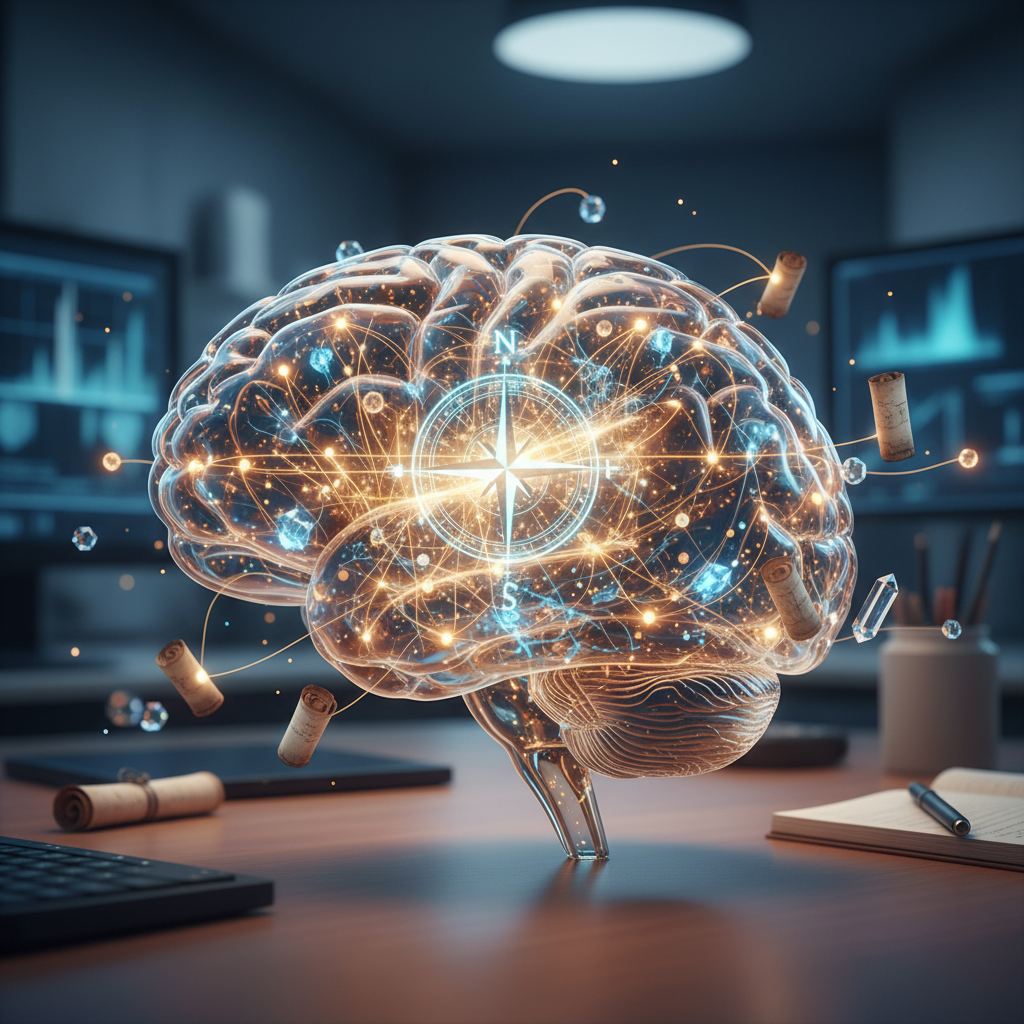
The phrase is shorthand rather than a precise technical label, but it points to something real: a network of spatial and orientation signals that help the brain track direction, location, and environmental context. These systems are closely tied to regions such as the hippocampus and entorhinal cortex, both of which have long been known to play major roles in memory.
The emerging idea is that stable navigation signals — including head-direction signals and related spatial codes — may help anchor memories in a way that allows them to persist over time.
This is not an immediately clinical discovery. It is a basic neuroscience story. But it touches a very large question: why do some memories last?
Memory and navigation may never have been separate systems
For decades, researchers often treated memory and navigation as overlapping but distinct topics.
One field focused on how the brain encodes and retrieves experiences. Another explored how the brain maps space, direction, and movement. Increasingly, though, that separation looks artificial.
One of the major reviews in the supplied evidence argues that neural systems first identified for spatial representation — including networks related to place cells and grid cells — also contribute to broader relational memory and flexible behaviour. In plain terms, the same brain architecture that helps an organism move through the world may also help it organise experiences, relationships, and context.
That idea feels intuitive once it is stated clearly. Human memory is rarely just about what happened. It is also about where, in what setting, in what arrangement, and in relation to what else. A remembered conversation may come with the room, the route, the body orientation, the emotional atmosphere, and the sense of place all at once.
The brain does not usually store experience as isolated facts floating in empty space.
The role of the hippocampus and entorhinal cortex
If there is a centre of gravity in this story, it lies in the hippocampus and entorhinal cortex.
The hippocampus has long been central to how scientists understand episodic memory — memory for lived experience — and also to spatial navigation. The entorhinal cortex acts as an important interface between the hippocampus and broader cortical networks and is deeply involved in spatial organisation and contextual coding.
It was in work on these regions that researchers first identified famous classes of neurons linked to position and spatial structure. Some fire when an animal occupies a specific place. Others respond in regular, grid-like spatial patterns. The consequence of that work was profound: the brain does not merely react to space. It constructs internal maps of space.
The newer question is whether the stability of these internal maps helps explain why some memories remain accessible over time. If the brain preserves a reliable representation of orientation and context, perhaps it also preserves a more stable structure for retrieving the experiences attached to that framework.
The “internal compass” is more than a catchy metaphor
The phrase “internal compass” can sound loose, but it has a real scientific basis.
Among the most discussed spatial systems are head-direction signals — neural systems that encode which way an organism is facing — as well as other representations related to position, movement, and spatial framing. Together, they help the brain maintain coherence as the body moves through the environment.
Without those systems, orientation breaks down. The world becomes harder to organise as a navigable whole.
The conceptual leap in this newer interpretation is that something similar may apply to memory. If the brain lacks a stable internal map of orientation and context, experiences may be less firmly anchored and therefore less likely to remain durable.
That does not mean memory is “just navigation”. It means the brain may use navigation-like signals as a broader organising scaffold.
These signals may exist at larger scales than once thought
Another review in the supplied evidence strengthens this picture by showing that spatial signals may not be limited to single cells.
They may also be detectable in mesoscopic neural representations and neural oscillations. That matters because it suggests spatial coding could be a property of larger-scale brain dynamics, not only of small sets of highly specialised neurons.
If that is true, then the stability of the brain’s internal navigation system may be less like a tiny technical feature and more like a structural language the brain uses to maintain coherence across perception, memory, and behaviour.
That possibility is especially intriguing because it connects memory not just with stored content, but with the ongoing stability of neural activity patterns.
Why context matters so much in remembering
In daily life, memory is deeply context-dependent.
People often remember better when they encounter cues associated with the original experience: a room, a direction, a route, the arrangement of objects, the emotional tone of a place. That fits well with the idea that memories are organised within relational maps rather than stored as free-floating pieces of content.
The brain may not merely archive information. It may position it.
If that is correct, then memory durability could depend partly on how consistently the brain maintains those internal coordinates. A more stable spatial or contextual representation may make later recall easier — not because a memory sits in one fixed place like a file in a drawer, but because it remains embedded in a navigable network of relationships.
That is a more dynamic and arguably more realistic way of thinking about remembering.
What the evidence actually supports
This is where caution matters.
The supplied literature strongly supports a close relationship between spatial navigation systems and memory processes, especially in the hippocampus and entorhinal cortex. It also supports the plausibility that stable spatial signals contribute to how the brain organises experiences and flexible behaviour.
What it does not directly prove is the headline claim in its strongest form: that stability of the brain’s internal compass explains how memories last.
The most relevant sources here are reviews and conceptual syntheses, not a single direct experiment showing that stable head-direction or related signals are the decisive mechanism of memory persistence over time. One of the supplied records is also only weakly useful as direct evidence.
So the most accurate frame is not that neuroscience has solved memory durability. It is that a compelling mechanistic idea is gaining support.
Why this matters even without immediate clinical use
Basic neuroscience often matters long before it becomes medicine.
The value of this line of work is that it changes the questions scientists ask about memory. Instead of asking only where a memory is stored or which molecule strengthens it, researchers are also asking what kind of internal structure a memory needs in order to remain stable. How much does context matter? To what extent is remembering a form of mental navigation?
Those questions bring together fields that once seemed separate: memory, spatial orientation, flexible thinking, and perhaps even future imagination. After all, remembering the past and imagining what might happen next may both depend on the brain’s ability to build stable relational maps.
That conceptual shift alone is important.
What this might mean down the road
It is far too early to turn this into a clinical promise. But discoveries in basic neuroscience often reshape how scientists think about disorders later on.
Diseases that affect the hippocampus and entorhinal cortex, including Alzheimer’s disease, already show in practice that memory and spatial disorientation can deteriorate together. That does not mean this new interpretation explains such conditions, nor that it points directly to treatment. But it does suggest that understanding how stable neural maps support context and recall may eventually enrich the way memory disorders are studied.
For now, though, the significance is mostly conceptual rather than clinical.
And that is still valuable.
The most interesting takeaway
The available evidence supports a growing view in neuroscience: the brain systems that help orient the body in space also appear to be deeply involved in how memory is organised.
The idea that stable internal navigation signals help memories last makes sense within that framework. It fits with what is known about the hippocampus, the entorhinal cortex, and spatial representations in encoding context and retrieving experience.
What does not yet exist is a direct, definitive demonstration that this stability is the central explanation for memory persistence. For that reason, the finding is best understood as a promising mechanistic clue rather than a final answer.
Still, it is a powerful clue. It suggests that remembering may depend less on simply keeping the past stored away and more on preserving the brain’s sense of where that past belongs.