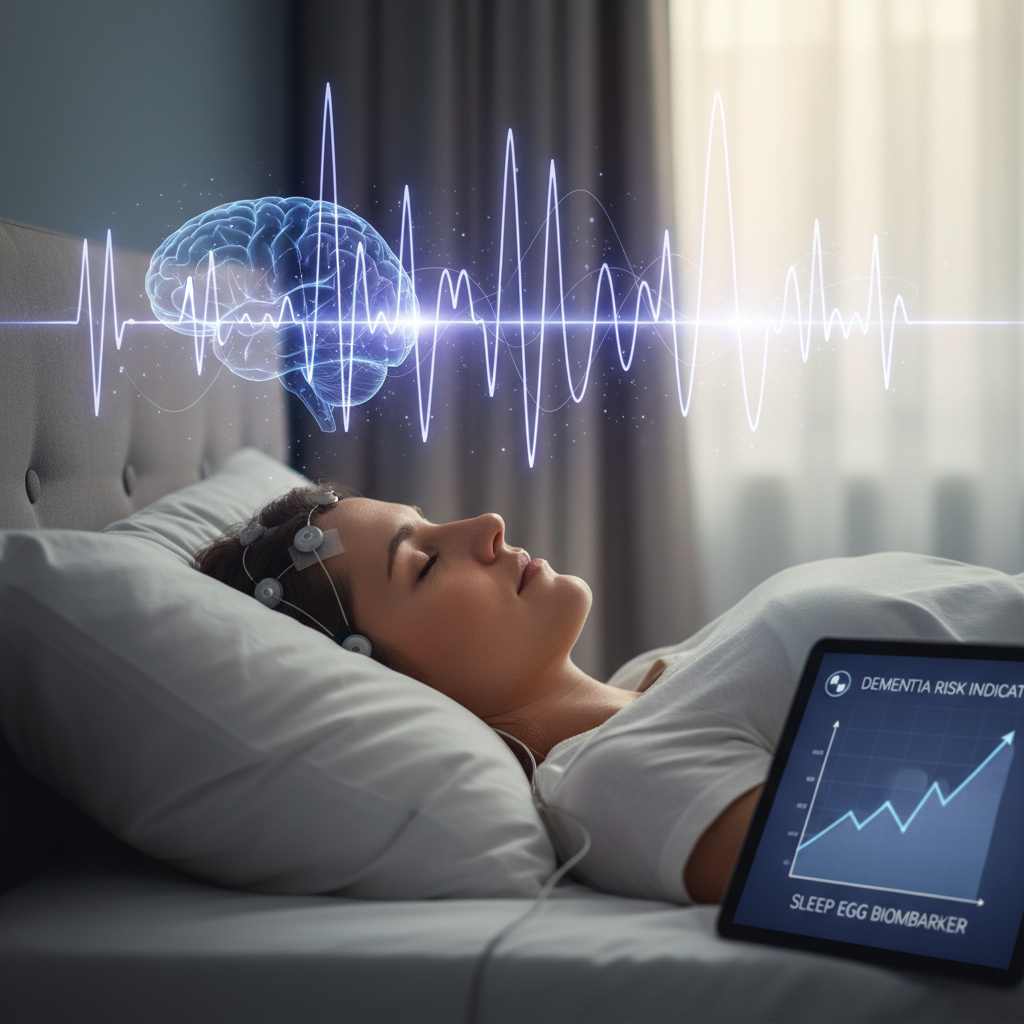
Subtle sleep brainwave patterns may offer early clues to dementia risk — but they are not yet a ready-made predictive test
Subtle sleep brainwave patterns may offer early clues to dementia risk — but they are not yet a ready-made predictive test
For a long time, sleep was mostly viewed as a consequence of brain health: when the brain begins to fail, sleep tends to worsen. That idea still holds. But newer research is pointing towards something more interesting. Sleep may not simply reflect neurodegeneration after it has begun. It may also contain early, measurable signals that something is changing in the brain before dementia becomes clinically obvious.
That is what makes sleep EEG so compelling. By recording the brain’s electrical activity overnight, it can detect subtle patterns across different sleep stages — especially slow-wave sleep, REM sleep and possibly features such as sleep spindles. Those signals are increasingly being studied as potential biomarkers of Alzheimer’s disease and, by extension, as clues to elevated dementia risk.
The idea is biologically plausible and clinically attractive. But the most careful reading of the supplied evidence still calls for restraint: the literature supports association with Alzheimer’s disease more strongly than it supports fully validated prospective risk prediction.
Why sleep is such an appealing place to look
Sleep is not a single state. It is a structured biological process with distinct stages, each linked to different brain functions. Slow-wave sleep is thought to be especially important for restoration and memory consolidation. REM sleep is tied to complex cognitive and emotional processes. The brain also generates characteristic electrical patterns during sleep, including shifts in frequency and brief bursts such as sleep spindles.
That matters because changes in these patterns may reflect deeper changes in brain health. If certain aspects of sleep architecture begin to erode, researchers suspect they may be signalling more than ordinary poor sleep. They may be revealing early signs of disease-related change.
In Alzheimer’s disease, that possibility is particularly compelling because sleep disruption is so common and often precedes obvious cognitive decline. The challenge is sorting out whether those sleep changes are merely consequences of disease, active participants in disease biology, or useful early markers of risk.
What the evidence actually supports
The strongest evidence provided is a systematic review and meta-analysis showing that Alzheimer’s disease is associated with a recognisably altered sleep profile. Compared with controls, people with Alzheimer’s had reduced total sleep time, lower sleep efficiency, less slow-wave sleep and less REM sleep, along with more time awake and longer sleep latency.
That is important for two reasons. First, it suggests Alzheimer’s is linked to specific and measurable changes in sleep architecture, not simply to vague complaints of poor sleep. Second, the same meta-analysis found that lower slow-wave sleep and REM sleep were associated with more severe cognitive impairment, which strengthens the case that these features may have clinical relevance.
The review also notes that alterations in EEG frequency components and sleep spindles may hold biomarker potential, although the evidence there remains more limited.
Taken together, the supplied literature supports the idea that subtle sleep EEG patterns could plausibly help identify early disease-related change or elevated dementia risk.
But association is not the same as prediction
This is the central caution.
Showing that people with Alzheimer’s tend to have altered sleep is not the same as showing that a sleep EEG can accurately predict who will go on to develop dementia. Those are related but very different claims.
The supplied studies are stronger on the association side. They suggest that sleep architecture and sleep-related brainwave patterns shift in Alzheimer’s disease and may track with cognitive severity. What they do not establish is the practical predictive performance of specific EEG markers in real-world screening or early risk stratification.
That means key questions remain unanswered. How sensitive would such a marker be? How specific? Would it distinguish Alzheimer’s risk from normal ageing, depression, sleep apnoea or other neurological conditions? Would it add something meaningful beyond existing biomarkers or clinical assessments?
The current evidence does not yet settle those questions.
Why sleep EEG still has real biomarker appeal
Even with those limitations, sleep EEG remains an attractive candidate in the broader biomarker landscape.
For one thing, it is non-invasive. Unlike more invasive biomarker approaches, it does not require spinal fluid sampling. It also offers something distinctive: a direct readout of brain activity during a highly organised physiological state. That makes it conceptually different from both structural imaging and subjective sleep reports.
It is also plausible that sleep-based measures could reveal change at a relatively early stage. If subtle shifts in slow-wave sleep, REM sleep or spindle activity emerge before overt dementia, they might eventually help identify people who need closer follow-up, further biomarker work-up or inclusion in prevention trials.
That is the promise. But it remains a promise in development rather than a fully realised clinical tool.
The biology helps explain the excitement
Part of the reason this area has generated so much attention is that the biology makes sense. Slow-wave sleep and REM sleep are involved in processes linked to memory, synaptic plasticity and broader brain maintenance. Disturbances in those stages could therefore be more than a side effect of disease. They might reflect mechanisms that interact with neurodegeneration itself.
That does not mean the direction of cause is simple. Sleep disruption may contribute to brain vulnerability, result from underlying disease, or both. But either way, sleep becomes more than a symptom. It becomes a potentially informative signal.
Still, not every reference supplied supports the main clinical claim equally well. One of the cited papers concerns hippocampal sharp wave-ripple activity and is largely mechanistic rather than a direct clinical study of sleep EEG as a dementia-risk tool in humans. Another focuses on Creutzfeldt-Jakob disease, which is not directly relevant to broader dementia-risk prediction in ageing populations.
That mismatch reinforces the need not to overstate how validated the sleep EEG story currently is.
The risk of overselling a “sleep test for dementia”
This is exactly the kind of topic that can be exaggerated easily. The idea of predicting dementia risk while someone sleeps is elegant, intuitive and technologically appealing. But that is also why it needs discipline.
It would be too strong to suggest that clinicians already have a routine sleep EEG tool that can meaningfully predict dementia risk for the average older adult. The supplied evidence does not provide sensitivity, specificity, clear thresholds or real-world screening performance for particular EEG markers.
It also does not show whether these signals are specific enough to be useful outside research settings. Many conditions affect sleep architecture, from psychiatric illness to medication use to other sleep disorders. A clinically useful predictor would need to separate dementia-related signal from all that background noise.
That level of validation is not yet established here.
What this changes right now
The most important shift may not be a new test, but a new way of thinking. Sleep is increasingly being treated not merely as a casualty of brain ageing, but as a source of biological information about it.
That matters now, even before any predictive tool is ready for routine use. It suggests that sleep disturbances in older adults deserve more serious attention, not just because they affect quality of life, but because they may carry clues about broader neurological health.
It also supports continued work on non-invasive biomarker strategies that could one day make early detection less burdensome and more accessible.
The most balanced takeaway
The supplied evidence supports the idea that brain activity patterns during sleep are altered in Alzheimer’s disease and may have biomarker potential. Reduced slow-wave sleep, reduced REM sleep and possibly changes in spindle activity or EEG frequency features all look like plausible signals of early disease-related change.
But it would go too far to say that sleep EEG can already predict dementia risk with the kind of reliability needed for routine clinical use. At this stage, the science is stronger for association with Alzheimer’s disease than for fully validated prediction.
The most accurate reading, then, is both hopeful and restrained: sleep EEG may become a valuable non-invasive window into brain ageing and future dementia risk, but for now it remains a promising biomarker frontier rather than a settled predictive test.