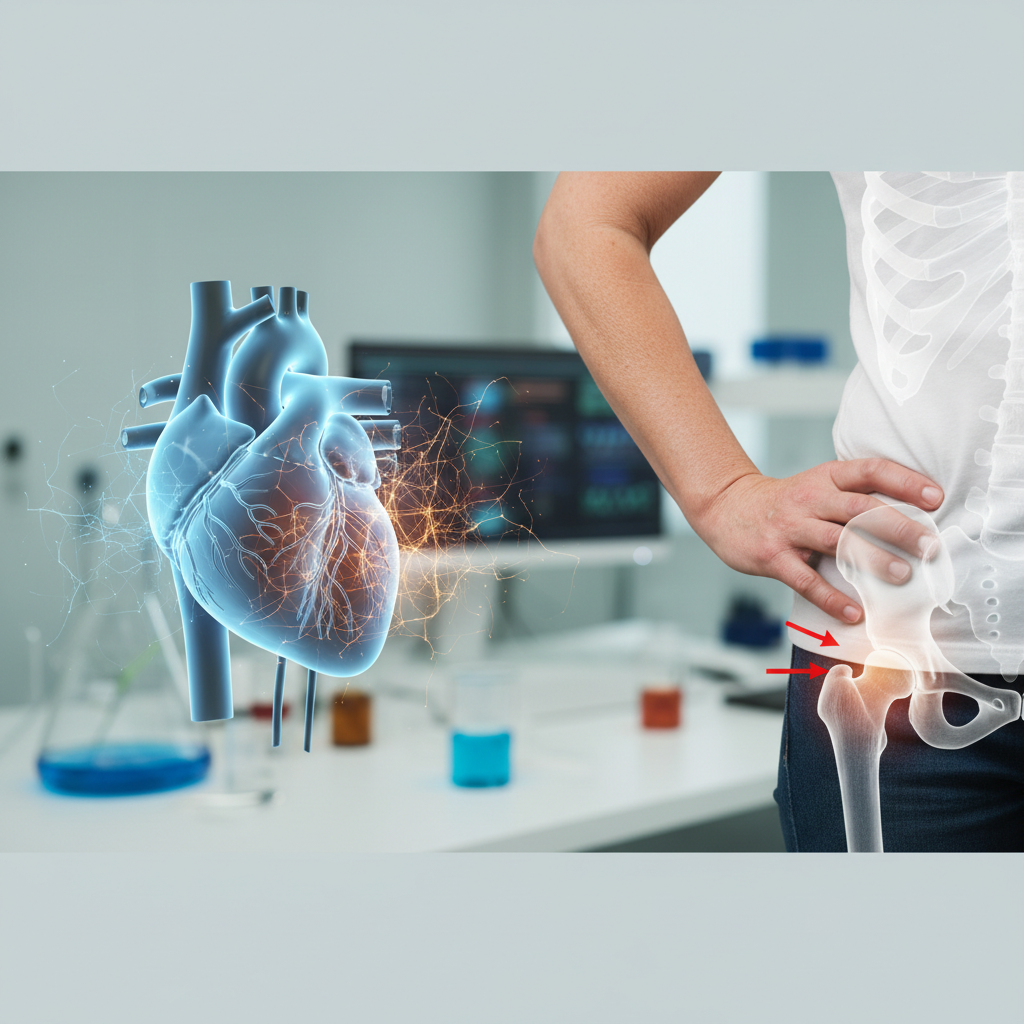
Heart health and fracture risk may be more connected after menopause than they look — but the new metric is not proven yet
Heart health and fracture risk may be more connected after menopause than they look — but the new metric is not proven yet
Menopause is not simply the end of reproductive cycles. It is also the point at which two major health threats begin to rise more sharply at the same time: cardiovascular disease and bone loss leading to osteoporosis and fractures.
At first glance, those problems seem to belong to different medical worlds. One is about blood vessels, blood pressure, cholesterol and events such as heart attack or stroke. The other is about calcium, bone density, falls and skeletal fragility. But that separation is not always as clear as specialist medicine makes it appear. Increasingly, research into postmenopausal health suggests that heart and bone may share risk factors, biological pathways and perhaps some overlapping warning signals.
That is why the idea behind the headline is so intriguing: could a new heart-health metric help identify fracture risk in postmenopausal women? It is not an unreasonable question. But the most careful reading of the supplied evidence is more restrained. There is biological plausibility for an association between cardiovascular health and bone health, yet the available materials do not directly validate a new heart-health score as a reliable fracture-risk tool.
Why heart and bone keep appearing in the same conversation
In clinical practice, cardiovascular disease and osteoporosis have long coexisted in the same population. In postmenopausal women, preventive care often involves attention both to cardiometabolic risk and to bone health.
That is not accidental. Preventive care guidance for postmenopausal women emphasises both cardiovascular risk-factor management and osteoporosis screening. In other words, medicine already treats these as parallel concerns in the same stage of life.
The Women’s Health Initiative reinforces that point historically. It was specifically designed around major postmenopausal outcomes, including cardiovascular disease and osteoporotic fractures. That does not prove one heart-health metric predicts the other outcome, but it does show that these two domains have long been seen as part of the same broader landscape of postmenopausal risk.
The biological link is plausible
One reason this story attracts attention is that heart and bone health share several biological influences.
After menopause, the drop in oestrogen affects multiple tissues at once. It contributes to worsening vascular health and cardiometabolic profiles while also accelerating bone loss. Other factors such as physical inactivity, chronic low-grade inflammation, insulin resistance, smoking and ageing can increase vulnerability in both systems.
Certain endocrine conditions can also affect both cardiovascular outcomes and bone density. The review on subclinical hyperthyroidism included in the references is a useful example. It shows that some systemic conditions can worsen cardiovascular health and skeletal health at the same time.
None of that proves a heart-health score can predict fractures. But it does make the broader association biologically reasonable. A person with poorer cardiovascular health may also be more likely to have a biological context that increases bone fragility.
What the supplied references actually support
The references provided support a general conclusion: cardiovascular risk and fracture risk are overlapping and clinically important concerns in postmenopausal women.
The preventive-care review makes clear that postmenopausal health requires simultaneous attention to cardiovascular prevention and osteoporosis screening. That supports the broader idea that these conditions belong in the same clinical frame.
The Women’s Health Initiative design paper reinforces the same message. Large-scale research in women’s health has long considered cardiovascular disease and osteoporotic fracture as major outcomes of the postmenopausal years.
The review on subclinical hyperthyroidism adds a layer of biological plausibility by showing that some physiological disturbances can affect both cardiovascular health and bone density.
Taken together, that evidence supports the plausibility of an association. It does not directly support the stronger claim that a new cardiovascular health metric can identify fracture risk with clinical reliability.
A plausible association is not the same thing as a useful test
This is the most important distinction.
It is one thing to say that cardiovascular health and bone health are linked by shared pathways. It is another to say that a new heart-health score can be used to reliably identify which women are at risk of fracture.
To support that stronger claim, the evidence would need to show that the metric was directly evaluated as a fracture predictor: how well it discriminates risk, whether it improves on existing fracture-risk tools, whether it adds clinically meaningful information, and whether it changes decisions in practice.
The supplied studies do not do that. None of them directly evaluates a new cardiovascular metric as a fracture-risk predictor. One is a study-design paper rather than an outcomes analysis. Another is a general preventive-care review. The thyroid paper is relevant for plausibility, but not for validating the proposed risk marker.
So any strong claim that a heart-health metric can identify fracture risk would go beyond what these materials actually support.
Why this line of thinking still matters
Even with those limits, the idea is still useful because it pushes medicine towards a more integrated view of postmenopausal health.
For a long time, specialist care tended to treat heart disease and osteoporosis as separate problems. Increasingly, that looks too narrow. Heart, bone, metabolism, muscle and hormones all age together, and they are shaped by some of the same forces.
That means a woman with significant cardiovascular risk may also be someone whose bone health deserves closer attention, particularly if other factors such as low body weight, prior falls, frailty or endocrine issues are also present. Likewise, women being assessed for osteoporosis or fracture may benefit from a broader cardiovascular lens.
That integrated approach does not require a new score to be useful. It is already clinically sensible based on what is known about shared postmenopausal risk.
Prevention is still the strongest practical message
The most useful takeaway here is not that women should undergo a new heart-health test to predict fractures. With the evidence provided, that would be premature.
The stronger practical message is that cardiovascular prevention and fracture prevention should probably be thought about together more often after menopause. Physical activity, smoking cessation, good nutrition, blood pressure and glucose control, fall prevention, bone screening when appropriate, and attention to endocrine and metabolic disorders can support more than one system at the same time.
That is less dramatic than the headline, but probably more helpful in real care.
The most balanced takeaway
The supplied evidence supports the idea that cardiovascular health and bone health share clinical relevance and at least some overlapping biological pathways in postmenopausal women. Hormonal change, inflammation, metabolic disruption and certain systemic conditions make an association between heart-health status and fracture risk plausible.
But it would overstate the evidence to say that a new heart-health metric can reliably identify fracture risk. The materials provided do not directly test or validate that claim.
The best way to read this story is as a reminder that postmenopausal health is deeply interconnected. Heart and bone may be more closely linked than they appear. What remains unproven is whether that link can yet be turned into a dependable new clinical risk score.