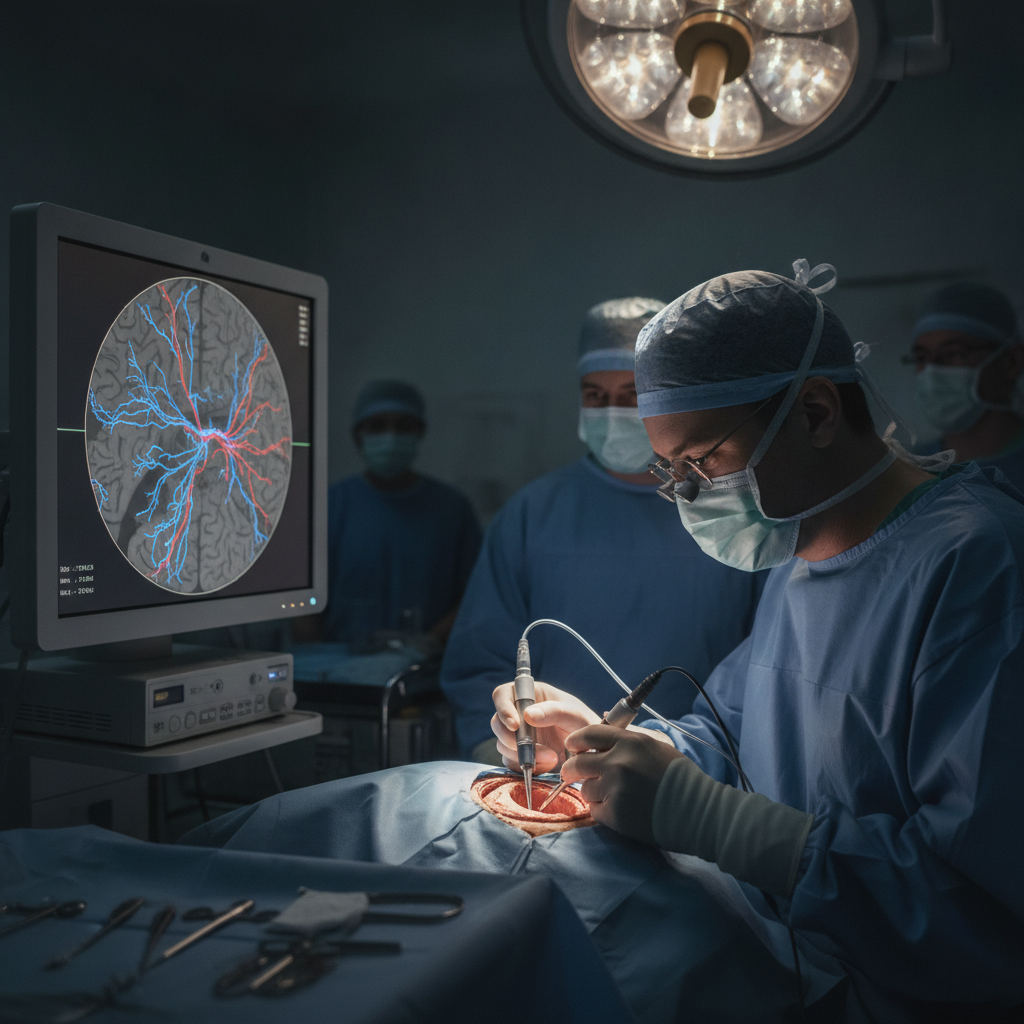
Better monitoring of brain blood flow during surgery may help reduce neurological injury, but the headline’s specific technique is not proven by the supplied studies
Better monitoring of brain blood flow during surgery may help reduce neurological injury, but the headline’s specific technique is not proven by the supplied studies
In neurosurgery and other vascular procedures involving the brain, the greatest danger is not always something sudden and obvious. Sometimes the problem begins quietly: cerebral blood flow drops, oxygen delivery becomes inadequate, or the brain’s own autoregulation fails under physiological stress. If that is not recognised in time, the outcome can be devastating.
That is why any advance that promises to visualise or monitor cerebral blood flow more effectively during surgery attracts so much attention. The clinical logic is powerful: if surgical teams can detect early signs of hypoperfusion or cerebral oxygen shortage, they may be able to intervene before lasting neurological damage occurs.
The safest reading of the supplied evidence is that better monitoring of cerebral perfusion and oxygenation during high-risk procedures may help reduce neurological injury by identifying hypoperfusion earlier. But there is an important boundary to keep in place: the supplied studies do not independently verify the specific headline claim that one “newly discovered view” of brain blood flow is already proven to prevent disability or save lives.
Why brain blood flow matters so much during surgery
The brain depends on a constant and tightly regulated blood supply to maintain its function. Unlike many other tissues, it tolerates interruptions or significant reductions poorly, even if they are relatively brief.
During some operations, that balance can be threatened by several factors:
- blood pressure changes;
- vascular manipulation;
- temporary arterial clamping;
- changes in carbon dioxide and ventilation;
- or failure of cerebral autoregulation.
When perfusion falls below what the brain needs, ischaemic injury can begin. The difficulty is that this is not always immediately obvious from routine clinical signs, especially when the patient is under anaesthesia.
That is exactly why intraoperative monitoring has become such an important area of interest.
What the evidence does support clearly
The supplied references consistently support the general clinical importance of monitoring cerebral perfusion and cerebral oxygenation during high-risk procedures, particularly in neurovascular settings.
Reviews of carotid surgery and aneurysmal subarachnoid haemorrhage management show that maintaining adequate cerebral perfusion is a central challenge in these contexts. That alone supports an important clinical message: during some brain-related or vascular procedures, the brain needs close surveillance so that reduced flow does not go unnoticed.
There is also support for the idea that monitoring cerebral oxygenation and autoregulation may help detect poorly tolerated hypotension or hypoperfusion that could contribute to neurological complications.
That is the strongest foundation in the evidence set.
The physiology makes sense: seeing more may allow earlier action
The appeal of this field comes from straightforward physiological logic. If neurological injury can begin with inadequate perfusion, then methods that allow clinicians to see that process earlier and more clearly may create a window for intervention before the damage becomes established.
In practice, that might mean adjusting:
- blood pressure;
- circulating volume;
- ventilation;
- anaesthetic strategy;
- or even technical decisions during the operation itself.
So the potential value of improved monitoring is not simply in generating interesting data. It is in changing clinical decisions while there is still time to protect the brain.
But the headline goes beyond what the supplied studies prove
This is where the strongest caution belongs.
The supplied PubMed material does not directly identify or validate the specific “newly discovered view” of brain blood flow described in the headline. The cited papers are broad reviews and summaries, not direct trials of a new intraoperative imaging method showing that it clearly reduces disability or mortality.
That distinction matters a great deal.
The studies support the broader principle that cerebral perfusion matters and that better monitoring may be clinically useful. What they do not support with the same strength is the stronger claim that one specific new perspective or monitoring technique has already been shown to save lives or prevent major neurological debilitation in routine practice.
Some of the strongest evidence comes from specific vascular settings
Another important limitation is that some of the clearest examples in the supplied literature come from situations such as:
- carotid surgery;
- aneurysmal subarachnoid haemorrhage;
- and other high-risk neurovascular settings.
Those are highly relevant contexts, but they do not automatically represent all brain surgeries. A monitoring principle that is useful in those settings may not translate with equal strength to every intracranial procedure.
That does not weaken the broader concept of brain protection. It simply means the findings should not be generalised too broadly.
Better monitoring is not the same as proven outcome benefit
In perioperative medicine, there is a crucial difference between two things:
- detecting a physiological problem more effectively;
- proving that this improved detection changes hard clinical outcomes.
The first is easier to demonstrate. The second is much more demanding.
A monitoring tool can identify changes in cerebral oxygenation or perfusion elegantly, but that does not automatically prove that its use reduces stroke, neurological disability, functional decline, or death. To establish that, more direct clinical studies would be needed, ideally comparing strategies and measuring meaningful patient outcomes.
That is the leap suggested by the headline, but not independently confirmed by the supplied evidence.
Why cerebral autoregulation matters here
One of the most important concepts behind this discussion is cerebral autoregulation. Under normal conditions, the brain can adjust vascular tone to keep blood flow relatively stable even when blood pressure changes.
But that system can become impaired or more vulnerable in some patients, including older adults, people with vascular disease, and those undergoing major neurovascular procedures.
That is why autoregulation monitoring is attractive. It may help show that a blood pressure appearing acceptable on paper may not actually be safe for a specific patient’s brain. This is one of the strongest arguments in favour of more individualised monitoring.
What this could mean for the future
Even without validating the headline in full, the supplied evidence points towards an important direction in modern surgery: moving away from relying only on general systemic measures and towards a more personalised approach to brain protection.
If future tools can reliably, continuously, and practically show how well the brain is being perfused during surgery, they may improve intraoperative decision-making. But before such approaches become standard, it will still be necessary to show:
- that the technique is reproducible;
- that it changes management in useful ways;
- that it improves meaningful outcomes;
- and that the benefit applies across different procedures and patient groups.
What clinicians and patients should take from this
For clinicians, the strongest message is that monitoring cerebral perfusion and oxygenation remains an important frontier in reducing neurological risk during high-risk surgery.
For patients, the fairest reading is that medicine increasingly recognises how important it is to protect the brain during surgery, but not every promising monitoring idea has already been proven to prevent major disability or save lives.
The balanced takeaway
The most responsible interpretation of the supplied evidence is that better monitoring of cerebral perfusion during high-risk procedures may help detect hypoperfusion earlier and, in principle, reduce neurological injury.
The cited reviews strongly support the clinical importance of maintaining adequate cerebral blood flow and oxygenation in neurovascular settings, and they reinforce the rationale for using cerebral oxygenation and autoregulation monitoring to detect poorly tolerated physiological stress.
But the limits need to remain explicit: the supplied references do not directly validate the specific “newly discovered view” of brain blood flow described in the headline, they are not direct trials of a new intraoperative imaging technique, and they do not independently prove that one specific method already prevents disability or saves lives. Much of the evidence also comes from particular vascular contexts, which may not generalise to all brain surgery.
Even so, the broader direction is sensible. In brain and neurovascular surgery, being able to recognise when the brain is becoming underperfused may be one of the keys to acting before injury becomes permanent. For now, the real promise lies less in a single proven technique and more in a principle that is becoming increasingly clear: if the goal is to protect the brain better, it may need to be monitored more precisely.