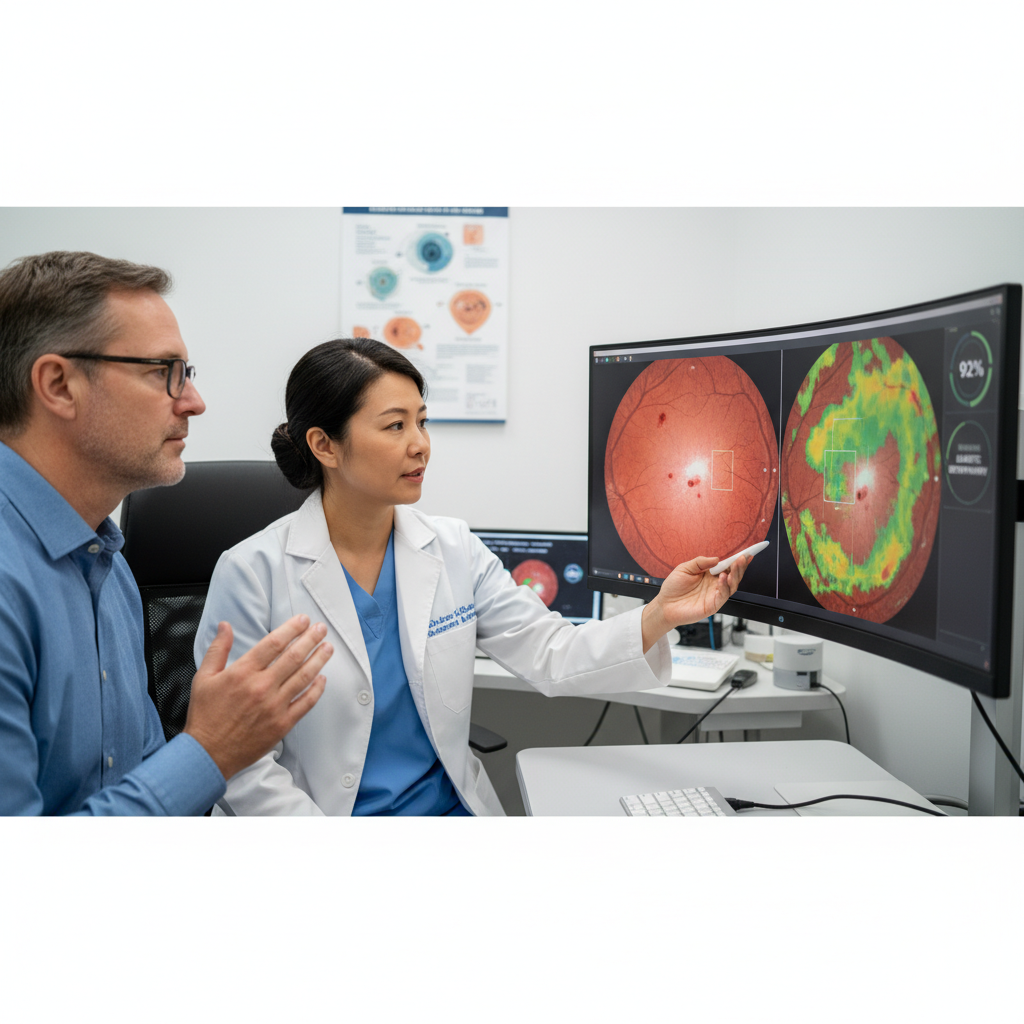
AI may help eye doctors detect retinal disease faster, but it does not replace the specialist
AI may help eye doctors detect retinal disease faster, but it does not replace the specialist
Few areas of medicine look as naturally suited to artificial intelligence as ophthalmology. Much of the work depends on images: retinal fundus photographs, optical coherence tomography (OCT), and other scans that turn the back of the eye into a detailed visual dataset.
That is exactly why AI has gained so much traction here. When diagnosis depends on recurring visual patterns, but must be delivered at scale, quickly, and consistently, well-trained systems can become useful partners.
The safest reading of the supplied evidence is that AI tools have already shown high accuracy for identifying some major retinal diseases, especially diabetic retinopathy, and may help eye doctors speed up screening, triage, and diagnostic workflow. But the core message is not that AI will replace ophthalmologists. The stronger claim is that it may support screening, case prioritisation, and clinical efficiency.
AI is most attractive where demand is high and specialists are scarce
The retina is one of the few tissues in the body that can be photographed relatively easily and non-invasively. That gives ophthalmology two ideal ingredients for AI-assisted analysis:
- large volumes of standardised images;
- and a strong need to detect disease early, before vision loss becomes obvious.
That combination matters especially in population screening programmes. Diseases such as diabetic retinopathy require large-scale monitoring, but specialist capacity is often limited.
That is where AI becomes especially appealing: not necessarily to make every final diagnosis on its own, but to filter, flag, and prioritise the cases that need faster specialist review.
The strongest case is still diabetic retinopathy
Within the supplied evidence, the most direct and convincing support is concentrated on diabetic retinopathy.
Deep-learning systems have already shown high sensitivity and specificity for detecting referable diabetic retinopathy from retinal fundus photographs. That is important because the clinical usefulness of a screening tool depends heavily on whether it can reliably pick out the patients who need specialist attention.
In practical terms, that could mean fewer high-risk patients missed in long queues and less specialist time spent reviewing clearly normal images in already overburdened systems.
Good diagnosis is not only about accuracy — it is also about timing
When AI in medicine is discussed, much of the focus goes to accuracy. And accuracy matters. But in retinal disease, speed matters too.
A great deal of avoidable vision loss happens not because medicine lacks knowledge, but because diagnosis and referral happen too late. If AI can help detect important findings earlier across large image volumes, it may improve when patients enter the right care pathway.
That may be the most meaningful promise here: not only spotting disease correctly, but shortening the path between image, suspicion, and clinical action.
The potential goes beyond diabetes, but with less direct certainty
The review literature in the supplied set supports a broader picture in which AI also shows promise in other retinal diseases, including age-related macular degeneration, as well as in imaging workflows involving OCT and fundus photography.
That suggests ophthalmology may be moving towards a model where algorithms assist across multiple retinal conditions, not just one.
But caution matters here. The strongest direct evidence in the supplied set still centres on diabetic retinopathy. So it would be too broad to assume the same level of confidence applies across all retinal diseases.
The safer conclusion is that AI looks especially mature for certain well-defined uses and promising, but not equally proven, in others.
Where the technology could matter most
The clearest near-term value of AI in retinal care appears in settings such as:
- large-scale screening;
- early detection in areas with limited specialist access;
- prioritisation of suspicious scans;
- and support for more efficient clinical workflow.
That is especially relevant in health systems dealing with long waits and uneven specialist distribution.
In places where there are too few ophthalmologists for the volume of need, an automated system that can sort normal images from concerning ones and elevate urgent cases could provide a genuine efficiency gain.
High accuracy alone does not solve everything
Even with strong technical performance, an important limitation remains: many studies show that AI can diagnose accurately in research or validation settings, but that does not automatically prove faster real-world workflow or better long-term outcomes in every clinical environment.
Between strong technical performance and better patient care lies a practical chain that includes:
- workflow integration;
- staff training;
- adequate image quality;
- clinical oversight;
- and clear protocols for what happens after an AI result.
In other words, having a strong algorithm is not enough. It has to be placed inside a system that knows how to use it properly.
Image quality, bias, and real-world variation still matter
Another key issue is that AI performance can vary depending on:
- image quality;
- disease prevalence;
- dataset diversity;
- and the validation environment.
That means a system that performs well in one dataset may perform less well in another, especially if it encounters different populations or poorer-quality images.
There is also the risk of bias, weaker performance in underrepresented groups, and failure in atypical cases. That is why any serious clinical use still requires external validation, monitoring, and physician oversight.
Ophthalmologists are not being replaced
This is probably the most important point to keep straight. The supplied evidence does not support the idea that AI replaces ophthalmologists.
What it does support is something more useful and more realistic: AI may help specialists work more effectively. It can act as an initial screening layer, a diagnostic support tool, and a way to prioritise demand in high-volume settings.
But clinical context still determines what a finding means, whether more tests are needed, how urgent the case is, and what treatment plan makes sense.
In medicine, especially real-world medicine, recognising a visual pattern is only part of the job.
What this means for patients
For patients, the potential impact is fairly concrete. If these systems are well implemented, they could mean:
- faster diagnosis;
- less delay in referral;
- a better chance of catching disease before vision is lost;
- and broader access to screening, especially where specialists are harder to reach.
In quiet diseases such as early diabetic retinopathy, that matters a great deal. Patients often do not notice symptoms until damage is already underway.
If AI helps find those cases sooner, its value will be less futuristic than it sounds and more practical than many assume.
The balanced takeaway
The most responsible interpretation of the supplied evidence is that AI can improve the speed and efficiency of diagnosing and screening for some retinal diseases, especially diabetic retinopathy, by analysing images accurately and supporting triage, referral, and clinical workflow.
The data strongly support the use of deep-learning systems for detecting referable diabetic retinopathy in retinal fundus photographs. Broader ophthalmology reviews also support promising applications in other retinal conditions and in imaging tools such as OCT. That makes ophthalmology one of the strongest clinical areas for practical AI integration.
But the limits must stay clear: the strongest evidence is still concentrated on diabetic retinopathy, high accuracy does not automatically guarantee better outcomes in every setting, and AI should be understood as support for screening and workflow rather than a replacement for ophthalmologists.
Even so, the direction is meaningful. When the challenge is reviewing thousands of retinal images, finding the patients who need attention earliest, and doing so with less delay, AI may become one of the most useful tools in modern eye care.