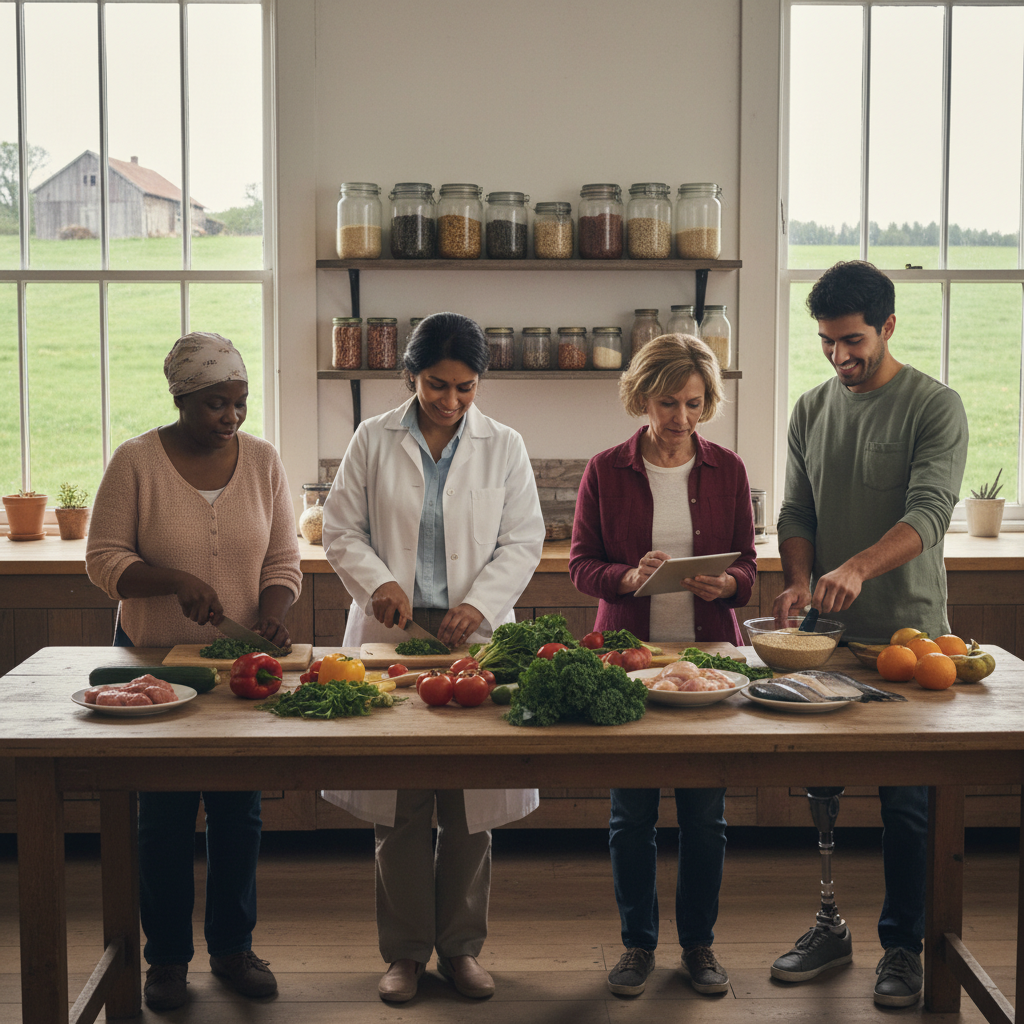
A food literacy programme may help rural, uninsured patients manage diabetes better — but its impact still needs caution
A food literacy programme may help rural, uninsured patients manage diabetes better — but its impact still needs caution
Diabetes is often framed as a strictly clinical problem: high blood sugar, HbA1c levels, medication, cardiovascular complications, kidney disease, neuropathy. All of that is real and important. But in daily life, diabetes control also depends on a long series of repeated decisions — what to eat, how much to spend, where to shop, how to cook, how to fit nutrition advice into work schedules, transport limits, family routines, and uneven access to care.
That is why the idea behind food literacy for diabetes is so compelling. Rather than relying only on general advice, it suggests teaching people practical skills that help them interpret food choices, plan meals, make realistic decisions, and turn nutrition recommendations into something usable in daily life.
The headline goes further and says that a programme of this kind helped rural, uninsured patients develop healthier eating skills. That is a plausible and socially important story. But the most responsible reading has to begin with one major limitation: no PubMed papers were supplied to independently verify the design of the programme, the outcomes measured, or the strength of the results.
Why food literacy makes sense in diabetes care
Diabetes is a condition in which self-management matters enormously. Unlike one-off treatments, it depends on everyday decisions. Those include understanding carbohydrates, portion size, meal timing, food quality, how eating interacts with medication, and even the basics of shopping and meal preparation.
That is where food literacy can be useful. It goes beyond simply receiving nutrition information. It includes practical capacities such as:
- understanding food labels and ingredients;
- recognising ultra-processed products;
- planning meals on a limited budget;
- adapting nutrition advice to local food culture;
- cooking in realistic ways;
- and making more informed choices in difficult food environments.
On paper, that makes a great deal of sense for diabetes. A person can be told for years to “eat better” without ever being given the tools to do so within the actual constraints of their life.
Why this matters even more in rural and uninsured populations
The headline also highlights a group for whom this kind of programme may be especially relevant: people who are rural and uninsured.
That matters because diabetes does not happen in a social vacuum. In many rural settings, there may be less continuous care, fewer dietitians, longer travel distances to clinics, fewer shopping options, and less reliable access to fresh foods at affordable prices.
When someone is also uninsured, the problem becomes even harder. The cost of care competes directly with the cost of food. Appointments, tests, medication, and transport all take space in the household budget. In that context, telling patients simply to “follow a healthy diet” without practical support may be unrealistic.
This is why food literacy matters as a health-equity issue. It starts from the idea that applied knowledge and practical food skills may be just as important as formal medical advice, especially when the health system does not provide stable nutrition support.
What it might actually mean that the programme “helped”
Without the underlying study, it is impossible to know exactly what “helped” means here.
That is not a small detail. The benefit could have been measured at very different levels, such as:
- improved nutrition knowledge;
- increased confidence in making food decisions;
- better shopping or cooking skills;
- short-term behaviour change;
- or, in a stronger scenario, better clinical outcomes such as glucose control or HbA1c.
Those are not equivalent. Knowledge gains can be useful, but they do not automatically mean better health outcomes. By contrast, measurable improvement in glycaemic control would carry a much stronger clinical implication.
Because no scientific paper was provided, it is not possible to know where on that spectrum this programme actually had an effect.
The gap between learning and being able to change
Even when educational programmes work well, another issue remains: learning a skill is not the same as being able to act on it consistently.
That difference is especially important in diabetes. A patient may learn perfectly well:
- how to build a more balanced plate;
- how to reduce sugary drinks;
- how to read labels;
- how to spread carbohydrates across the day.
And still run into barriers such as:
- food insecurity;
- the cost of fresh food;
- lack of transport;
- limited healthy food availability nearby;
- unstable work schedules;
- inadequate cooking space or equipment;
- or poor continuity of medical care.
So while food literacy programmes may be valuable, they do not solve the structural barriers that make diabetes self-management difficult.
The strongest part of the story: practical skills do matter
Even with those limitations, the headline does highlight something that diabetes care often underestimates: knowing what to do in daily life matters as much as understanding the disease itself.
Many health-education efforts fail because they stay at the level of generic instruction. They tell people to cut sugar, choose whole foods, avoid ultra-processed products, and watch portions. All of that is correct. But it can still feel remote if patients are never shown how to translate those ideas into grocery shopping, batch cooking, packed lunches, or feeding a family on a tight budget.
Programmes built around food literacy appear to be trying to fill that gap between advice and action. That alone is a meaningful shift in emphasis: away from nutrition as abstract rules and towards nutrition as lived practice.
What should not be overstated
Because the evidence provided here is weak, several stronger claims should be avoided.
The first is that this particular programme has been proven to improve glycaemic control. It may have, but that cannot be confirmed from the material supplied.
The second is that a food-skills intervention, on its own, solves the inequities faced by rural and uninsured patients. It does not. At best, it may relieve one important part of the burden.
The third is that one programme should be presented as an already validated, scalable solution for underserved populations more broadly. Without data on durability, adherence, cost, and clinical outcomes, that would go too far.
What this story adds to the diabetes conversation
Even with those caveats, the story adds something useful to public discussion. Diabetes care cannot be understood only as medication access. It also depends on practical food and nutrition skills, food environments, and social conditions that make self-management possible or impossible.
That is especially relevant in vulnerable populations. In rural and uninsured communities, the problem is often not simply “lack of information”. It is the combination of limited information, weak support, and difficult material conditions.
A well-designed food literacy programme could serve as a bridge between nutrition advice and everyday autonomy. What remains unknown, based on the evidence supplied here, is how strong that bridge really is.
Why the idea still matters even without strong verification
In public health, not every important intervention begins with a large definitive trial. Some ideas matter because they respond to obvious real-world needs. And it is difficult to deny that many people with diabetes need practical help learning how to eat better under the conditions they actually live in, not the ideal conditions imagined in clinical advice.
In that sense, the story matters because it shifts the conversation away from “the patient is not following the diet” and towards a more useful question: was the patient ever truly given the practical tools to make dietary advice workable?
That is an important reframing, especially for populations that are consistently underserved.
The most balanced conclusion
The most responsible interpretation is this: food literacy programmes for diabetes are a plausible and potentially useful way to strengthen self-management, especially among rural and uninsured patients facing added barriers of cost, access, and continuity of care.
But the evidence available here is weak. No scientific papers were provided for independent verification, so it is not possible to assess the programme’s design, what outcomes were measured, how large the benefits were, or how long they lasted. It is also unclear whether the effects were limited to knowledge and skills or extended to stronger clinical outcomes.
So the safest conclusion is that this story should be read as a promising idea in diabetes self-management and health equity, not as proof that one specific programme has already demonstrated broad and durable clinical benefit. The clearest value of the idea is in recognising that, for many patients, eating better is not just a matter of willpower — it is a matter of practical support, social context, and real access to the conditions that make change possible.