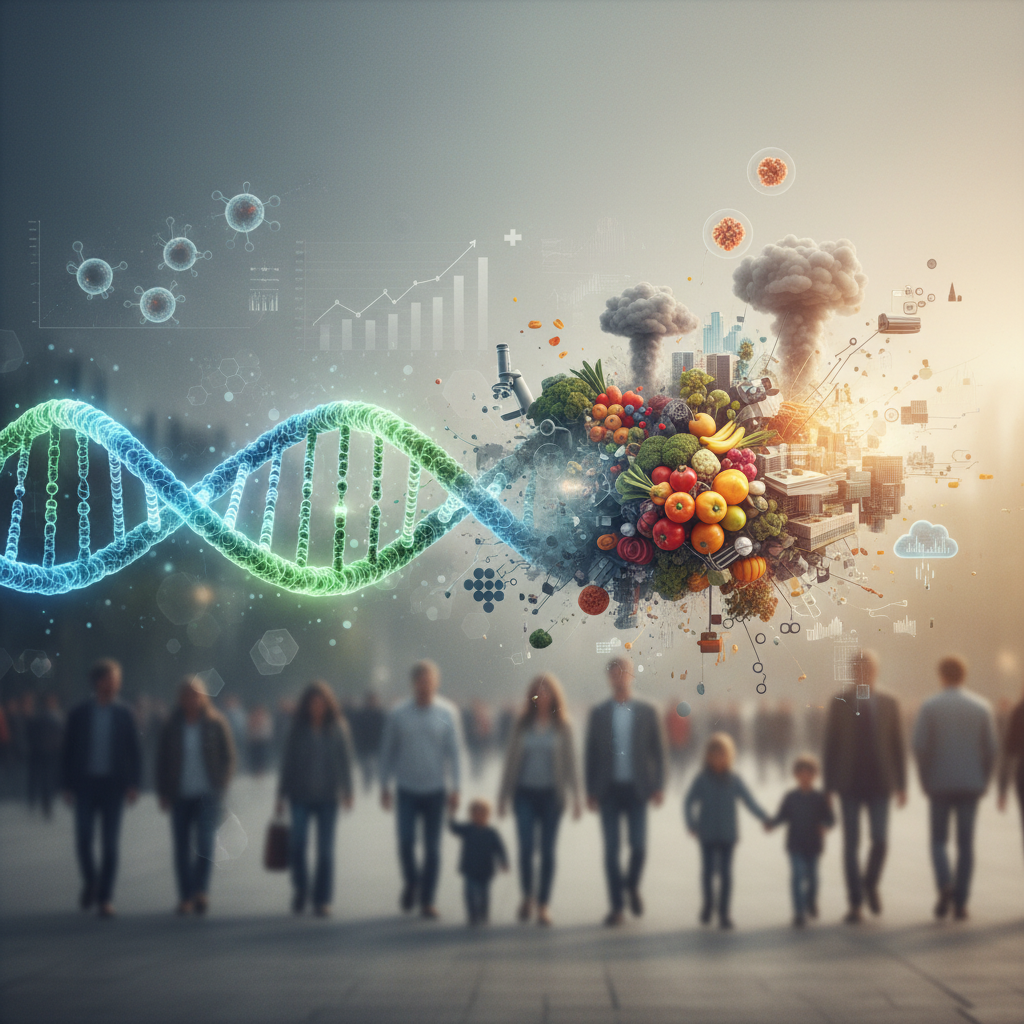
Your Health Is Not Written in DNA Alone: Why the Exposome Is Changing How We Think About Disease Risk
Your Health Is Not Written in DNA Alone: Why the Exposome Is Changing How We Think About Disease Risk
For years, precision medicine was presented largely as a story about DNA.
The promise was compelling: decode a person’s genes, identify vulnerability, and predict disease before it appears. That story still matters. Genes clearly influence biological susceptibility, treatment response and risk for many conditions. But they have never told the whole story.
A growing body of research is pushing medicine towards a broader and more realistic view: health outcomes are shaped not only by inherited biology, but also by the exposures a person accumulates across a lifetime. Air pollution, tobacco smoke, diet, stress, work conditions, infections, social context, obesity, prenatal environment and neighbourhood all become part of the risk picture.
That wider collection of influences is increasingly described as the exposome — the sum of environmental and lifestyle exposures that interact with the body over time.
The supplied evidence does not directly prove the strongest version of the headline claim — that combined environmental exposures rival genetics across broad health outcomes in a comparative way. But it does support a major underlying idea: many diseases are shaped by the interaction between biological susceptibility and lived environment, not by genetics alone.
The old “genes versus environment” argument no longer works well
For a long time, health discussions often fell into a familiar binary: a disease was either genetic or environmental.
That division now looks increasingly unhelpful.
In many cases, genes appear to set a level of susceptibility, while the environment helps determine whether, when and how that susceptibility turns into disease. That does not weaken the role of genetics. It puts genetics into a more realistic framework.
Modern research on complex disease keeps pointing in the same direction. Risk rarely comes from one isolated cause. It tends to emerge from layers of influence that overlap, reinforce one another, or interact in ways that are difficult to separate neatly.
That matters not only for science, but also for prevention. If illness arises from this kind of layered biology, then reducing risk cannot depend solely on identifying inherited predisposition. It also means understanding the environments people move through every day.
Cancer already shows how mixed risk can be
One of the supplied reviews, on nasopharyngeal carcinoma, illustrates this particularly clearly.
In that disease, risk does not seem to arise from genes alone, nor from exposure alone. It reflects an interplay among genetic susceptibility, environmental exposures and viral infection. That makes it a useful example of how modern disease biology often works.
What matters is not one factor in isolation, but the way multiple influences converge.
This helps explain something people often see in real life: two individuals can face similar environmental conditions and have very different health outcomes, while two people with comparable biological vulnerability may still follow very different paths depending on what they encounter over time.
Asthma may be one of the clearest examples of gene-environment interaction
The supplied asthma review describes the condition as a strong example of gene-environment interaction, with air pollution, tobacco smoke, occupational exposures, obesity, stress and atopy all contributing to risk in genetically susceptible people.
This is essentially the exposome in action.
Asthma does not usually arise from one single trigger. It often reflects the combined effect of repeated exposures acting on a body already inclined towards airway disease. That means understanding risk requires more than family history or symptom patterns. It also means looking at what a person breathes, where they work, how they live, and what sorts of stressors surround them.
For the UK, this matters in very practical ways. Urban air quality, damp housing, occupational hazards, smoking exposure and social inequality all become part of the health conversation. The exposome framework suggests these are not peripheral details. They may be central to disease risk.
Neurodevelopment fits this picture too
Another supplied review, on autism epidemiology, also supports a combined model of health risk. It describes roles for rare mutations, polygenic risk, epigenetics and possible prenatal environmental exposures.
This is a particularly sensitive area because public discussions of autism often collapse into extremes: either everything is framed as genetic, or there is a rush to blame one environmental factor. The literature instead points towards a much more complex picture.
Neurodevelopment appears to arise through multiple layers of influence, some inherited and some linked to the prenatal or early-life environment. That does not support simplistic conclusions, but it does reinforce the larger point that health outcomes are often shaped by interaction rather than by one dominant cause.
What the exposome changes about prevention
Perhaps the most important contribution of this perspective is not simply that it explains disease differently, but that it changes how prevention is imagined.
If risk emerges from the combination of biology and accumulated exposures, then prevention is not just about finding people with the “wrong” genes. It is also about changing the conditions that push vulnerable biology towards disease.
That means cleaner air, less tobacco exposure, safer work environments, healthier food systems, lower toxic stress, better prenatal care, and communities that are less structurally harmful to health.
In that sense, the exposome may help bridge precision medicine and public health.
Instead of treating prevention as a choice between personalised medicine and population-level intervention, it suggests the two belong together. A sophisticated understanding of health risk should include both inherited susceptibility and lived environment.
Why this idea is so powerful
There is something genuinely transformative about this shift.
For years, genetics had the advantage of scientific neatness. DNA is comparatively stable. It can be measured with precision. Environmental exposure is much messier. It changes over time, overlaps with other exposures, and can be difficult to quantify consistently.
The exposome challenges medicine to deal with that mess rather than ignore it.
And that matters, because the mess is where real life happens. People do not live in controlled laboratory conditions. They live in homes, cities, workplaces, traffic, poverty, stress, heat, smoke, food environments and social systems. If medicine wants to explain why health outcomes differ, those lived conditions cannot be treated as secondary.
The big limitation: environment is much harder to measure than genes
There is also a reason this field remains difficult.
The supplied PubMed evidence does not directly study the exposome in a large comparative framework. None of the referenced papers quantifies whether combined environmental exposures truly rival genetics across broad human health outcomes. Instead, they come from disease-specific reviews showing that environmental and genetic influences often interact.
That is a meaningful distinction.
Exposome research is methodologically challenging because exposures are numerous, correlated, time-varying and often poorly measured. Some matter only during specific life stages. Some interact with one another. Some leave lasting biological marks, while others do not.
So while the concept is powerful, any sweeping claim that environmental exposures have been proven to match genetics across all health outcomes would overstate the evidence provided here.
Even so, the direction of science is difficult to ignore
Despite those limitations, the broader direction is increasingly clear.
Common diseases are unlikely to be explained by genes alone. The future of risk prediction will probably need to integrate genetics, biology, environmental exposure, behaviour and social context more effectively than current models do.
That could lead to a more useful kind of precision prevention. Instead of asking only, “What genes put this person at risk?”, medicine may increasingly ask, “What combination of exposures is pushing this person towards illness?”
That shift matters because it makes prevention less fatalistic. Genes are not destiny in any simple sense. And environment is not background scenery. Between the two lies a large space where risk may still be modified.
What this means for everyday health
For most people, this perspective offers a message that is less glamorous than the promise of a perfect genetic forecast, but probably more useful.
It says health is built over time. The air you breathe, the work you do, the stress you carry, the food available to you, the neighbourhood you live in, and the conditions surrounding pregnancy and childhood all matter. Not as vague social context, but as part of the biology of disease itself.
It also pushes back against one of the more discouraging myths in health: that a genetic predisposition means very little can be done. In many cases, what happens between predisposition and disease remains highly modifiable.
The most balanced conclusion
The supplied studies do not directly prove that the exposome rivals genetics across all human health outcomes, nor do they test that headline claim in a broad comparative analysis. But they do support something essential: many diseases are shaped by the interaction of biological susceptibility and accumulated environmental exposure across the life course.
Cancer, asthma and autism each illustrate that risk often comes from layered influence rather than a single cause. That reinforces the value of a broader view of prevention — one in which genes still matter deeply, but no longer monopolise the explanation.
In the end, the exposome does not reduce the importance of genetics. It simply reminds us of a more basic truth: health is not written in DNA alone. It is also written in air, work, food, stress, infection and the environments in which life unfolds.