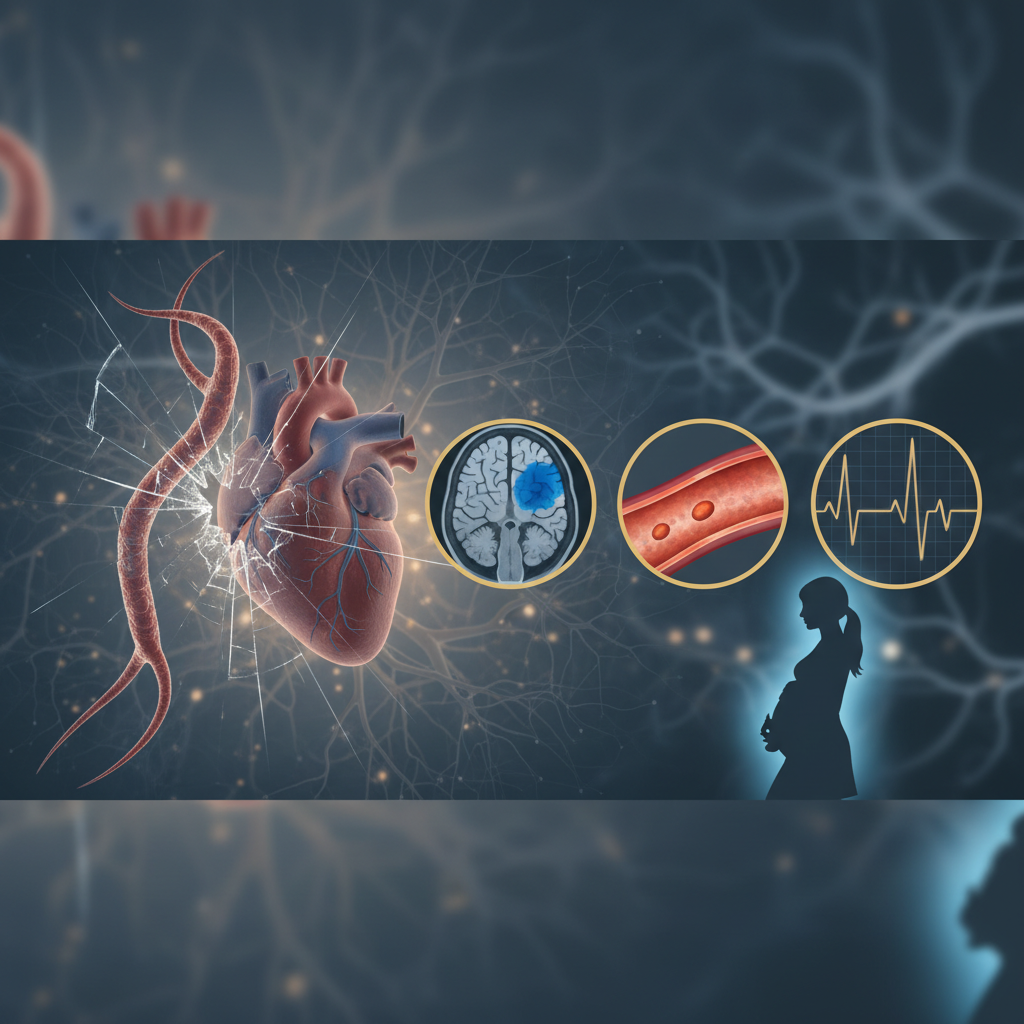
Syphilis is rising again and can lead to stroke, hearing loss, and devastating pregnancy harms — but the supplied evidence does not confirm a broad heart-attack risk
Syphilis is rising again and can lead to stroke, hearing loss, and devastating pregnancy harms — but the supplied evidence does not confirm a broad heart-attack risk
For a while, syphilis seemed like the kind of disease that belonged more to medical history than to current public-health anxiety. That is no longer true. Cases have been rising again, reviving concern about an infection that never disappeared, but was often mentally filed away as old, treatable, and less urgent than newer health threats.
That shift matters because syphilis is not simply a sexually transmitted infection that causes a sore and then goes away with antibiotics. When it is missed or untreated, it can become a systemic disease with consequences that reach far beyond the initial infection. It can affect the nervous system, damage hearing and vision, complicate pregnancy, and in some settings lead to serious neurologic events, including stroke.
This is the context behind a headline linking syphilis to stroke, heart attack, and other serious problems. The broader warning is justified: syphilis can cause severe harm. But the most responsible reading of the supplied evidence requires a careful distinction between what is strongly supported and what is not directly demonstrated.
The references supplied clearly support three messages:
- syphilis incidence has been rising;
- untreated infection can lead to major complications, including neurosyphilis with stroke;
- and syphilis in pregnancy remains associated with devastating outcomes, including stillbirth and infant death.
What the references do not directly establish is the headline’s broader suggestion that routine syphilis infection is linked to a general increase in heart-attack risk.
The return of an infection many people assumed was under control
Syphilis, caused by Treponema pallidum, remains a very real public-health concern. Rising case numbers matter not only because they point to ongoing transmission, but because they suggest gaps in prevention, testing, follow-up, and access to care.
Part of the problem is that early syphilis may not look dramatic. Initial lesions can be painless, may go unnoticed, and can disappear even without treatment. That makes the infection deceptively easy to underestimate.
But disappearance of early symptoms is not the same as cure. When diagnosis is delayed, the infection can progress quietly, and its later effects may appear in ways that are much harder to immediately link back to the original sexually transmitted infection.
That ability to hide in plain sight is one reason the rise in syphilis matters so much. More transmission means more missed or delayed diagnoses, and that means more opportunity for serious complications to emerge.
The strongest evidence here: neurosyphilis and stroke
Among the supplied references, the most clinically relevant point is the finding that neurosyphilis can occur at any stage of infection. That is important because older public assumptions sometimes treat neurosyphilis as a rare, very late-stage complication.
The recent clinical review supplied here emphasises that neurosyphilis can present with:
- meningitis;
- uveitis and other visual problems;
- hearing loss;
- and stroke.
That is not a trivial list. When syphilis involves the central nervous system, it can produce inflammation and vascular injury that lead to cerebrovascular events. In practice, that means syphilis can sometimes sit behind a stroke presentation, including in people who were not initially being assessed for a sexually transmitted infection.
This is where the headline has its strongest footing. A connection between syphilis and serious neurologic complications, especially stroke through neurosyphilis, is much better supported by the supplied evidence than a general claim about broad cardiovascular risk.
Syphilis remains especially dangerous in pregnancy
Another major point strongly supported by the evidence is the harm syphilis can cause in pregnancy. This may be one of the clearest reminders that syphilis is far from a minor or easily dismissible infection.
The clinical review emphasises that syphilis in pregnancy can contribute to:
- stillbirth;
- infant death;
- congenital syphilis;
- and other severe harms to the baby.
That should reshape how the story is read. Even if part of the cardiovascular framing in the headline reaches beyond the available evidence, the central public-health warning remains serious: syphilis can still cause profound, preventable damage when screening and treatment fail.
Why syphilis deserves attention beyond its early symptoms
One of the recurring problems in public understanding is that syphilis is often reduced to its early skin or genital signs. That is far too narrow a picture. Syphilis is a systemic infection, and its later manifestations can involve multiple organs and systems.
That helps explain why it may be overlooked until a more alarming complication appears. A person may not connect sudden hearing loss, eye inflammation, or a neurologic event with an untreated infection acquired months or even years earlier.
This gap between infection and complication also contributes to under-recognition. And it is one reason rising incidence matters so much: more infections in circulation increase the chances of severe presentations in people who were never diagnosed in time.
Where the headline likely overreaches
The most delicate part of the headline is the suggestion that syphilis is linked more broadly to a higher risk of heart attack and other cardiovascular events in a general sense. Based on the supplied references, that claim goes beyond what can be safely stated.
There are several reasons for caution.
First, the most directly relevant source is a general clinical review of syphilis, not a cohort study specifically designed to measure myocardial infarction risk attributable to infection.
Second, the Global Burden of Disease papers cited here support the idea that syphilis still matters at a population level, but they do not directly test whether syphilis causes stroke or heart attack in the general population through broad cardiovascular pathways.
Third, while cardiovascular complications of syphilis exist in historical and clinical contexts, that is not the same as demonstrating that routine syphilis infection in contemporary settings broadly increases heart-attack risk at the population level.
In health journalism, that distinction matters. It is one thing to say syphilis can lead to severe complications, including neurologic and in some cases vascular consequences. It is another to imply that common syphilis infection broadly raises heart-attack risk as though that were already firmly established by the evidence supplied here.
What rising case counts really mean for public health
Even with that caution, the situation remains serious. Rising syphilis cases suggest that prevention, testing, and treatment systems are still failing in important ways.
That has several practical implications:
- more screening in populations at higher risk;
- stronger prenatal testing and timely treatment;
- greater clinical awareness of neurologic, visual, and hearing symptoms that may reflect syphilis;
- and broader recognition that a sexually transmitted infection can have major systemic consequences.
The key point is that syphilis is not only a transmission problem. It is also a missed-diagnosis problem, and sometimes a failure-to-treat-in-time problem.
What clinicians and patients should take from this story
The most useful lesson here is not a generalised fear of heart attack. It is the reminder that syphilis needs to be taken seriously before it progresses to more dangerous forms.
In practical terms, that means:
- testing earlier when there has been risk exposure, suspicious symptoms, or pregnancy;
- treating promptly when infection is confirmed;
- considering neurosyphilis in compatible neurologic, visual, or auditory presentations;
- and avoiding the mistake of assuming that a treatable infection is therefore a trivial one.
Syphilis is often much easier to treat than to repair after complications have developed.
What this story gets right
The story is right to frame rising syphilis rates as an urgent health issue. It is also right to emphasise that the infection can lead to serious complications, rather than only temporary or localised symptoms.
It also usefully reminds readers of something many people — and sometimes clinicians — may overlook: neurosyphilis can occur at any stage and can present dramatically, including with stroke. That point alone is enough to justify renewed public-health attention.
What should not be said with too much certainty
At the same time, it would be too strong to use the supplied evidence to say that routine syphilis broadly increases the risk of myocardial infarction or other major cardiovascular events in the general epidemiologic sense.
The safest reading is narrower:
- syphilis is rising;
- the infection can lead to serious systemic complications;
- stroke risk is well supported, especially through neurosyphilis;
- pregnancy harms are major and well established;
- but a broad heart-attack link is not directly validated here.
The most balanced reading
The supplied evidence supports a weak to moderate but clinically important conclusion: syphilis is resurging and can cause serious harm well beyond the initial infection, including neurosyphilis with stroke, uveitis, hearing loss, and devastating pregnancy outcomes such as stillbirth and infant death.
But the responsible interpretation has to acknowledge a central limitation: the supplied studies do not directly verify the claim that syphilis is broadly linked to a higher risk of heart attack and other cardiovascular events in the general population.
So the safest conclusion is this: syphilis is rising again and remains a potentially severe infection, especially because of its neurologic and congenital complications. That alone is enough to make it a major public-health concern — without overstating what the supplied evidence has not clearly shown.