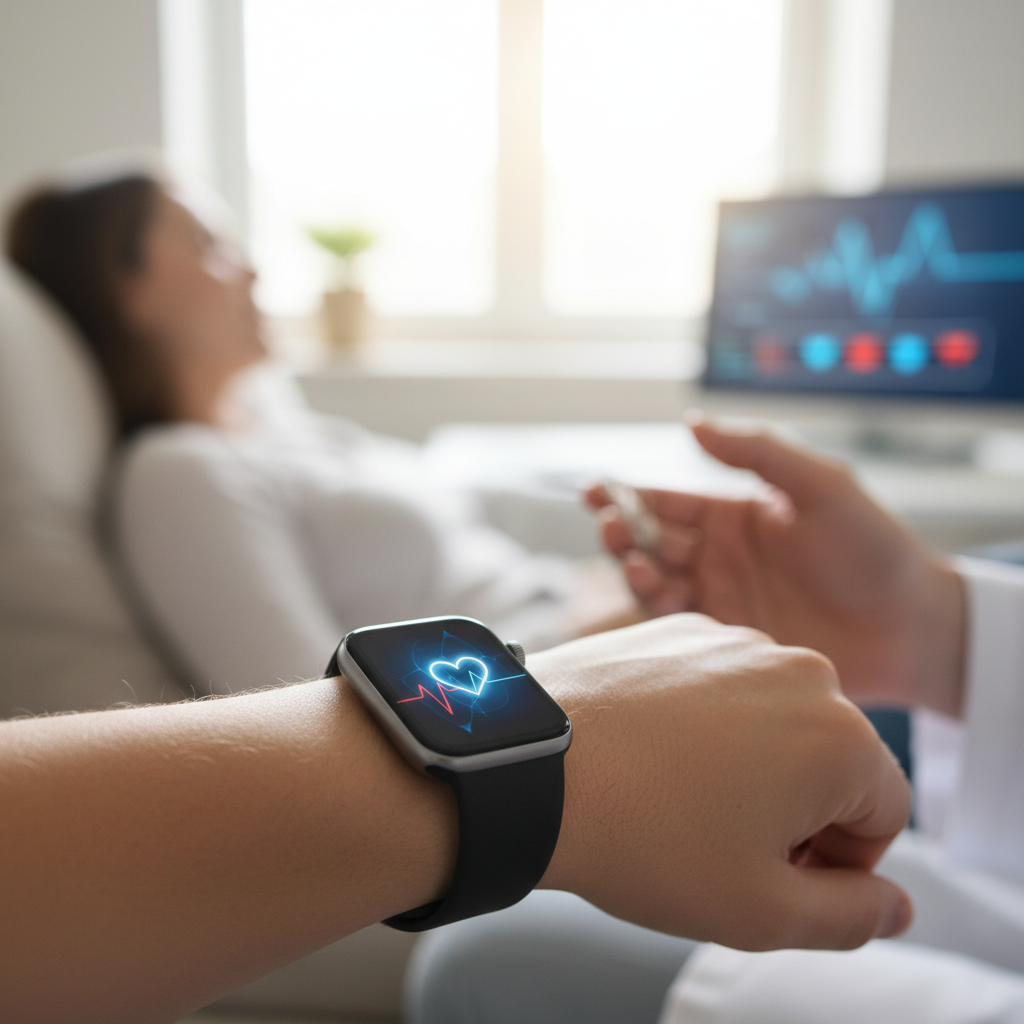
Smartwatches may help flag heart failure hospital risk — but the strongest evidence still comes from dedicated wearable sensors
Smartwatches may help flag heart failure hospital risk — but the strongest evidence still comes from dedicated wearable sensors
Heart failure often worsens gradually rather than all at once. A patient may seem relatively stable for days or weeks and then deteriorate to the point of emergency assessment or hospital admission. One of the biggest problems in managing heart failure is that by the time symptoms are obvious enough to trigger help-seeking, the underlying decline may already have been building for several days.
That is why wearable technology has attracted so much interest. If physiological signals begin to shift before a patient becomes clearly unwell, then continuous monitoring might make it possible to detect those changes earlier and intervene sooner. The new headline suggests that smartwatches could predict the risk of hospitalisation due to heart failure. The broad idea is plausible, but the evidence available supports a more careful version of the story.
What the supplied studies support most clearly is this: wearable devices may help detect early signs of worsening heart failure and predict hospitalisation risk, potentially giving clinicians more time to respond. But the strongest evidence still comes mainly from dedicated clinical wearable sensors, not necessarily from ordinary consumer smartwatches.
Why heart failure decompensation may be predictable
Heart failure rarely deteriorates without warning. Before a crisis severe enough to require hospital care, the body often begins to change in measurable ways. These may include shifts in:
- heart rate;
- respiratory rate;
- physiological variability;
- daily physical activity;
- sleep patterns;
- and other indirect markers of cardiovascular stress.
The challenge is that many of these changes are too subtle for patients to notice early. By the time breathlessness, swelling, or exhaustion become unmistakable, the process may already be well underway.
That is why continuous physiological monitoring is so attractive. If a wearable can track these variables over time, it may be able to identify an early pattern of deterioration before the patient reaches a point of obvious clinical decline.
What the studies actually show
One of the most important studies in the evidence set is the LINK-HF multicentre study. It found that continuous wearable physiological monitoring could identify precursors of heart failure rehospitalisation with useful sensitivity and with several days of lead time.
That matters because the value of monitoring is not simply in confirming that a patient is unwell once they are already close to admission. Its real promise lies in providing an early-warning window. Even a few days may be clinically important if it allows medication adjustment, earlier review, patient contact, or another intervention before a crisis escalates.
A more recent clinical trial also reported that using data from a wearable heart failure sensor to guide management was associated with a 38% relative reduction in 90-day heart failure rehospitalisation compared with usual care. That is especially notable because it moves beyond risk prediction alone. It suggests that monitoring may help when the data are linked to a structured clinical response.
In other words, the benefit may lie not just in the signal, but in the combination of signal plus action.
How remote monitoring changes the model of care
Traditionally, heart failure follow-up has relied heavily on clinic visits, self-reported symptoms, and in some cases daily weight checks. These tools still matter, but they have obvious limitations. They depend on symptom awareness, patient consistency, and long intervals between clinical assessments.
Wearables change that model by making observation more continuous. Instead of waiting until a patient feels clearly worse, the aim becomes identifying physiological drift before it becomes a visible clinical crisis.
That fits with the broader rise of digital biomarkers and remote monitoring. In chronic diseases that tend to deteriorate in episodes, the focus is increasingly shifting from reacting to crises towards recognising early warning signs.
Where the smartwatch headline needs caution
This is where the headline needs to be interpreted carefully. The phrase smartwatch prediction of heart failure hospitalisation is compelling because smartwatches are familiar, widely used, and already worn by many people. But the studies provided do not directly validate standard consumer smartwatches as stand-alone tools for predicting heart failure hospitalisation.
The strongest evidence centres on dedicated wearable sensors developed specifically for clinical monitoring in heart failure populations. That does not mean consumer smartwatches could never move into a similar role. It does mean that the evidence supplied here supports the broader concept of wearable monitoring more clearly than it supports everyday smartwatches as already established clinical tools.
That distinction matters. It would be easy for readers to assume that an ordinary retail smartwatch is already a validated early-warning system for heart failure admission. The current evidence does not justify that claim.
What makes a wearable clinically useful
Not every device that gathers physiological data becomes medically useful. To genuinely improve heart failure care, a monitoring system has to do several things well:
- collect reliable physiological signals;
- detect patterns that matter clinically;
- separate meaningful change from background noise;
- generate alerts that are actionable;
- and, most importantly, connect those alerts to a care pathway that can respond.
That last point is crucial. Predicting hospitalisation risk does not by itself improve outcomes. The benefit comes when prediction leads to something useful — earlier medication changes, clinical review, patient contact, or urgent reassessment.
Without that response pathway, monitoring may simply create more data without creating much benefit.
The practical barriers are still real
The review literature also points to several practical obstacles that remain important:
- adherence to wearing the device;
- variable data quality;
- false alerts;
- integration into routine care pathways;
- cost and access;
- and uncertainty about generalisability to broader, more diverse populations.
These issues matter because technology that performs well in a structured study does not always translate easily into everyday care.
What the evidence most safely supports
Even with these cautions, the supplied evidence still supports an important conclusion: wearable monitoring in heart failure is no longer just a futuristic idea. There is reasonable evidence that continuous physiological sensing can help detect worsening earlier and may reduce rehospitalisation when the information is used to guide care.
That matters because heart failure remains one of the major drivers of recurrent admission, functional decline, and health system burden. Any strategy that helps recognise deterioration earlier has meaningful potential.
What should not be promised yet
At the same time, the headline should not be read as proof that ordinary smartwatches are already validated stand-alone tools for predicting heart failure hospitalisation. Nor should it imply that wearing a device automatically improves outcomes.
Technology may help, but benefit depends on:
- the quality of the measurements;
- the strength of the algorithm;
- the patient’s clinical context;
- adherence to device use;
- and a health system that can act on the information generated.
So the wearable does not replace clinical care. At best, it extends observation between encounters.
The most balanced reading
The supplied evidence supports a moderately strong conclusion: wearable technology may help predict worsening heart failure and impending hospitalisation, creating opportunities for earlier intervention. LINK-HF showed that continuous physiological monitoring could identify warning signs days before rehospitalisation, and a more recent study suggests that management guided by wearable sensor data may reduce rehospitalisations.
But the responsible interpretation still needs nuance. The strongest studies focus mainly on dedicated clinical sensors, not standard consumer smartwatches. Wider generalisability, integration into routine care, and the role of everyday smartwatches remain open questions.
So the safest conclusion is this: the story is best understood as an advance in remote monitoring and early warning in heart failure, with real potential to improve care and reduce admissions. But based on the evidence supplied here, it is still too early to treat ordinary consumer smartwatches as already validated stand-alone tools for predicting heart failure hospitalisation.