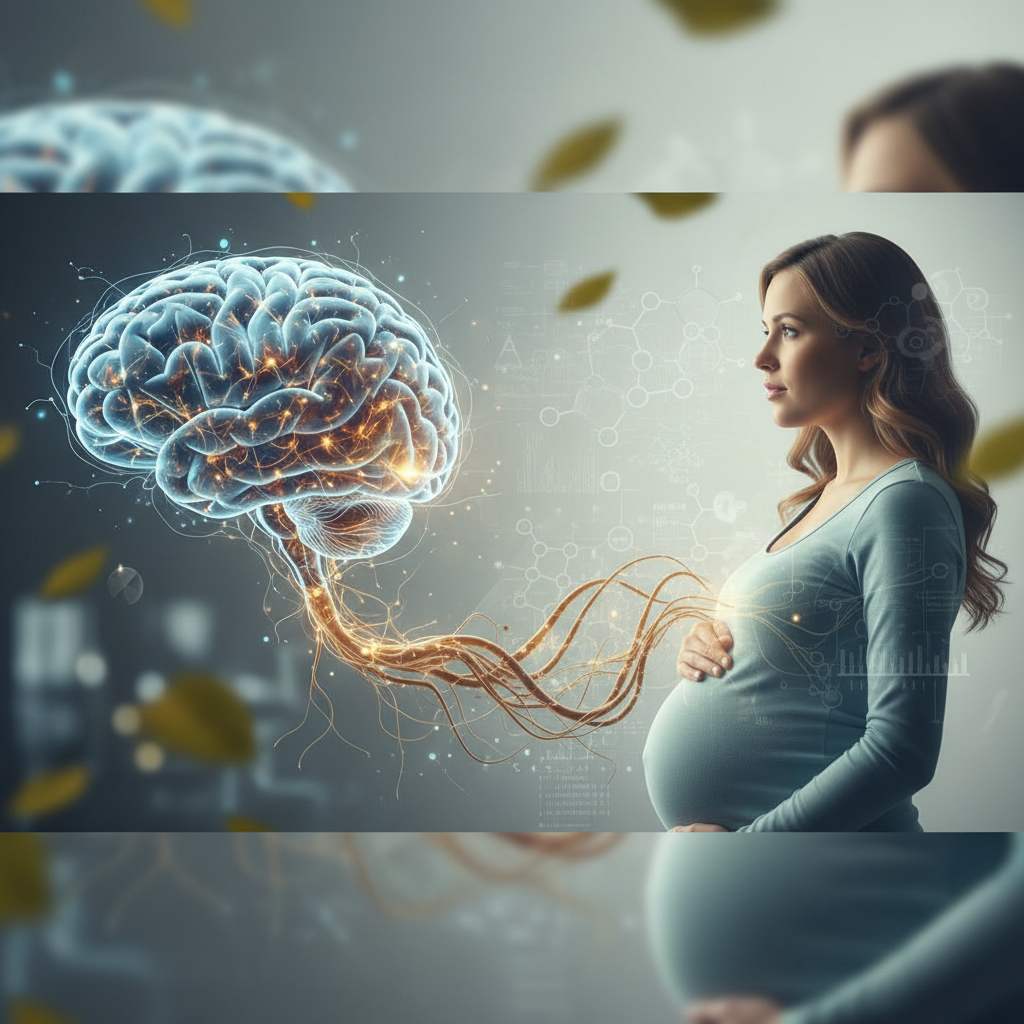
Pregnancy Changes the Brain — and the Science Is Finally Catching Up
Pregnancy Changes the Brain — and the Science Is Finally Catching Up
For decades, the idea of “baby brain” has hovered somewhere between stereotype and stand-up material. Forgetfulness, emotional swings, feeling not quite yourself — all of it was often bundled into a vague, faintly patronising suggestion that pregnancy somehow made the brain worse.
What science is beginning to show is both more serious and more interesting. Pregnancy does appear to change the brain. Not as a punchline, and not simply as a story of decline, but as part of a major biological adaptation driven by dramatic hormonal shifts.
That is an important change in framing. Because once pregnancy is understood as a period of neurobiological reorganisation rather than simple impairment, a lot of old assumptions start to look flimsy.
This is not just “baby brain”
Pregnancy is one of the most profound hormonal events in adult life. Levels of estradiol, progesterone, cortisol, prolactin, placental lactogen and oxytocin rise and interact in ways that affect far more than the uterus or the developing fetus. These hormones also act on the brain.
A review of neurophysiological and cognitive changes in pregnancy describes widespread effects on brain function, homeostasis, mood, behaviour and cognition. That is a much broader picture than the old notion of absent-mindedness. It suggests that the pregnant brain is not simply under strain, but being reshaped.
This matters because the way these changes are described shapes how pregnant women are treated — clinically, socially and even professionally. If the default assumption is that pregnancy makes women foggy or less capable, the science can easily be twisted into something belittling. But that is not what the evidence points to.
The emerging view is that at least some of these changes may be adaptive. In other words, the brain may be recalibrating itself for a very specific biological and behavioural task.
Hormones are not background noise
It is easy to use “hormones” as a catch-all explanation and move on. But in pregnancy, hormones are not background noise. They are the engine of the entire transformation.
Progesterone, for example, has long been known for its role in sustaining pregnancy. But broader endocrine research also supports its involvement in mood regulation, stress responses, emotional processing and cognition in females. Estradiol has similarly far-reaching effects on the brain, while cortisol alters the body’s stress systems in ways that may have consequences for both mind and behaviour.
Then there are prolactin and oxytocin, both closely linked to caregiving, bonding and behavioural shifts. Taken together, these changes suggest that pregnancy may tune the brain differently rather than simply disrupt it.
That distinction is not semantic. It changes the tone of the whole discussion. A shift in attention, memory, emotional sensitivity or social awareness during pregnancy may not mean the brain is functioning poorly. It may mean it is functioning differently because its priorities have changed.
A brain in adaptation, not in retreat
One of the most useful ways to understand the current science is to stop asking whether pregnancy alters the brain and start asking what those alterations might be for.
From an evolutionary perspective, it would be more surprising if pregnancy did not lead to major changes in brain function. The body is preparing not just to sustain a fetus, but to navigate birth, stress, metabolic upheaval, social change and, often, the transition into caregiving. It makes sense that the brain would adapt in ways that support those demands.
That could include changes in emotional salience, threat detection, stress responsiveness, motivation and social processing. It may help explain why some women feel more emotionally reactive, more attuned to risk, more sensitive to relationships, or simply mentally different during pregnancy.
Importantly, that “different” should not automatically be translated into “worse”.
Why the old story has been so misleading
The “baby brain” stereotype took hold because it felt relatable. Many women do report forgetfulness, distractibility or a sense of mental overload during pregnancy. But the cultural interpretation of those experiences has often been shallow.
Part of the problem is that cognition is not one single thing. Memory, attention, emotional processing, executive function and social awareness do not all move together. A person may feel slower in one domain while becoming more sensitive or responsive in another.
Another problem is context. Pregnancy rarely unfolds in ideal laboratory conditions. Poor sleep, nausea, physical discomfort, anxiety, work pressure, body changes and anticipation about birth all affect how clearly someone thinks. These influences are real, and they can easily become entangled with hormonal and neurobiological changes.
So when a pregnant woman says she feels mentally “off”, that experience may reflect several overlapping realities at once. Reducing it to a joke about being scatterbrained misses the complexity of what is happening.
Mood changes are part of the biology too
One of the strongest takeaways from this research is that pregnancy-related brain changes are not only about cognition. They are also about mood and emotional regulation.
Pregnancy is a neurobiologically sensitive period. The same hormonal systems involved in maintaining pregnancy also affect stress reactivity, emotional processing and mental wellbeing. That does not mean emotional difficulty is inevitable, nor that every mood change is pathological. But it does mean pregnancy is a period in which the brain is more actively involved than medicine has sometimes acknowledged.
Research on prenatal stress strengthens this picture, even if some of it focuses more on the developing baby’s brain than the mother’s. The broader message is that pregnancy is a major biological event with consequences that extend into the nervous system. Maternal psychological state is not incidental to that process.
In practical terms, this should matter for care. If pregnancy involves substantial changes in the brain, then mental health during pregnancy should not be treated as secondary to blood pressure checks, scans and blood tests. Anxiety, low mood, overwhelm and sleep disruption are not side notes when the brain itself is adapting.
What science still cannot fully explain
For all the excitement around this field, there are still important gaps.
The evidence supplied here strongly supports the broad claim that pregnancy changes the brain, but it does not yet provide a complete map of what those changes mean in humans over time. There is still a shortage of direct longitudinal imaging studies following the same individuals before, during and after pregnancy.
Some of the mechanistic ideas also rely partly on animal research or on interpretations that combine animal and human findings. That is common in neuroscience, but it means caution is needed. The broad pattern is convincing; the finer details are still being worked out.
There is also the question of variation. Not everyone experiences pregnancy in the same way. Prior mental health, stress, trauma, social support, sleep quality, physical health and life circumstances will all shape how pregnancy-related brain changes are felt and expressed. What is adaptive in one context may feel destabilising in another.
So the right message is not that pregnancy rewires every brain in a single predictable way. It is that pregnancy appears to trigger real neurobiological changes whose meaning is likely complex, context-dependent and still only partly understood.
Why this matters beyond the lab
This is not just an academic story. The way pregnancy-related brain changes are understood affects how women are listened to — and how seriously their experiences are taken.
If pregnancy is framed mainly as a deficit state, women may be dismissed as unreliable, over-emotional or mentally diminished. If it is framed only as glowing fulfilment, they may feel pressured to ignore very real shifts in mood and cognition. Neither view is helpful.
The emerging science offers a better middle ground. It suggests that pregnancy can alter the brain in meaningful ways without those changes being inherently harmful. That opens the door to a more intelligent conversation: one that takes pregnant women seriously, recognises that their brains as well as their bodies are changing, and stops treating adaptation as a weakness.
The bottom line
The most important message from this research is not that pregnancy “affects” the brain in the gloomy, deficit-driven way the phrase is often used. It is that pregnancy appears to reshape the brain through powerful hormonal and neurobiological shifts.
Many of those changes may be adaptive, helping to recalibrate mood, behaviour and cognition for a major life transition. The science is still developing, and many mechanisms in humans remain only partly understood. But one thing is becoming increasingly difficult to ignore: “baby brain” was never the whole story.
Pregnancy does change the brain. The real mistake was assuming that meant something had gone wrong.