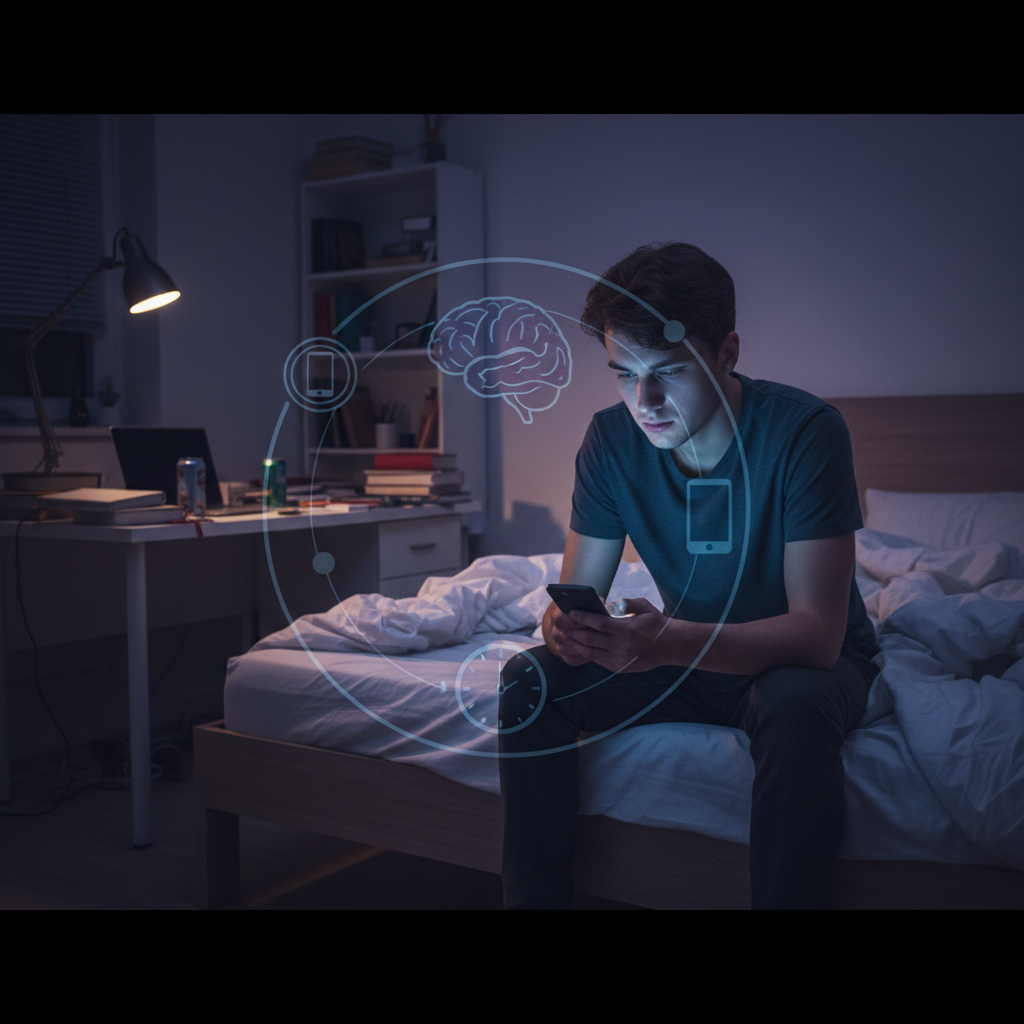
Poor sleep and poor mental health in young people may be feeding each other — and social media can intensify the cycle
Poor sleep and poor mental health in young people may be feeding each other — and social media can intensify the cycle
There is a question hanging over families, schools, clinics and public policy: why do so many young people seem to be sleeping badly while also feeling mentally worse? The temptation is to look for one simple culprit — phones, school pressure, the pandemic, anxiety, social media. But the strongest explanation supported by the supplied evidence is more uncomfortable and more realistic: the problem likely works in cycles.
The safest reading of the available literature is that sleep problems and poor mental health in young people are deeply intertwined and likely reinforce one another over time. Within that loop, digital habits — especially problematic social media use — appear to act as an important amplifier, but not the sole cause.
That distinction matters. It avoids both the moral panic version of the story and the dismissive one. Sleep is not a side issue in psychological distress, and social media is not just a convenient scapegoat invented by adults. The more plausible picture is that several pressures interact, and sleep sits near the centre of the mechanism.
What the evidence shows most clearly
The supplied studies directly support the idea that poor sleep and poor mental health in young people are closely linked.
Systematic reviews show that problematic or excessive social media use is associated with:
- poorer sleep quality;
- depression symptoms;
- anxiety symptoms;
- and reduced wellbeing.
That would already matter on its own. But the more important point is that the relationship does not appear to be purely static, as though young people who use more social media simply happen to also sleep worse. Some longitudinal evidence suggests that frequent social media use can come before both poorer sleep and poorer mental health.
At the same time, some studies suggest that sleep quality may mediate part of the relationship. In practical terms, that means social media habits may worsen sleep, poor sleep may worsen emotional health, and psychological distress may then push young people further into dysregulated digital use.
That is exactly what gives strength to the “vicious cycle” model.
Sleep does not just accompany distress — it may help drive it
Another important part of the evidence is that insomnia and sleep disruption do not seem to function only as passive symptoms of poor mental health. A broader meta-analysis shows that insomnia predicts later depression.
That matters because it moves sleep out of the role of bystander. It suggests that sleep problems are not merely what happens once mental health is already deteriorating. In many cases, they may also help push that deterioration forward.
Clinically, that makes sense. Inadequate or fragmented sleep affects emotional regulation, stress tolerance, attention, memory, impulse control and psychological recovery. In adolescents and young adults — who are already moving through periods of intense biological, emotional and social change — that impact may be especially pronounced.
Social media appears to be an accelerant, not a complete explanation
It is tempting to turn this entire story into a simple verdict against social media. But that would go further than the supplied evidence allows.
The literature does strongly support the idea that problematic social media use is associated with both poorer sleep and poorer mental health. That is consistent and important. What it does not support is the stronger claim that social media alone explains the full decline in young people’s sleep and mental health.
There are clearly other pressures that may also matter, including:
- academic pressure;
- social insecurity;
- economic stress;
- family conflict;
- irregular routines;
- night-time light exposure;
- social comparison;
- and pre-existing vulnerabilities.
Social media seems best understood here as an amplifier inside a system that may already be strained. It can delay bedtime, interrupt rest, heighten emotional arousal, increase comparison and make mental disengagement harder. But the larger problem does not fit entirely inside a screen.
Why these cycles are so hard to break
The strength of the vicious-cycle model is that each part makes the others worse.
A familiar pattern might look something like this:
- a young person spends more time online, especially late at night;
- sleep becomes shorter or more disrupted;
- they wake up more tired, irritable or anxious;
- school, relationships and everyday stress become harder to manage;
- they turn back to digital distraction, connection or validation;
- and sleep is pushed further off course.
Not every case follows that exact sequence, of course. But the general model is plausible and well supported by the available evidence. It also helps explain why shallow interventions often fail. If the problem is cyclical, addressing just one part in isolation may not be enough.
The mistake of treating sleep as optional
One cultural problem in this discussion is that sleep is still often treated as if it were secondary: good to have, but negotiable. In many settings, sleeping less is almost framed as evidence of productivity, social connection or adaptation to modern life.
For young people, that is especially risky. Sleep is not merely recovery time. It is part of emotional processing, learning, attention and mental stability.
When sleep collapses, the result is not just tiredness. It is a reduced ability to manage life at all.
Where adults often get the story wrong
There are two common mistakes, and they go in opposite directions.
The first is minimisation: assuming poor sleep and chronic exhaustion are simply normal parts of modern adolescence.
The second is moralising: reducing the whole issue to lectures about discipline or phone addiction, as though removing a device alone will solve complex emotional distress.
The supplied evidence points to something more sophisticated. It suggests that sleep and mental health need to be understood together, and that digital habits are one real part of the picture, but not the whole picture.
That leads to more useful responses:
- taking sleep patterns seriously;
- reducing disorganised late-night digital use;
- recognising anxiety and depression early;
- and treating sleep as part of mental health rather than a separate lifestyle issue.
What the evidence still does not settle
Even with strong overall support, there are important limits.
Much of the youth-specific evidence remains observational, which means it supports bidirectional association more clearly than definitive causation. The studies also show substantial heterogeneity, suggesting effects may differ by:
- age;
- gender;
- geography;
- how problematic use is defined;
- and how sleep and mental health outcomes are measured.
It is also worth noting that some of the strongest longitudinal evidence on insomnia predicting depression comes from broader epidemiological samples, not exclusively youth-only cohorts.
So the safest formulation is not “social media causes depression by ruining sleep” or “sleep alone explains the youth mental health crisis”. It is more careful: poor sleep and psychological distress appear to reinforce one another, and problematic social media use may intensify that process.
What this means in practice
If the best model is a vicious-cycle one, then prevention and support need to be more integrated as well.
That means improving youth mental health may require serious attention to:
- sleep regularity;
- late-night screen habits;
- sleep environments;
- early emotional distress;
- school routines that work against adequate sleep;
- and forms of digital use that become hard to control.
It is not a choice between treating sleep and treating mental health. In many cases, they are different parts of the same problem.
The balanced takeaway
The most responsible interpretation of the supplied evidence is that sleep problems and poor mental health in young people likely reinforce one another in self-perpetuating cycles, and that problematic social media use acts as one important amplifier within that process.
Systematic reviews support the association between problematic social media use, poorer sleep, depression, anxiety and lower wellbeing. Longitudinal studies suggest frequent use can come before declines in sleep and mental health, while some evidence indicates that sleep quality mediates part of these relationships. The broader insomnia-depression meta-analysis strengthens the case that poor sleep may be not only a consequence of distress, but one of its drivers.
But the limit should stay in view. The evidence does not support the idea that social media or sleep alone fully explains worsening youth mental health.
What it does support, quite strongly, is already important: if we want to understand why so many young people are struggling, we need to stop treating sleep, distress and digital habits as separate issues. In many cases, they are part of the same loop — and that is exactly why the response has to be connected too.