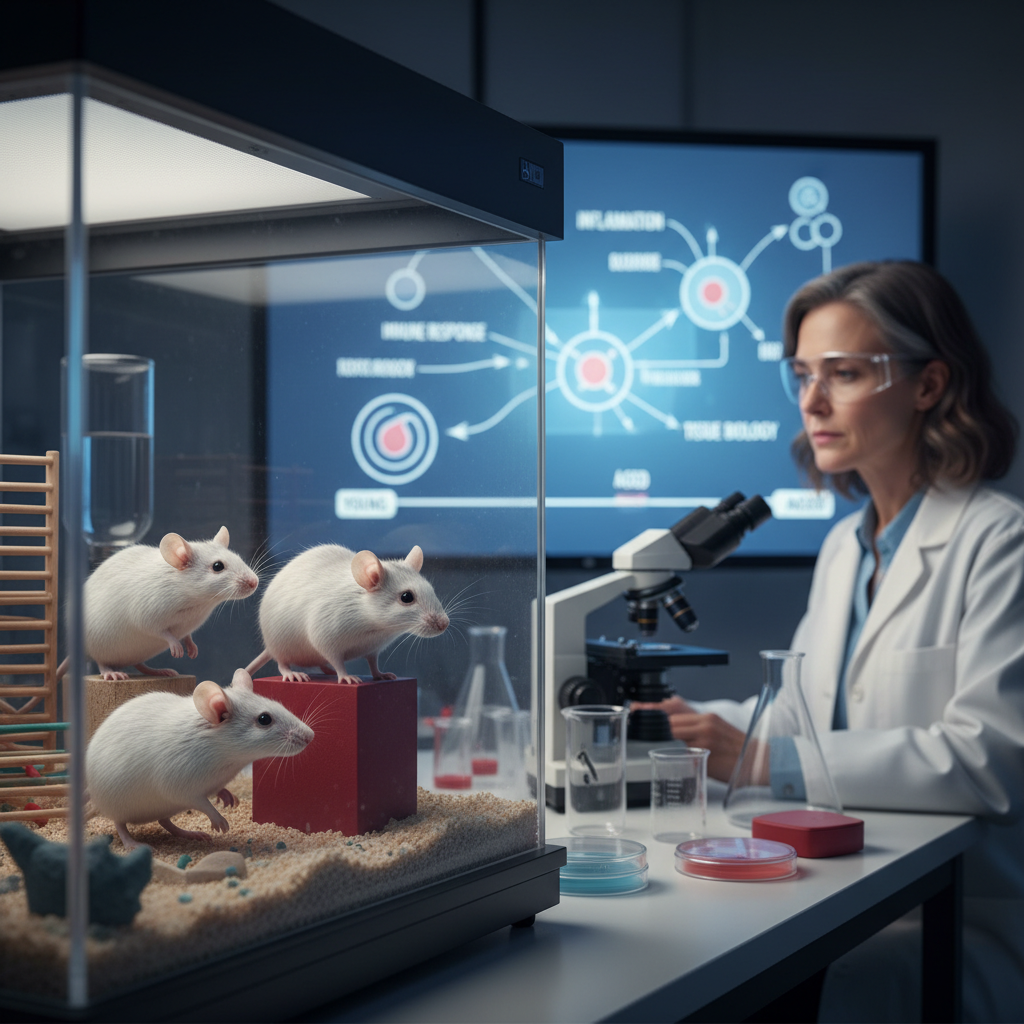
Older mice may reveal what young models miss about cancer and ageing
Older mice may reveal what young models miss about cancer and ageing
In biomedical research, the ideal experimental model is often described as controlled, reproducible, and standardised. That is one reason cancer studies have long relied heavily on young animals. They are more predictable, involve fewer competing biological variables, and make for cleaner experiments.
But there is an obvious problem with that approach. Human cancer is, to a large extent, a disease of ageing. Most tumours do not arise in biologically young bodies. They emerge in organisms shaped by chronic inflammation, tissue remodelling, immune change, cellular senescence, and years of accumulated metabolic and environmental stress.
That is what makes the idea of using older mice in cancer and ageing research so important. The issue is not simply about swapping one animal model for another. It is about recognising that ageing profoundly changes the terrain in which a tumour begins, grows, and interacts with the body. If that terrain changes, then very young laboratory animals may miss key parts of the biology researchers are trying to study.
The evidence provided supports that framing in a moderate but meaningful way. It backs the idea that ageing alters the biological context of tumorigenesis and that older animal models may offer a more realistic view of age-related cancer biology. At the same time, it also makes clear that this does not automatically solve the wider translational limits of animal research.
Cancer does not arise in a biological vacuum
One of the most important ideas in modern oncology is that cancer does not depend only on mutations inside tumour cells. It also depends on the environment those cells inhabit.
That environment includes:
- the state of the immune system;
- the body’s inflammatory baseline;
- tissue structure and remodelling;
- growth and repair signalling;
- and the presence of aged or senescent cells.
All of those features change with age. That means studying cancer in young organisms may be useful for some questions, but not necessarily for all of them. A tumour arising in an older body does not encounter the same biological ecosystem it would in a younger one.
Ageing and cancer share key mechanisms
The references supplied reinforce a broader concept that is already well established: ageing and cancer are linked through overlapping biological processes. These include:
- cellular senescence;
- chronic low-grade inflammation;
- tissue remodelling;
- and altered immune function.
Senescence is a good example. Cells that become senescent stop dividing, but they do not simply disappear. They remain metabolically active and can influence surrounding tissue. In some settings, that may help prevent malignant transformation. In others, it may promote inflammation and create conditions that make tumour development easier.
That dual role helps explain why ageing and cancer are connected in such a complicated way. Ageing does not merely add time to the body. It changes the biological setting in which cells live.
What young models may fail to capture
Young animal models are still useful, and it would be wrong to present them as outdated. They help isolate mechanisms, reduce confounding variables, and test hypotheses under tightly controlled conditions.
The difficulty is that this experimental cleanliness can come at a biological cost. By simplifying the organism too much, a model may drift away from the real-life condition researchers are trying to understand.
In cancer linked to ageing, young animals may underrepresent:
- age-related changes in the tumour microenvironment;
- shifts in immune surveillance;
- accumulated inflammatory signalling;
- declining tissue-repair resilience;
- and molecular pathways that only become important in older tissues.
In other words, a young model may answer questions about cancer, but not necessarily questions about cancer in the context of ageing.
The mammary-gland study and the possible role of midkine
Among the supplied evidence, a recent mammary-gland study helps make this argument more concrete. It identified age-related cellular changes and pointed to midkine as a possible mediator of increased tumour susceptibility with age.
That matters for two reasons.
First, it suggests that ageing is not just a passive backdrop. It may actively reshape tissue biology in ways that increase vulnerability to tumour formation.
Second, it illustrates how older animal models can uncover age-dependent drivers of tumorigenesis that might not be visible in younger animals. If a molecular factor becomes important only when tissue has aged, then studying it in a very young organism may fail to reproduce the biology of interest.
That is one of the strongest arguments for age-appropriate models: they may reveal mechanisms that traditional experimental designs are not well positioned to detect.
Why ageing changes tissue so much
As tissues age, they do not simply become worn-out versions of themselves. They often become biologically different.
Possible changes include:
- altered cellular composition;
- less stable cell-to-cell communication;
- accumulation of inflammatory cues;
- hormonal and metabolic shifts;
- and immune responses that are either weaker or more dysregulated.
That matters because cancer development depends heavily on those interactions. A potentially malignant cell does not grow in isolation. It interacts with fibroblasts, extracellular matrix, blood vessels, immune cells, and signals related to stress and repair. If those surrounding features change with age, the path of tumour development may change as well.
That is why older animals may provide a more realistic picture of how many cancers emerge in the real world.
This is an argument for better-fit models, not one perfect model
It is tempting to read this story as though the solution were simple: stop using young animals and switch to older ones. But that would be too simplistic.
The strongest message is not that older mice are always better. It is that the model should match the scientific question. For questions about age-related tumour susceptibility, immune context, tissue change, and cancer mechanisms tied to ageing, older models may make more biological sense.
That reflects an important maturity in research design. Instead of searching for a universal model, the goal becomes finding the most appropriate model for the phenomenon being studied.
What the evidence still does not prove
Although the conceptual case is strong, the evidence also has limits.
First, it supports the broad idea well, but it does not directly compare older versus younger mice across multiple cancer models. So the argument is persuasive, but not universally demonstrated in every cancer setting.
Second, one of the strongest mechanistic studies provided was conducted in rats rather than mice. That does not undermine the broader biological logic, but it does require some caution when interpreting a mouse-specific headline too literally.
Third, some of the cited literature is review-based or older, which means the strength of the evidence lies more in the overall conceptual framework than in a single directly matching experimental paper.
Older animals are still animal models
Another important point is not to overstate what older models can solve. Even when animal experiments use age-appropriate models, there are still important differences between animal ageing and human ageing.
Laboratory animals raised under highly controlled conditions:
- experience different environments from humans;
- age on different timelines;
- have less complex life histories;
- and do not always reproduce the same interplay of genetics, environment, metabolism, and time seen in people.
So older mice may be more realistic than younger mice for some questions without becoming perfect stand-ins for human cancer.
What this could improve in practice
Even with those limits, the shift in thinking is important. If oncology research takes age more seriously in model design, that could improve:
- identification of mechanisms truly active in aged tissues;
- discovery of biomarkers more relevant to older patients;
- understanding of why certain tumours emerge later in life;
- and selection of treatment targets that better reflect the aged tumour microenvironment.
This may not be the flashiest change in cancer research, but it may be one of the more sensible ones: stop studying a disease of ageing mainly in organisms that are too young to represent that context.
The most balanced reading
The supplied evidence supports a moderate and biologically plausible conclusion: using older animals may reveal cancer mechanisms linked to ageing that younger models are likely to underrepresent or miss. Ageing and cancer share processes such as cellular senescence, chronic inflammation, tissue remodelling, and immune alteration, and recent work suggests that age-linked mediators — such as midkine in mammary tissue — may contribute to increased tumour susceptibility.
But a responsible interpretation also requires caution. The evidence is more conceptual than definitive, it does not consistently compare old versus young animals across many cancer models, and it remains constrained by the broader limits of animal research.
The safest conclusion, then, is this: older mice may improve cancer-and-ageing research because they better reflect the biological setting in which many tumours actually emerge. But they do not, by themselves, eliminate the translational challenges of experimental oncology. The advance here is less a magic fix than a meaningful step towards greater biological realism.