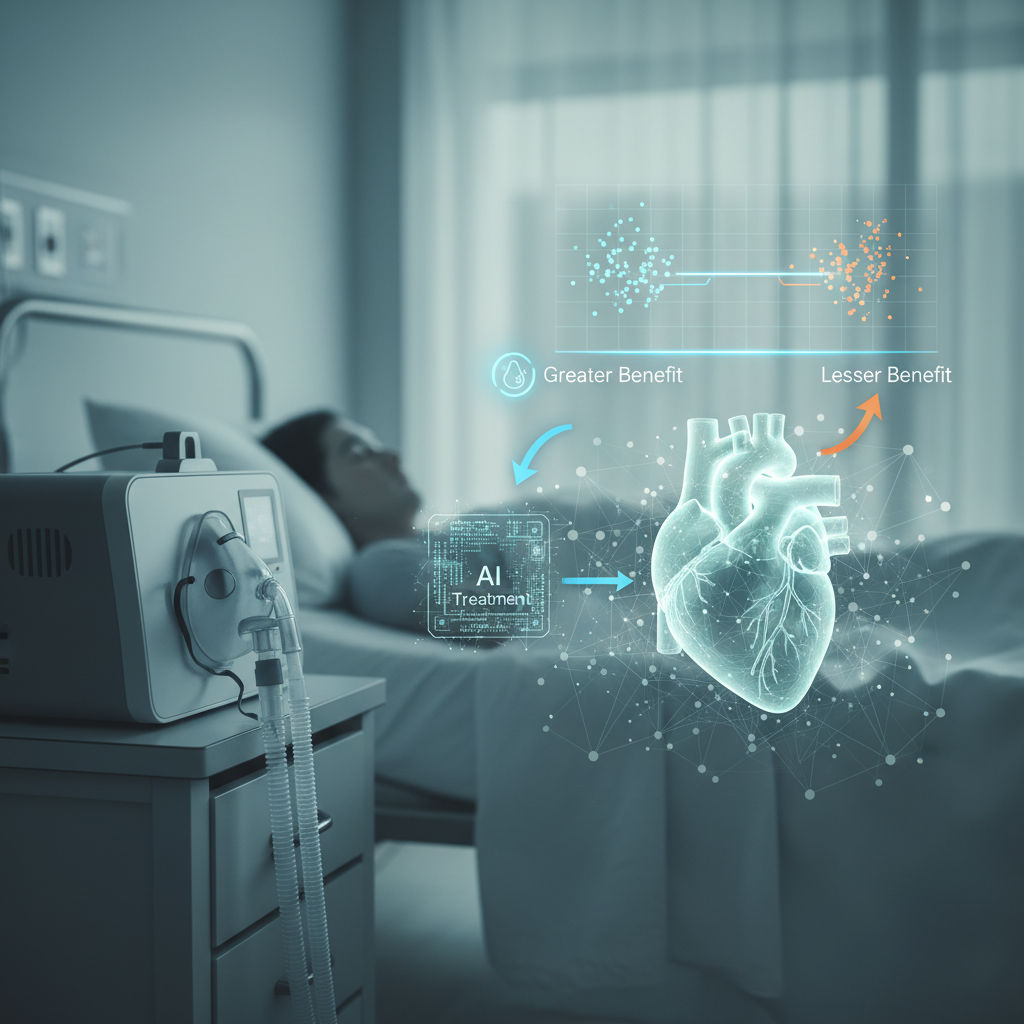
AI suggests CPAP may not affect cardiovascular risk the same way in everyone with sleep apnoea
AI suggests CPAP may not affect cardiovascular risk the same way in everyone with sleep apnoea
The connection between obstructive sleep apnoea and cardiovascular disease seems straightforward at first glance. Repeated drops in oxygen, fragmented sleep, surges in sympathetic activity, inflammation, and overnight haemodynamic stress all help explain why people with sleep apnoea face higher risks of hypertension, arrhythmias, coronary disease, and stroke.
With that logic, CPAP — continuous positive airway pressure — has long seemed like an obvious way to protect the heart as well as improve breathing during sleep. If sleep apnoea contributes to cardiovascular stress, then treating the apnoea should reduce cardiovascular events. But in practice, large randomised trials have not produced a clear, uniform cardiovascular benefit.
That is where the new headline about an AI model comes in. Its central idea is plausible: CPAP may not influence cardiovascular risk uniformly across all patients, and artificial intelligence may help identify subgroups who benefit more — or perhaps less — from treatment. But the headline’s dramatic wording goes further than the evidence can safely support.
The question the new analysis is really asking
One of the most persistent problems in sleep apnoea research is this: why would a therapy that clearly improves breathing disturbances not consistently translate into obvious cardiovascular protection across major trials?
One increasingly important answer is that obstructive sleep apnoea may not be one single cardiovascular entity. Two patients can carry the same diagnosis and still differ in ways that may matter greatly, including:
- daytime sleepiness;
- severity and pattern of oxygen desaturation;
- average event duration;
- metabolic profile;
- baseline cardiovascular disease;
- treatment adherence;
- and the kind of cardiovascular vulnerability they have to begin with.
If that is true, then asking whether CPAP lowers cardiovascular risk “on average” may be too crude. The average result may obscure important differences between subgroups.
What the supplied evidence actually shows
The key study in the supplied evidence is a post hoc machine-learning analysis of the ISAACC trial. Rather than testing a pre-specified treatment effect, it used data after the fact to look for patient subgroups in whom CPAP appeared to behave differently.
That analysis identified some groups in which CPAP appeared more protective against cardiovascular events and others in which outcomes appeared less favourable. The subgroups were defined using features such as average event duration and hypercholesterolaemia.
This is important because it offers a possible explanation for why earlier randomised evidence may have looked neutral overall. If some patients benefit more strongly while others benefit little, or differently, the net trial result can flatten into apparent neutrality.
In other words, the cardiovascular effect of CPAP may not be one-size-fits-all — and AI may help uncover that heterogeneity.
Why precision medicine is gaining traction in sleep apnoea
A more recent review in sleep apnoea research supports this broader interpretation. It argues that neutral randomised trial results may reflect a combination of factors, especially:
- disease heterogeneity;
- low adherence to CPAP;
- imprecise patient selection;
- and differences in clinical and cardiovascular phenotype.
That strengthens the case for a precision-medicine approach. Instead of asking only whether CPAP reduces cardiovascular events in people with sleep apnoea overall, researchers are increasingly asking: which patients, under which conditions, and with what level of adherence are most likely to benefit?
That shift matters. In many areas of medicine, a weak average result has eventually led not to abandonment of a treatment, but to better patient stratification.
What AI may contribute
The value of artificial intelligence here is not that it replaces clinical judgement. It is that it may detect complex patterns that simpler classifications miss. Sleep apnoea is not fully captured by a single apnoea–hypopnoea index. Two patients can have similar scores and still have very different physiological profiles.
Machine-learning tools can analyse many variables at once and sort patients into subgroups with potentially different trajectories. That is especially useful in heterogeneous disorders, where the average outcome may hide opposite responses within the same population.
In that sense, the core concept of the headline is sound: AI may help explain why CPAP’s cardiovascular impact appears to differ across patients.
Why the headline still overstates the evidence
This is where caution becomes essential.
The most important limitation is that the main supportive study is a post hoc subgroup analysis. That makes it hypothesis-generating, not definitive proof. These analyses are useful for finding patterns worth testing, but they are not strong enough on their own to guide treatment decisions in routine care.
The headline’s phrase “massively swing heart risk” is also stronger than the evidence justifies. It suggests a dramatic, well-established effect. The supplied studies do not support that level of certainty.
The safest interpretation is more restrained: the analysis suggests that the cardiovascular effects of CPAP may vary meaningfully between patient subgroups, and that AI could be useful in identifying those differences. That is quite different from saying that CPAP has been shown to dramatically alter heart risk in clearly defined groups.
Why this should not be turned into a “CPAP harms some patients” story
Another important caution is not to overread subgroup patterns as proof that CPAP broadly harms certain patients.
The analysis found some groups in which outcomes appeared worse, but that is not the same as demonstrating that CPAP itself causes harm in those patients. There are many reasons why those findings could be more complicated than they appear, including:
- real-world adherence;
- baseline sleepiness;
- severity and pattern of OSA;
- pre-existing cardiovascular disease;
- metabolic characteristics;
- and the statistical limitations of subgroup modelling itself.
So it would be inappropriate to suggest that AI has already identified patients who should not receive CPAP on cardiovascular grounds. The evidence is not there yet.
What this story really changes
The strongest contribution of this research is conceptual. It reinforces the idea that obstructive sleep apnoea may need to be treated less as a single entity and more as a family of phenotypes.
That matters because it changes how clinicians and researchers interpret older trials. Instead of concluding simply that CPAP does or does not help the heart, the better question may be whether the wrong patients were grouped together in the first place.
That is a meaningful advance even without immediate clinical application.
What still needs to happen before practice changes
Several steps are still needed before this type of work could influence routine care:
- the subgroup findings need to be replicated in other populations;
- the profiles need to prove stable and clinically identifiable;
- prospective studies need to test whether using these models improves treatment decisions;
- and, crucially, the strategy must show better real-world cardiovascular outcomes.
Without that, this remains promising translational research rather than ready-to-use clinical guidance.
The most balanced reading
The supplied evidence supports a moderately strong conclusion: the cardiovascular impact of CPAP in obstructive sleep apnoea may be heterogeneous, and AI-based subgrouping may help explain why treatment effects differ across patients. That fits with the broader argument that neutral randomised trial results may reflect disease heterogeneity, low adherence, and imprecise patient selection.
At the same time, the limitations are substantial. The key study is a post hoc machine-learning subgroup analysis, so it is hypothesis-generating rather than definitive. The subgroup findings need prospective validation before they can guide treatment. And the dramatic language of the headline clearly overstates what the evidence can support.
The most responsible conclusion, then, is this: AI may help explain why CPAP does not have the same cardiovascular effect in every patient with sleep apnoea, which strengthens the case for precision medicine in this field. But it is far too early to claim that these models are ready for routine use, or that CPAP should already be reinterpreted as broadly beneficial for some patients and harmful for others on the basis of this evidence alone.