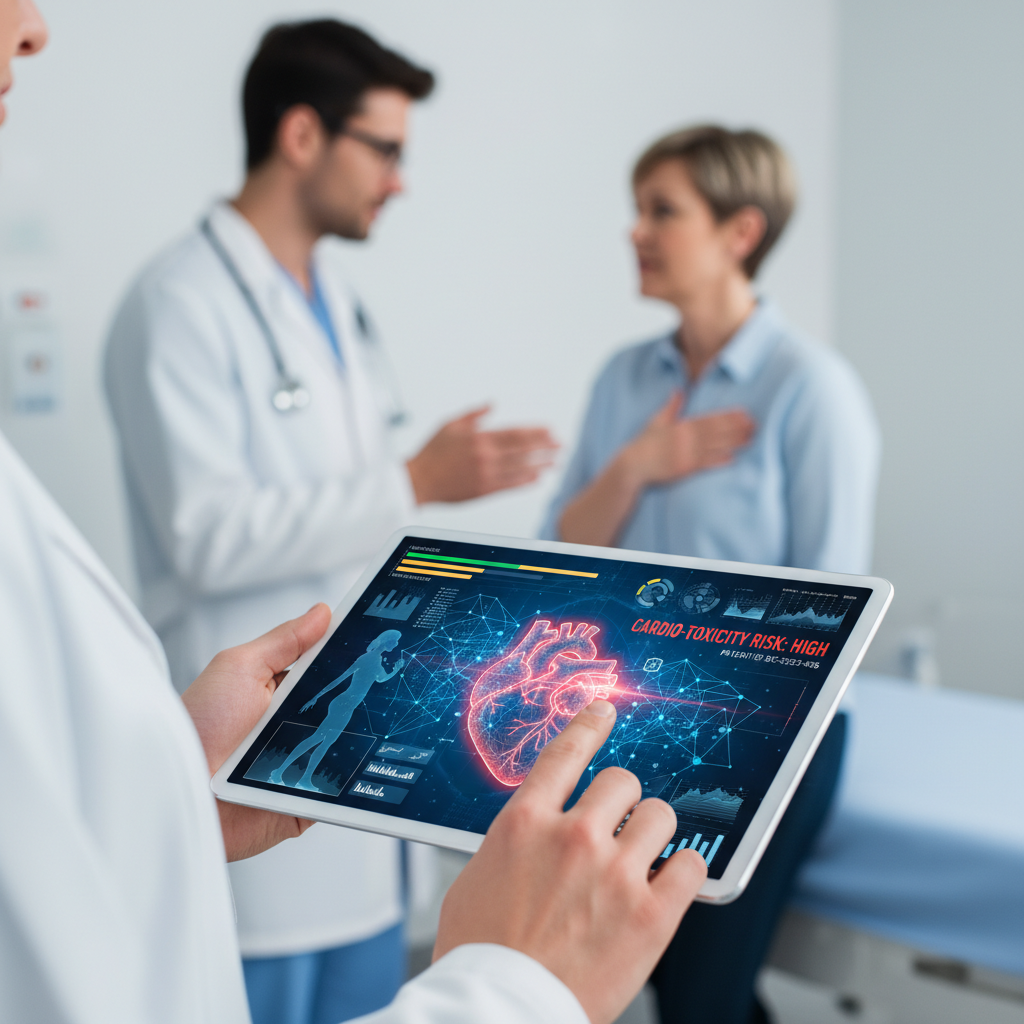
AI may spot heart risk in breast cancer patients before damage becomes obvious
AI may spot heart risk in breast cancer patients before damage becomes obvious
In cancer care, saving a life does not always mean confronting only the cancer itself. Sometimes it also means preventing treatment from causing serious harm elsewhere in the body. In breast cancer, that challenge is especially important because some highly effective therapies — including anthracyclines and trastuzumab — can also injure the heart in a subset of patients.
That is where one of the most promising ideas in cardio-oncology now comes in: using artificial intelligence to predict cardiotoxicity before it becomes clinically obvious.
The strongest safe interpretation of the supplied evidence is that AI may help identify which breast cancer patients are at higher risk of treatment-related cardiac dysfunction before or very early during therapy. That could make monitoring more targeted, scalable and proactive. But the key is to describe the advance accurately: for now, AI looks most useful as a tool for risk stratification and monitoring prioritisation, not as a replacement for echocardiography or specialist care.
The problem: successful cancer treatment can still strain the heart
Breast cancer outcomes have improved enormously over the past few decades. That is the good news. But success in cancer treatment changes the clinical picture. When more patients survive longer, treatment-related complications matter more — especially when they affect organs as vital as the heart.
Therapies such as anthracyclines and trastuzumab remain essential in many breast cancer treatment plans, yet they are also associated with ventricular dysfunction, reduced ejection fraction, heart failure and other forms of cancer therapy-related cardiomyopathy.
The clinical problem is that risk is not evenly distributed. Some patients move through treatment with little measurable cardiac effect. Others develop early damage, sometimes before symptoms become obvious. That makes better prediction more than a research exercise. It is a practical need.
What the AI studies actually found
The most direct and powerful evidence in the supplied set comes from a large real-world study in which AI was applied to baseline ECG images to stratify the risk of early cancer therapeutics-related cardiac dysfunction after anthracycline or trastuzumab treatment.
According to the supplied literature, patients screened as high-risk by the AI model had a strong association with later outcomes such as:
- cardiomyopathy;
- heart failure;
- or reduced left ventricular ejection fraction.
That matters because the ECG is simple, inexpensive and widely available. If AI can extract risk information from a baseline ECG that routine reading may miss or underuse, that creates a potentially scalable way to identify patients who need closer follow-up.
Instead of assuming every patient faces the same level of danger, clinicians may be able to separate those who need more intensive cardiac monitoring from those at lower immediate risk.
The signal may be biologically meaningful, not just statistically clever
One of the more important details in the supplied evidence is that the same study also included a mechanistic link: higher AI-ECG risk scores were associated with worse global longitudinal strain.
That is not a minor footnote. Global longitudinal strain is a sensitive marker of early, subclinical changes in heart function. It is often used to detect cardiac injury before more obvious drops in ejection fraction occur.
So the model may not simply be finding an abstract statistical pattern. It may be capturing signals tied to real early cardiac changes that already make sense within modern cardio-oncology and echocardiographic assessment.
That strengthens the argument that AI is detecting something clinically relevant, not merely generating a mathematically interesting score.
The field is moving beyond one single model
The broader picture also matters. The supplied references do not rest everything on one paper.
A separate AI-based breast cancer cardiotoxicity study found that baseline clinical features can also help predict early decline in left ventricular ejection fraction during the first year after treatment.
Taken together, that suggests a future in which cardiac risk assessment in breast cancer may combine:
- routine clinical features;
- simple baseline tests such as ECGs;
- and AI-based models that integrate risk in ways clinicians cannot easily do unaided.
That is an important shift. It suggests cardio-oncology may be starting to move from a mainly reactive model — waiting to detect injury once it appears — to a more anticipatory and stratified one.
Why this matters in real-world care
In theory, every patient exposed to potentially cardiotoxic treatment could receive close cardiac surveillance. In practice, resources are limited. Serial echocardiograms, specialist follow-up, strain analysis and repeated assessment all take time, staff and infrastructure.
That is where AI could have real value. If it can help flag who is most likely to be vulnerable, it may allow health systems to:
- target monitoring more efficiently;
- prioritise echocardiography and cardio-oncology referral;
- identify high-risk patients earlier;
- and use limited resources more rationally.
That is especially important in settings where access to specialised cardiac imaging or integrated cardio-oncology services is uneven.
What this does not prove
Even with strong evidence for prediction, caution still matters.
The best-supported claim here is about risk stratification, not about improved long-term outcomes. The supplied literature supports the idea that AI can identify patients at higher risk of treatment-related heart problems. It does not yet prove that AI-guided care leads to fewer cases of heart failure, less permanent dysfunction or better survival.
There are other limits too. Some of the evidence includes patients beyond breast cancer, such as those with non-Hodgkin lymphoma receiving similar cardiotoxic therapies. That broadens the relevance somewhat, but it also means the headline should not overstate breast-cancer-specific certainty.
Model performance may also vary across:
- different health systems;
- ECG or image quality;
- local treatment patterns;
- and patient populations.
That is a familiar problem in medical AI. A model that performs well in one environment does not automatically transfer perfectly into another.
AI is best framed as triage support, not replacement care
The most important practical distinction is this: AI does not replace echocardiography, cardiology expertise or specialist assessment.
The safer message, and the one best supported by the evidence, is that AI may help triage patients and prioritise monitoring. It could identify which patients may warrant earlier imaging, closer follow-up or more attention from cardio-oncology teams.
That is a meaningful role. But it is very different from claiming that AI can independently manage cardiotoxicity risk.
When AI is oversold as a substitute for clinical judgement, disappointment is almost guaranteed. When it is used to improve the timing and focus of clinical attention, the case becomes much stronger.
The next challenge is proving clinical impact
Predictive tools can look impressive in research settings. The harder question is whether they improve care once they are built into routine practice.
That means the next stage of this field is not just to show that AI predicts risk. It is to show that integrating AI into workflows leads to:
- better monitoring decisions;
- earlier intervention;
- fewer meaningful cardiac complications;
- and better patient outcomes overall.
That will also require dealing with familiar implementation problems, including:
- external validation;
- workflow redesign;
- false positives;
- bias;
- and integration into real clinical systems.
So while the science is promising, responsible adoption still depends on more than model accuracy.
The balanced takeaway
The most responsible interpretation of the supplied evidence is that AI may help identify breast cancer patients at higher risk of treatment-related cardiotoxicity before or early during therapy, making cardio-oncology surveillance potentially more targeted and scalable.
The strongest support comes from a large real-world AI-ECG study in which high-risk baseline screens were strongly associated with later cardiomyopathy, heart failure and reduced ejection fraction after anthracycline or trastuzumab therapy, with added biological support from the association between higher risk scores and worse global longitudinal strain. Other AI-based work suggests baseline clinical features can also help predict early decline in heart function.
But the boundary is important. The evidence is strongest for prediction, not yet for proof that AI-guided care improves long-term patient outcomes.
Even so, the direction of the field is clear. Cardio-oncology may be moving towards a model in which clinicians do not wait for heart damage to become obvious before responding. If AI can help identify who needs closer watching early on, it may become one of the more useful near-term applications of AI in cancer medicine — not by replacing specialists, but by helping protect the heart while the cancer is being treated.