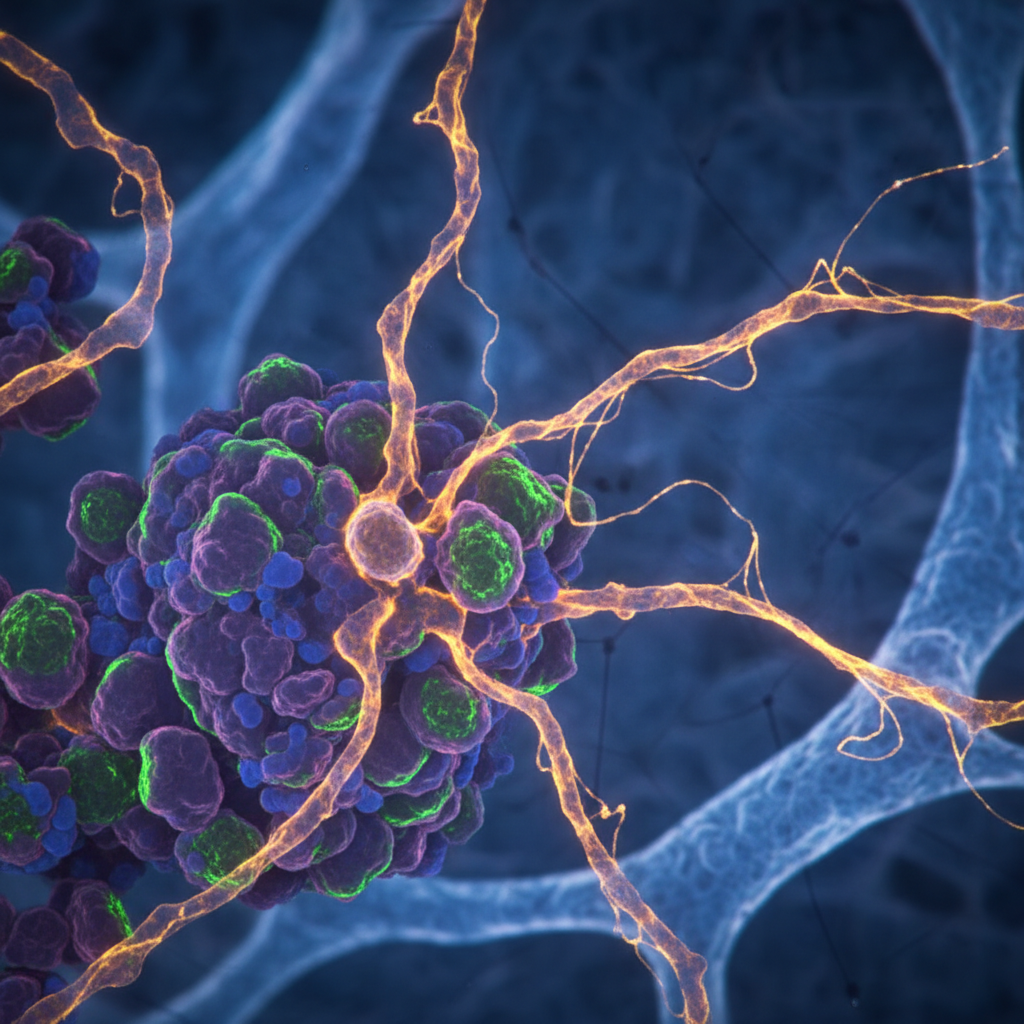
A protein may help explain why triple-negative breast cancer spreads so quickly — but the finding points to one promising mechanism, not a single answer
A protein may help explain why triple-negative breast cancer spreads so quickly — but the finding points to one promising mechanism, not a single answer
Among breast-cancer subtypes, few raise as much clinical concern as triple-negative breast cancer. It tends to behave more aggressively, offers fewer established therapeutic targets, and carries a higher risk of recurrence and metastasis. When it spreads, it often does so early and in ways that are biologically difficult to control.
That is why any study that sheds light on how this subtype metastasises attracts immediate interest. Understanding the mechanisms of spread is not just a matter of basic biology. It is part of a much larger effort to answer one of oncology’s hardest questions: what allows some tumour cells to leave the original cancer, survive the journey, establish themselves in other organs, and resist treatment?
The new headline, which points to a key protein behind this process, goes directly to that question. And in this case, the supplied scientific evidence is more substantial than many headlines of this kind. The evidence meaningfully supports the idea that ACSL4 can act as an important driver of metastasis in triple-negative breast cancer by altering membrane phospholipids and activating signalling linked to cell adhesion, migration, and tumour progression.
But the responsible interpretation still requires caution. This is one promising and biologically plausible mechanism, not a complete or universal explanation for all of triple-negative breast cancer’s aggressiveness.
Why triple-negative disease is so clinically difficult
Triple-negative breast cancer gets its name because it does not express three of the major targets used to classify and treat other breast cancers:
- oestrogen receptor;
- progesterone receptor;
- and HER2.
In practical terms, that means fewer well-established targeted treatment options. But that is not the whole problem. This subtype also tends to show:
- greater biological instability;
- faster growth;
- a higher risk of early metastasis;
- and worse outcomes in some patients, especially when disease does not respond well to chemotherapy.
The broader review literature supplied here reinforces exactly that point: triple-negative breast cancer is a particularly aggressive category, and its progression appears to depend on multiple molecular pathways rather than the hormone-receptor biology seen in other breast-cancer subtypes.
What the new study actually adds
The most important finding in the supplied references is the identification of ACSL4 as a mechanistic contributor to metastatic behaviour in triple-negative breast cancer.
This matters because the study does more than report a loose association. It proposes a concrete biological route. In broad terms, ACSL4 appears to promote metastasis by:
- remodelling membrane phospholipids;
- changing the physical and signalling properties of cancer cells;
- and activating integrin beta-1 signalling, which then feeds downstream pathways linked to spread.
That gives the finding real weight. It is not simply that this protein appears in aggressive tumours. It is that the protein seems to participate in the biological changes that help tumour cells behave in more invasive and metastatic ways.
Why membrane biology matters so much
At first glance, membrane phospholipids may sound like a very technical detail. But they are central to how cells behave. The cell membrane is not just a boundary. It is an active platform where cells sense their environment, adhere to surrounding structures, receive signals, and regulate movement.
If a protein such as ACSL4 changes that membrane composition, it can alter how a cancer cell:
- interacts with nearby tissue;
- activates adhesion receptors;
- responds to stress and outside signals;
- and gains migratory and invasive capacity.
That helps explain why a biochemical mechanism like this can have such large effects on metastatic potential. In cancer, subtle structural changes can produce major functional consequences.
The role of integrin beta-1
A second important part of the study is the activation of integrin beta-1, a molecule with a central role in cell adhesion and communication with the surrounding microenvironment. In cancer, this kind of pathway matters enormously because metastasis depends on cells being able to detach, reattach, migrate, and adapt to entirely new environments.
When ACSL4 promotes this signalling, the consequences go beyond local tumour growth. It supports a more mobile, invasive, and metastasis-ready cell state.
This fits well with the broader modern view of cancer spread: metastasis is not simply about cells growing faster. It often involves a coordinated programme that changes how cells move, adhere, survive, and colonise new tissue.
Why the therapeutic angle is especially interesting
Perhaps the most encouraging part of the supplied evidence is that the researchers did not stop at mechanism alone. According to the study, pharmacologic inhibition of ACSL4 reduced tumour growth and metastasis in triple-negative breast-cancer models, while also increasing chemosensitivity.
That matters because it brings the work closer to a genuine translational question. If a molecular factor is not only associated with metastasis but can also be blocked in ways that reduce aggressive behaviour, it becomes more than a biological explanation. It becomes a possible therapeutic target.
Still, that is where caution matters most. A promising target is not the same thing as an available treatment.
What this story gets right
The headline gets something important right by suggesting that specific molecular programmes may underlie the speed with which triple-negative breast cancer spreads. It also rightly treats metastasis as a biologically organised process rather than a random event.
That matters because it helps shift the discussion away from an unhelpfully vague idea — that this subtype is simply “aggressive” by nature — towards a more useful one: there are identifiable biological mechanisms that help produce that aggressiveness.
The study also reinforces a valuable idea in modern oncology: membrane biology, lipid remodelling, and adhesion signalling may be just as important to tumour behaviour as more familiar genetic alterations.
What should not be overstated
At the same time, it would be wrong to present ACSL4 as though it fully solves the mystery of triple-negative breast cancer.
There are several reasons for restraint.
First, triple-negative breast cancer is biologically heterogeneous. It is not one uniform disease, and different patients may metastasise through partly different molecular routes.
Second, even if ACSL4 is an important driver in some settings, that does not mean it explains every case of rapid spread.
Third, the strongest evidence here is mechanistic and preclinical. That is scientifically valuable, but it is not the same as large-scale clinical proof in patients.
Fourth, translating a promising molecular target into an effective therapy is a long process involving validation, safety, patient selection, treatment combinations, and demonstration of real clinical benefit.
Why this could still change how treatment is understood
Even with those limitations, the finding matters because it expands the map of possible vulnerabilities in triple-negative disease. In a subtype with relatively few well-established targets, every biologically meaningful pathway matters.
In time, this kind of work could help:
- identify tumours with especially high metastatic potential;
- select patients whose disease depends more heavily on this pathway;
- design combinations that reduce invasion while improving chemotherapy response;
- and explain why some tumours spread much earlier than others.
That means the importance of the study is not limited to whether ACSL4 becomes a drug target tomorrow. Even before that, it changes how researchers think about the problem.
What this finding most realistically means
The most balanced interpretation is not that scientists have finally discovered why all triple-negative breast cancers spread so quickly. It is that they have identified an important mechanism that may help explain part of the metastatic aggressiveness of this subtype, and that may eventually offer a therapeutic opening.
That is a less dramatic sentence, but it is much more faithful to the evidence.
The most balanced reading
The supplied evidence supports a moderate and meaningful conclusion: triple-negative breast cancer is especially aggressive and metastasis-prone, and ACSL4 appears to play an important role in that behaviour by remodelling membrane lipids and activating integrin beta-1 signalling linked to tumour spread. The observation that its inhibition reduced growth, metastasis, and increased chemosensitivity in models also strengthens its appeal as a biological target.
But the responsible interpretation has to recognise the limits. The study describes one promising mechanism, not a complete explanation for the full aggressiveness of triple-negative disease. It also does not show, on its own, that a new treatment is ready or that one protein determines the prognosis of all patients.
So the safest conclusion is this: ACSL4 may help explain why some triple-negative breast cancers spread so efficiently, and that represents a real advance in understanding metastasis. But triple-negative disease remains biologically diverse, and turning this insight into concrete clinical benefit will still require a great deal of further work.