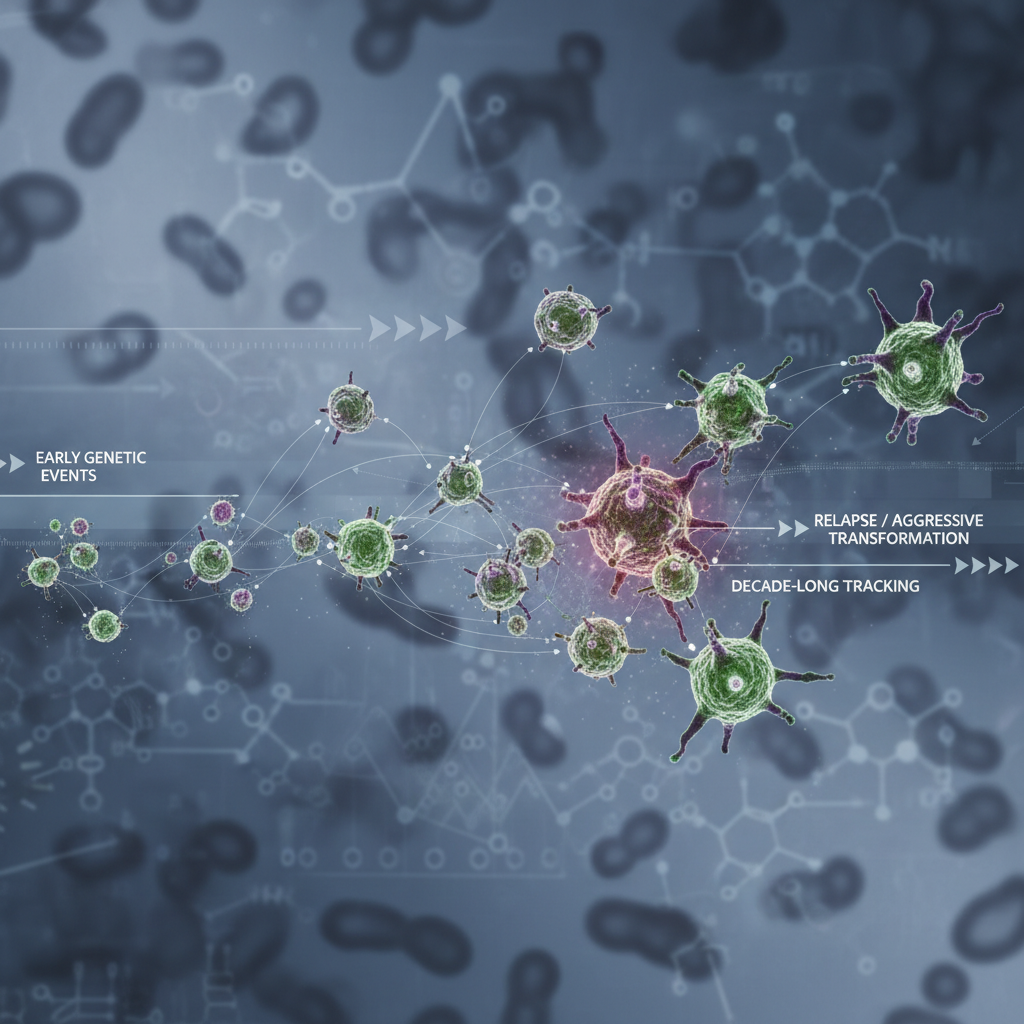
A long-term study is revealing how some blood cancers evolve — and why certain diseases come back more aggressive
A long-term study is revealing how some blood cancers evolve — and why certain diseases come back more aggressive
One of the hardest questions in blood-cancer care has also been one of the most frightening for patients: why do some diseases seem quiet for years and then suddenly return or transform into something more aggressive?
The older answer, often left partly unstated, was relatively simple. The cancer changed, accumulated alterations, escaped control, and worsened. That remains true, but it is no longer enough. What newer research suggests is that the story is less linear and more evolutionary. Instead of imagining the tumour as a single uniform entity moving steadily forward, studies increasingly suggest that many blood cancers evolve through complex clonal dynamics, with branching paths, persistent early alterations, and diverging trajectories even among tumours that look similar on the surface.
That is the backdrop to the headline about a decades-long study revealing how blood cancers evolve and why some patients worsen. The framing is directionally sound, but the safest interpretation needs precision: the evidence package provided supports this message most directly in follicular lymphoma, and only more indirectly for blood cancers as a broader category. Even so, the wider implication matters: long-term molecular tracking can reveal early lesions and distinct evolutionary paths that help explain relapse and transformation.
Cancer does not always progress in a straight line
For years, it was easy to picture tumour progression as a fairly linear process: one cell acquires a mutation, expands, accumulates additional changes, and becomes more aggressive. That happens in part. But the reality appears to look more like a branching tree than a straight arrow.
Different tumour subclones can emerge early, coexist, compete, recede, or gain advantage at different moments. Some alterations appear long before any obvious clinical deterioration. Others may matter less in isolation than in the evolutionary pathway the tumour follows over time.
That helps explain why two patients with apparently similar mutational landscapes can still end up on very different clinical paths. What matters is not only which mutations are present, but how clones are organised, how they persist, and how they branch over time.
What the follicular lymphoma study showed
The strongest and most directly relevant evidence in the package comes from a longitudinal multi-omics study in follicular lymphoma, a disease well known for slow evolution, repeated relapse, and, in some patients, transformation into a more aggressive form.
That study showed that early genetic events and stable copy-number alterations can be identified years before relapse or transformation. That is an important finding because it shifts worsening away from the idea of a sudden biological turn and towards something that may have been developing quietly for a long time.
In practical terms, part of what looks clinically like a late relapse may reflect molecular lesions and clonal routes that were already established well before the disease became visibly more dangerous.
Similar mutations do not always mean the same future
One of the most interesting parts of the follicular lymphoma work is the finding that transformation and non-transformation cases can share a broadly similar mutational landscape while still following different evolutionary trajectories.
That matters because it challenges a simplistic version of molecular oncology. A single mutation is not always destiny. Sometimes the critical issue is clonal dynamics — when alterations arise, which subclones persist, and how the internal structure of the tumour shifts over time.
For research and, eventually, clinical care, that suggests that predicting relapse risk may depend less on one standout mutation and more on reading the tumour’s longer evolutionary history.
Why this helps explain relapse and transformation
Relapse does not always mean the exact same cancer simply returning. In some cases, it may reflect the re-emergence of clones that survived treatment, remained hidden for a period, and later gained advantage. Transformation into a more aggressive disease may arise when certain branches of the tumour’s evolutionary tree acquire combinations of changes that increase growth, adaptability, or treatment resistance.
When researchers follow disease over many years, it becomes possible to see that the cancer did not remain biologically still between diagnosis and relapse. It continued to reorganise itself internally, even when routine clinical tests could not yet show that clearly.
That is an important conceptual shift. Worsening starts to look less like a sudden event and more like the visible result of a long molecular build-up.
Why serial molecular monitoring matters
The evidence package also supports a broader principle: tracking disease molecularly over time may be as important as characterising it at diagnosis.
In primary CNS lymphoma, longer-term biomarker work suggests that serial molecular monitoring can help explain durability of response and later progression. That is not the same disease as follicular lymphoma, but it supports the same larger logic: blood and lymphoid cancers are not static, and watching them over time can reveal things a single molecular snapshot cannot.
This is especially relevant at a moment when precision medicine is moving beyond the model of “one test, one decision” and towards a more dynamic view in which tumours are repeatedly reassessed as they evolve.
What this could mean for patients and clinicians
In practical terms, this kind of research does not mean every patient’s future can now be forecast precisely. The evidence does not support that level of certainty. What it does support is something more modest and potentially more transformative: the idea that molecular processes linked to later relapse or transformation may be visible years in advance, and that tracking those processes may improve the understanding of risk, response, and progression.
For clinicians, that could eventually mean better risk stratification, more individualized surveillance, and perhaps earlier intervention in subgroups with more concerning evolutionary patterns. For patients, the potential benefit would be a shift away from medicine that only reacts when relapse appears and towards medicine that tries to understand how relapse is being prepared.
What this story gets right
The headline gets it right in framing the issue as one of tumour evolution and relapse risk. It also gets it right in suggesting that long-term tracking can reveal early events relevant to understanding why some diseases worsen.
That is an important conceptual advance. Instead of thinking only in terms of “good mutation” or “bad mutation”, oncology is beginning to pay more attention to the tumour’s molecular biography.
And that matters because many blood cancers have long clinical courses, with apparently indolent periods followed by more serious changes. In that setting, time is not a side detail — it is part of the disease biology itself.
What should not be overstated
At the same time, it would go too far to suggest that this kind of work now allows clinicians to predict with confidence which patients with blood cancer will worsen. The evidence package does not support that.
It would also be too broad to generalise these results across all blood cancers. The strongest evidence here is for follicular lymphoma, and extension to leukaemia, myeloma, or other haematological malignancies needs caution.
It also matters that one of the supplied references concerns ovarian cancer and is not relevant to the headline’s main claim. That reinforces the point that the strongest scientific support here sits within a narrower part of the story than the broader wording of “blood cancers” suggests.
The challenge of turning biology into practice
Even when early genomic events are identified, a difficult question remains: how can that knowledge be turned into clinically useful prediction?
Detecting an alteration years before relapse is not the same as knowing exactly when the disease will worsen, or how best to intervene. Early biomarkers still need validation in larger cohorts, comparison with conventional clinical risk factors, and integration into real treatment decisions.
So while the evolutionary biology of these cancers is becoming clearer, its routine clinical use is still under construction.
The most balanced reading
The safest interpretation is this: some blood cancers, especially follicular lymphoma, evolve through complex clonal changes over time, and long-term follow-up studies are beginning to show that early molecular events and distinct evolutionary trajectories help explain relapse and transformation into more aggressive disease.
The supplied evidence supports this more dynamic view of cancer progression well. It shows that clinically similar cases may follow different evolutionary routes, that important alterations can appear years before worsening, and that serial molecular monitoring can reveal features of disease that a single time-point assessment misses.
But a responsible reading also has to preserve the limits: the strongest support comes from follicular lymphoma, the immediate predictive value for individual patients still requires further validation, and one long-term study does not mean researchers can now fully forecast progression across blood cancers as a whole.
Still, the conceptual advance is real. Blood cancer is starting to look less like a disease that simply “comes back” or “gets worse” and more like a disease that is evolving continuously — and whose molecular story may begin to be read long before the next clinical turning point arrives.