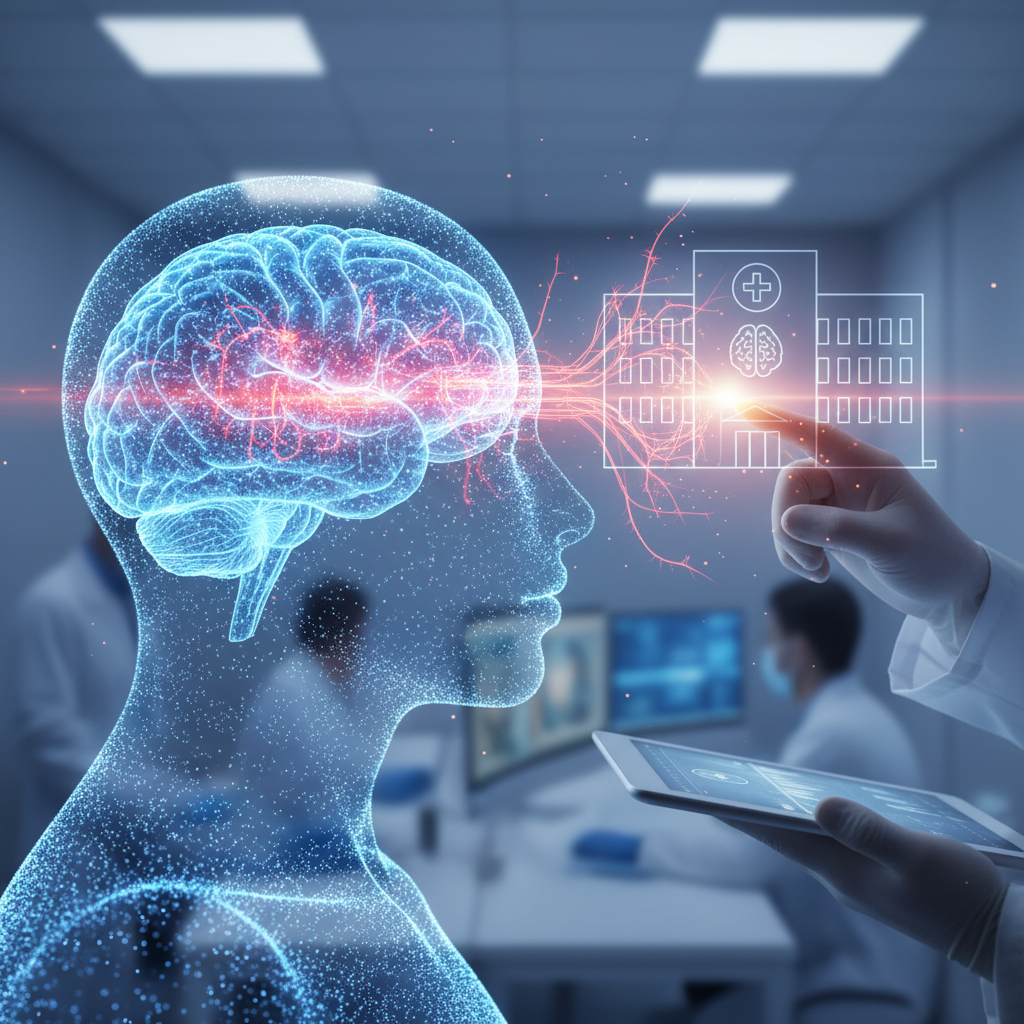
A brain scan may one day help predict psychiatric hospitalisation — but the evidence presented is still too thin
A brain scan may one day help predict psychiatric hospitalisation — but the evidence presented is still too thin
Few areas of medicine live with as much predictive uncertainty as psychiatry. A patient may appear relatively stable in clinic and then, days or weeks later, deteriorate sharply. Another may present with severe symptoms and still not go on to need hospital care. That difficulty in anticipating serious outcomes is exactly why any headline promising a new objective biomarker — especially a brain scan — for psychiatric hospitalisation risk attracts attention so quickly.
It is an appealing idea. If brain imaging could help identify which patients are closer to a major deterioration, that could support closer monitoring, earlier intervention, and perhaps prevent some of the most severe crises. In principle, this fits neatly into the broader ambition of precision psychiatry: making psychiatric care less dependent on symptoms and clinical impressions alone, and more informed by objective biological signals.
But the most responsible reading of the evidence provided has to be very cautious. The headline is plausible, but it could not be independently verified, because no PubMed studies were supplied alongside it. Without the underlying paper, it is impossible to know what kind of imaging was used, which patient population was studied, what psychiatric diagnosis was involved, how hospitalisation was defined, or how strong the predictive performance actually was.
Why the idea makes scientific sense
At a basic level, it is entirely reasonable to think the brain could carry measurable signals associated with higher risk of psychiatric worsening. Severe mental illness involves changes in circuits linked to:
- emotional regulation;
- stress response;
- inhibitory control;
- reward processing;
- threat perception;
- cognitive integration;
- and behavioural organisation.
If certain patterns of brain structure, connectivity, or activity are associated with rising vulnerability, then neuroimaging could, in theory, capture part of that risk before it becomes fully visible in behaviour.
That is why this kind of headline sounds plausible. It fits with a larger scientific effort to complement traditional psychiatric assessment with more objective measures.
The larger goal of precision psychiatry
Psychiatry has long faced a structural challenge. Unlike many other areas of medicine, it still depends heavily on reported symptoms, clinical interviews, and longitudinal observation. That does not make it unscientific. But it does mean its power to predict outcomes for a specific individual is often limited.
So it is not surprising that researchers are trying to improve answers to questions such as:
- who is most likely to relapse?
- who is at risk of rapid deterioration?
- who needs more intensive follow-up?
- who may be heading towards hospitalisation?
If a brain scan could help with those questions in a reliable way, it would be seen as a major step forward. It would shift psychiatry slightly away from a purely descriptive model and towards one that can stratify risk more precisely.
What the headline suggests
The headline points to exactly that horizon: a brain scan that can reveal the risk of psychiatric hospitalisation. In theory, a finding like that could be useful in several ways.
It might help:
- identify higher-risk patients after discharge;
- guide the intensity of follow-up care;
- support decisions about stepping treatment up;
- or trigger preventive intervention before a full crisis emerges.
If such a tool were robust, it could matter not only to patients, but also to healthcare systems, which often make major decisions under uncertainty and limited time.
The central problem: the study cannot be checked
This is where the main limitation becomes impossible to ignore. Because no PubMed articles were supplied, the central claim cannot be properly evaluated.
Without the underlying study, too many key questions remain unanswered:
- what imaging method was used — structural MRI, functional MRI, connectivity analysis, PET, or something else;
- which psychiatric condition was being studied — major depression, bipolar disorder, schizophrenia, early psychosis, or a mixed population;
- how “hospitalisation risk” was defined;
- what the follow-up period was;
- whether the imaging result performed better than ordinary clinical assessment;
- and how large the effect actually was.
Those are not minor details. They are the difference between an interesting concept and a clinically meaningful tool.
Statistical prediction is not the same as clinical usefulness
Even if a real study showed a statistically significant association, that still would not guarantee clinical value. Neuroimaging findings in psychiatry frequently run into major obstacles when they move from research settings into real care.
Common challenges include:
- limited reproducibility across centres;
- high cost;
- dependence on specialised equipment and analysis;
- poor generalisability beyond the original study sample;
- lower performance when tested in real-world populations;
- and difficulty showing that the tool meaningfully improves decisions.
In other words, something can be statistically predictive and still not be practical enough to matter in everyday psychiatry.
The risk of over-reading brain images
There is also a broader cultural problem: brain images tend to look authoritative. They feel objective, concrete, and scientific in a way that symptom descriptions often do not. But in psychiatry, that can lead to over-interpretation.
Psychiatric hospitalisation is not determined by brain biology alone. It is also shaped by:
- symptom severity;
- family and social support;
- access to outpatient care;
- substance use;
- medication adherence;
- suicide or violence risk;
- bed availability;
- and clinical as well as institutional decisions.
That means even a biologically meaningful scan would capture only part of the total risk. Hospitalisation is a clinical and social outcome, not a purely neurobiological one.
Where the headline may still be pointing in the right direction
Even with all that caution, the headline may still reflect a real and worthwhile research direction. Mental-health researchers are increasingly trying to build more sophisticated risk models by combining:
- symptoms;
- clinical history;
- behaviour;
- digital measures;
- genetics;
- and neuroimaging.
In that context, it is entirely plausible that brain scans could contribute one piece of a broader prediction model. The most realistic future is probably not a scan that, by itself, “reveals” who will be hospitalised. It is more likely to be a system in which neuroimaging modestly improves prediction when added to other clinical information.
That is a much more defensible interpretation than the idea that psychiatry is about to start using stand-alone brain scans to forecast hospital admission.
What the story gets right
The story gets one important thing right by focusing on a legitimate aim of modern psychiatry: improving prediction of serious deterioration rather than waiting for crises to become obvious.
It also rightly reflects the broader hope that objective biomarkers may, one day, complement clinical judgement in more complex cases. That is a reasonable aspiration, especially in a field where many severe outcomes are recognised most clearly only in retrospect.
If better risk tools could help spot trouble earlier, the benefit could be significant.
What should not be overstated
At the same time, it would be far too strong to suggest that brain scans are now ready to predict psychiatric hospitalisation in routine clinical care. The evidence provided does not support that.
It would also be misleading to imply that neuroimaging could replace psychiatric assessment, social context, or longitudinal follow-up. Based on the material available here, the safest statement is narrower:
- the idea is biologically plausible;
- it fits with the broader project of precision psychiatry;
- but the specific claimed finding could not be independently verified;
- and its actual clinical usefulness remains uncertain.
What this could mean in the future
If future research confirms robust findings, the most likely role for neuroimaging will not be to “predict the future” with certainty. It will be to help stratify risk somewhat more effectively.
In the best-case scenario, that could mean:
- closer follow-up for higher-risk patients;
- preventive intervention before crises escalate;
- more rational tailoring of care intensity;
- and fewer major decisions made only once a patient has already deteriorated badly.
But that future depends on several things that still need to be shown: reproducible results, larger and more representative populations, comparison against usual clinical care, and evidence that imaging actually improves decisions and outcomes.
The most balanced reading
The headline describes a plausible and important ambition of precision psychiatry: using brain-based markers to improve prediction of serious outcomes such as deterioration and hospitalisation. In principle, that makes sense and fits with broader attempts to make psychiatry less dependent on symptoms alone.
But the central limitation is unavoidable: no PubMed studies were supplied, so the specific finding, the imaging method, the patient population, and the predictive performance could not be independently verified from the scientific evidence provided.
The safest conclusion, then, is this: neuroimaging may one day play a useful role in estimating psychiatric risk, especially as a complement to clinical assessment. But based on the material provided here, it is still far too early to say that a brain scan can already predict psychiatric hospitalisation in a reliable and practical way. The idea deserves attention. The proof is still missing.